
Your Kitchen Is Already a Science Lab
Easy experiments with baking soda are one of the simplest ways to spark real curiosity in your kids — no special equipment, no expensive kits, and no science degree required.
Here are the most popular baking soda experiments you can try today:
- Baking soda volcano – mix baking soda with vinegar and dish soap for a foamy eruption
- Balloon inflation – pour baking soda into a bottle of vinegar to inflate a balloon with CO2 gas
- Fizzy art – drop colored vinegar onto baking soda to create bubbling, colorful designs
- Exploding bag – seal baking soda and vinegar in a zip-lock bag and watch it puff up and pop
- Invisible ink – write with a baking soda solution, then reveal it with heat or grape juice
- Dancing popcorn – drop kernels into a baking soda and vinegar mix and watch them bob up and down
- Acidity tester – mix baking soda with different foods to see which ones are acidic
All of these use ingredients you likely already have at home. Most take under 15 minutes. And all of them work just as well on a Tuesday afternoon as they do on a rainy weekend.
The best part? While your kids are having fun watching things fizz and bubble, they’re actually learning real chemistry. That white powder reacting with liquid vinegar produces carbon dioxide gas — the same gas found in real volcanoes. Science doesn’t get more hands-on than that.
These activities are also a genuine break from screens. They build focus, fine motor skills, and a sense of wonder — all things kids (and parents) could use more of.

The Science of the Fizz: Why Baking Soda Reacts
Before we dive into the projects, let’s look at the “why” behind the “fizz.” At the heart of almost every easy experiment with baking soda is a classic chemical reaction.
Baking soda is scientifically known as sodium bicarbonate. It is a “base” (or alkaline substance). Vinegar, on the other hand, contains acetic acid. When you combine a base and an acid, they don’t just sit there; they react to neutralize each other. This process involves two distinct steps: a double displacement reaction followed by a decomposition reaction.
The result of this chemical dance is the creation of carbonic acid, which is highly unstable. It immediately breaks down into water and carbon dioxide (CO2) gas. Those bubbles you see? That’s the CO2 escaping! Because this reaction absorbs energy from its surroundings to break chemical bonds, it is often an endothermic reaction, which is why the mixture might feel slightly cool to the touch.
Understanding the pH scale is a great way to extend the learning. Vinegar has a low pH of about 2.5 (very acidic), while baking soda has a pH of about 8 (slightly basic). When they meet, they race toward the middle of the scale. You can study acid-base chemistry with at-home volcanoes to see how these ions swap places to create that spectacular “fwoosh” of foam.
7 Top Projects: Finding the Best easy experiment with baking soda
When we look for the perfect easy experiment with baking soda, we want activities that encourage creative play and sensory interaction. As single parents, we know that the best activities are the ones that keep kids engaged for more than five minutes while teaching them something valuable. These projects aren’t just about the mess; they are about sparking curiosity with science experiments for kids at home.
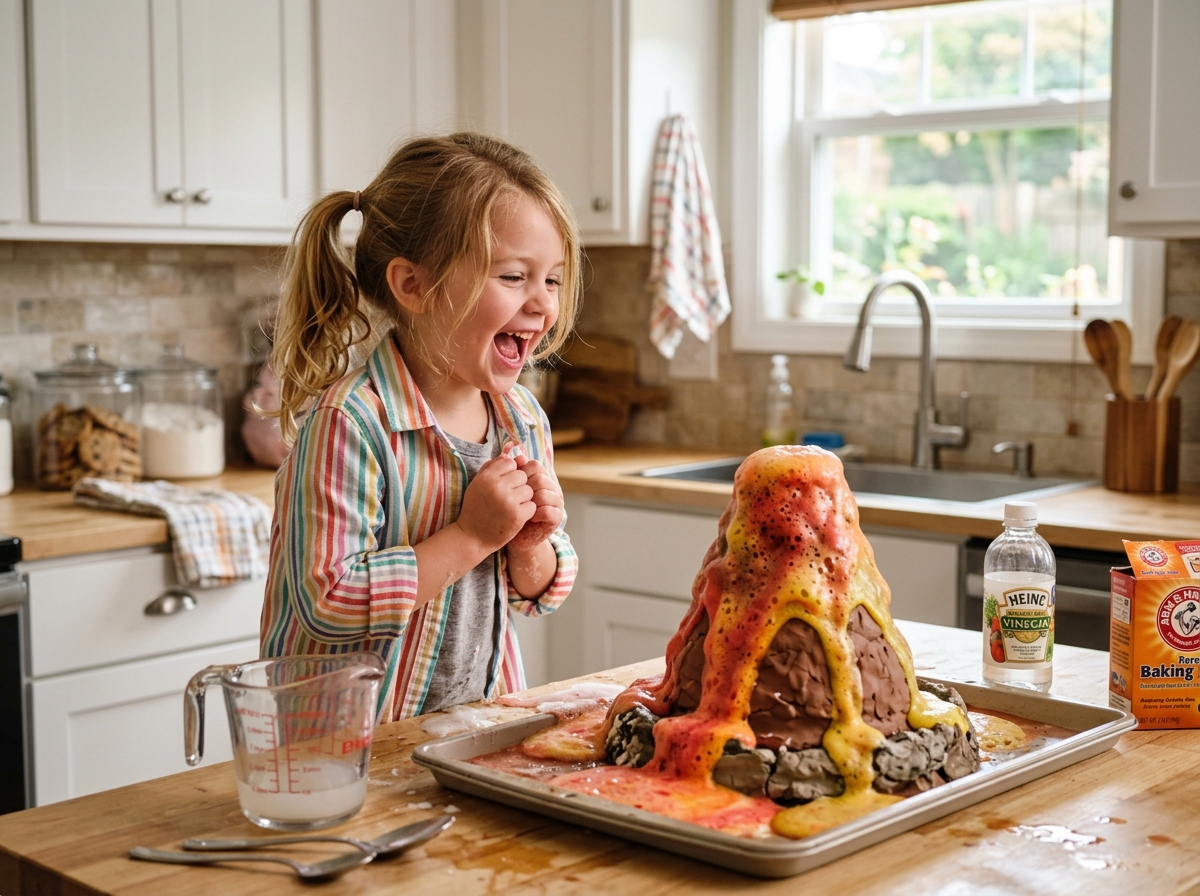
The Classic Volcano: A Must-Try easy experiment with baking soda
If there is one experiment that defines childhood science, it’s the volcano. It is the gold standard for a reason: it’s visual, exciting, and incredibly easy to set up.
To make a truly impressive eruption, you don’t just need baking soda and vinegar. The secret ingredient is dish soap. While the gas creates the bubbles, the soap traps that gas in tiny films, creating a thick, “oozing” lava rather than just a quick splash of liquid.
How to do it:
- Place a small container (like a plastic bottle or paper cup) inside a “mountain” made of playdough, sand, or even a simple paper cone.
- Add 2 tablespoons of baking soda to the container.
- In a separate cup, mix 1/2 cup of vinegar, a generous squirt of dish soap, and a few drops of red food coloring.
- Pour the vinegar mixture into the volcano and stand back!
For an educational twist, you can use a free observation sheet for your baking soda volcano to help your kids record what they see. This is a fantastic first step in science for kids that teaches them to follow instructions and observe results.
Inflating Balloons: A Pressure-Based easy experiment with baking soda
This experiment is like magic to younger children. Instead of blowing into a balloon, we let chemistry do the hard work. This project demonstrates how gas takes up space and creates pressure.
The Method:
- Use a funnel to pour about 1 cup of vinegar into an empty plastic bottle.
- Use a clean, dry funnel to put 1/3 cup of baking soda inside a deflated balloon.
- Stretch the neck of the balloon over the mouth of the bottle, but keep the “heavy” part of the balloon hanging down so the powder doesn’t fall in yet.
- When you’re ready, lift the balloon up so the baking soda drops into the vinegar.
As the CO2 gas is produced, it has nowhere to go but up, inflating the balloon in seconds. You can find more details on this baking soda balloon chemical reaction to see how different bottle shapes or vinegar temperatures might change the results. It’s a great way to introduce simple science to your 5-year-old.
Creative and Edible Variations
Beyond the “big two,” there are several other ways to use these ingredients for learning and play:
- Fizzy Art: Sprinkle a layer of baking soda on a tray. Give your child small bowls of vinegar tinted with different food colors and a medicine dropper. As they drop the liquid onto the powder, they create bubbling “craters” of color. It’s a fantastic sensory activity that builds fine motor skills.
- Invisible Ink: Mix equal parts water and baking soda. Use a cotton swab to write a secret message on paper. Once it dries, it’s invisible! To reveal it, you can carefully hold it near a lightbulb (heat) or paint over it with purple grape juice. The juice acts as a pH indicator, changing color when it hits the basic baking soda.
- The Science of Sour: Have you ever wondered why pickles or lemons make your mouth pucker? It’s the acid! You can use baking soda bubbles to detect sourness in different foods. If a food fizzes when you add baking soda, it’s acidic.
- Dancing Popcorn: Fill a jar with water and a bit of baking soda. Add popcorn kernels (they will sink). Then, add vinegar. The bubbles of CO2 will hitch a ride on the kernels, lifting them to the top. When the bubbles pop, the kernels sink again, creating a “dance.”
- The Bubble Bomb: For a slightly more “explosive” outdoor activity, try the baking soda and vinegar bubble bomb. By wrapping the baking soda in a paper towel “time-release packet” and sealing it in a zip-lock bag with vinegar, you create enough pressure to make the bag pop with a satisfying bang!
Essential Materials and Safety for Your Kitchen Lab
One of the best things about an easy experiment with baking soda is that you don’t need a lab coat. However, even “kitchen science” requires some ground rules to keep things fun and stress-free.
Materials Checklist:
- Baking Soda (Sodium Bicarbonate)
- White Vinegar (Acetic Acid)
- Dish Soap (for foam)
- Food Coloring (for visual appeal)
- Containers: Clear jars, plastic bottles, and trays to catch the mess.
- Tools: Funnels, droppers, and measuring spoons.
Safety and Cleanup Tips:
- Eye Protection: While these ingredients are common, vinegar is an acid and can sting if it splashes into eyes. If you have play goggles, use them!
- Staining Precautions: Food coloring is notorious for staining counters and clothes. Always perform these experiments on a rimmed baking sheet or plastic tray.
- Outdoor Setup: For experiments like the “Bubble Bomb” or the “Bottle Rocket,” head outside to the driveway or a park.
- Adult Supervision: Even though it’s “safe” science, an adult should always be present to handle any spills and guide the process.
- No Lab Coat Required: You can find more tips for simple science without the lab coat to make your home setup as efficient as possible.
Taking Science Further: Variables and Inquiry
Once your child has mastered the basic volcano, it’s time to turn a “demonstration” into a “scientific experiment.” This is where the real learning happens. Instead of just watching a reaction, we start asking “What if?”
A true experiment involves a hypothesis (an educated guess) and variables (things we change). For example, you can explore building a baking soda volcano and changing one thing at a time:
- Temperature: Does hot vinegar react faster than cold vinegar?
- Ratios: What happens if you use more baking soda but the same amount of vinegar?
- Bottle Size: Does a narrow-necked bottle make the “lava” shoot higher than a wide-mouthed jar?
If you want to get really technical (perfect for a science fair!), you can try quantitative measurement. Instead of saying the eruption was “big,” try weighing the bottle before and after the reaction. The “mass loss” tells you exactly how much carbon dioxide gas was ejected. You can even use an online ANOVA calculator to see if your results are “statistically significant,” meaning the changes you saw were likely due to your variables and not just luck.
Frequently Asked Questions About Baking Soda Science
Is the baking soda and vinegar reaction safe for toddlers?
Yes, generally! The ingredients are non-toxic. However, toddlers have a habit of putting things in their mouths. Concentrated vinegar doesn’t taste good and can be irritating, so close supervision is a must. Sensory play with “fizzy rocks” or “fizzy art” is usually a huge hit for this age group as long as they don’t rub their eyes with messy hands.
Can I use baking powder instead of baking soda for these experiments?
You can, but the reaction will be much weaker. Baking powder is actually a mixture of baking soda and a dry acid (like cream of tartar). It’s designed to react when it gets wet and hot in the oven. For a big, dramatic kitchen eruption, pure baking soda is the way to go.
Why didn’t my volcano erupt as much as expected?
The most common culprit is the “stale” reaction. If you add the vinegar too slowly, the gas escapes gradually rather than building up pressure. For the best “explosion,” you want to dump the vinegar in all at once. Also, check your baking soda’s freshness by dropping a little into a cup of vinegar; if it doesn’t fizz instantly, it’s time for a new box!
Conclusion
At Curta Arte, we believe that being a single parent shouldn’t mean missing out on these magical moments of discovery. Whether you are navigating life after divorce or are a solo parent by choice, our goal is to provide empathetic guidance and practical resources to make your life a little easier and a lot more fun.
Turning your kitchen into a lab with an easy experiment with baking soda is more than just a way to kill an afternoon. It’s a way to bond with your children, encourage their natural curiosity, and show them that the world is full of wonder—all with things you already have in your cupboard.
For more inspiration and fun activities for kids, keep exploring our resources. We are here to support you every step of the way on your parenting journey. Happy experimenting!
