
Why a Holiday Co-Parenting Schedule Makes or Breaks the Season
A holiday co-parenting schedule is a written plan that decides which parent spends which holidays with the children — and it takes priority over your regular custody arrangement.
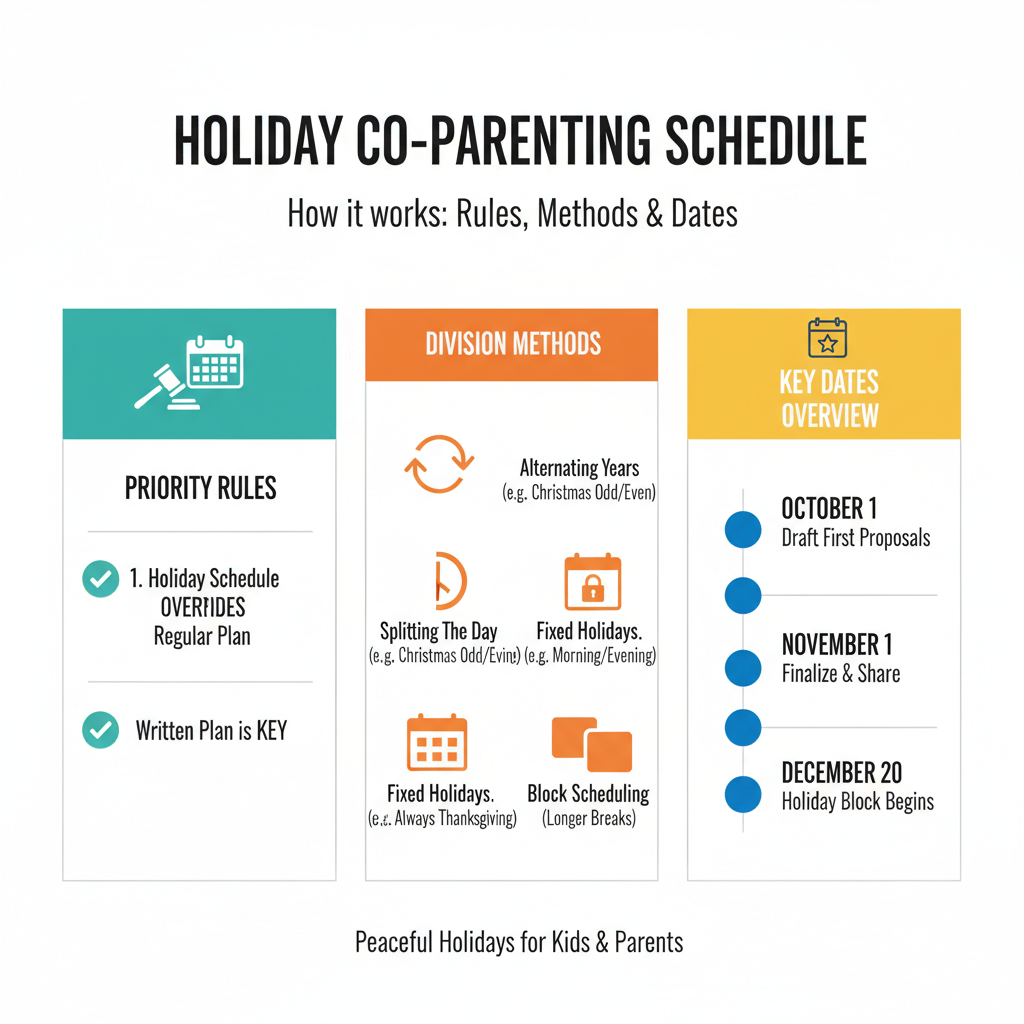
Here’s a quick look at how it works:
| Method | How It Works | Best For |
|---|---|---|
| Alternating years | Each parent gets a holiday in odd or even years | Most families |
| Splitting the day | Morning with one parent, evening with the other | Parents living close by |
| Fixed holidays | One parent always gets a specific holiday | Cultural or religious reasons |
| Block scheduling | Each parent gets a full chunk of a longer break | Long-distance families |
The holidays are supposed to feel joyful. But for divorced or separated parents, they can quickly turn into one of the most stressful times of the year.
Whose house does your child wake up in on Christmas morning? Where do they eat Thanksgiving dinner? When do they get to see grandma?
These are real questions your kids are asking — and without a clear plan, the answers can cause anxiety, conflict, and tears for everyone involved.
Research consistently shows that holiday schedules override regular parenting plans, meaning even if it’s normally your weekend, the holiday schedule takes over. That one fact alone causes countless arguments every single year — usually because the plan was never written down clearly enough in the first place.
The good news? A solid holiday co-parenting schedule removes most of that conflict before it starts. It gives your children predictability and emotional security, and it gives you one less thing to fight about during an already overwhelming time.
Understanding the Holiday Co-Parenting Schedule and Its Importance
At its core, a holiday co-parenting schedule is an “operating manual” for your family’s most sensitive days. We often see parenting plans written like wish lists—full of vague phrases like “as agreed upon by the parties.” In co-parenting, “by agreement” is often code for “an argument waiting to happen.” When December hits and emotions run high, vague language invites power plays.
The legal framework for these schedules, such as those found in the California Judicial Council forms or Utah Code Section 81-9-304, is designed to provide a statutory basis for custody. These laws exist because the court knows that children need stability. A well-defined schedule provides emotional security; children don’t have to wonder where they will be, and they don’t have to feel guilty about “choosing” one parent over the other.
One of the most critical aspects to understand is priority. In almost every jurisdiction, the holiday schedule has absolute priority over the regular parenting time. If it is Mom’s scheduled weekend but the court order says Dad has the children for Labor Day, Dad gets the children. Once the holiday ends, the regular schedule resumes exactly where it left off. This prevents “makeup time” disputes and keeps the calendar moving forward.
Whether you have a court-ordered plan or a private agreement, the goal is predictability. When we remove the guesswork, we reduce the conflict. This allows children to focus on what matters—like whether Santa can find them at two different houses—rather than worrying about their parents’ latest disagreement.
Common Ways to Divide Your Holiday Co-Parenting Schedule
There is no “one size fits all” when it comes to splitting time, but several tried-and-true methods have emerged as industry standards. We recommend choosing the one that best fits your geographic distance and your children’s ages.
Alternating Years
This is the most common and arguably the fairest method. In this setup, Parent A gets Thanksgiving in even-numbered years (2024, 2026), and Parent B gets it in odd-numbered years (2025, 2027). This ensures that over a two-year cycle, both parents experience every major holiday. It’s simple to track and easy for kids to understand.
Splitting the Day
If you live within a short driving distance, splitting the actual holiday can work well. For example, on Christmas Day, the children might stay with Parent A until 2:00 PM and then transition to Parent B for the evening. While this allows both parents to see the kids on the actual day, it can be logistically taxing. We suggest this only if transitions are peaceful and travel time is minimal.
Fixed Holidays
Sometimes, certain holidays hold deep cultural or religious significance for one parent but not the other. If one parent celebrates Hanukkah and the other does not, it makes sense for that holiday to be “fixed” with the practicing parent every year. In exchange, the other parent might receive a fixed secular holiday like the Fourth of July or Halloween.
Block Scheduling
For families dealing with significant distance, “block scheduling” is often the only realistic choice. Instead of splitting a single day, the entire winter break or summer vacation is divided into two large chunks. Parent A might take the first half of winter break (including Christmas Eve), while Parent B takes the second half (including New Year’s).
For more tailored advice on choosing the right structure, check out our advice for single parents.
Essential Dates and School Breaks to Include
When building your holiday co-parenting schedule, don’t just stop at the “Big Three” (Thanksgiving, Christmas, and New Year’s). A comprehensive plan covers the entire year to prevent mid-year surprises.

- Major Religious/Secular Holidays: Thanksgiving, Christmas, Hanukkah, Easter, Passover, Eid, or Diwali.
- Monday Holidays: MLK Day, President’s Day, Memorial Day, and Labor Day. These often create three-day weekends.
- Personal Milestones: The child’s birthday, Mother’s Day, Father’s Day, and each parent’s birthday.
- The “Fun” Holidays: Halloween and July 4th. These are often high-conflict because they involve community events and parties.
To make these days extra special, you might want to explore holiday magic theme-based activities for children to start new traditions in your own home.
Defining Your Holiday Co-Parenting Schedule for Major Events
Specificity is your best friend. A good plan doesn’t just say “Thanksgiving.” it says: “Thanksgiving shall begin on Wednesday at 6:00 PM and end on Sunday at 6:00 PM.”
You must define:
- Exact Start and End Times: Don’t leave this to “whenever school gets out.” Use hard times.
- Pickup and Drop-off Locations: Usually, the receiving parent should pick up the child to minimize “gatekeeping” issues.
- Transportation Responsibilities: Who is driving? Who is paying for the flight?
- Logistics: If a holiday falls on a Friday, does the holiday time merge into the regular weekend?
Balancing these logistics with a career can be tough, so we’ve put together a guide on how to balance work and parenting to help you manage the load.
Managing School Breaks in Your Holiday Co-Parenting Schedule
School breaks are longer than single-day holidays and require their own set of rules.
- Summer Break: Many parents opt for alternating weeks (Friday to Friday) or two-week blocks. Some plans allow for “undisturbed” vacation time where the other parent’s mid-week visits are suspended.
- Spring and Mid-Winter Breaks: These are typically alternated annually. If Parent A has Spring Break in 2025, Parent B gets it in 2026.
- Teacher Workdays: These “hidden” holidays can cause childcare chaos. A pro tip is to assign these to the parent who has the children for that weekend.
Managing these extended periods often requires a different strategy than the school year. See our additional resources on how to balance work and parenting-2 for more tips.
Logistics: Distance, Age, and Communication Tools
Your holiday co-parenting schedule should evolve as your life and your children change. What works for a toddler won’t work for a teenager, and what works for neighbors won’t work for parents living 500 miles apart.
Geographic Distance
Distance is a major factor in legal custody orders. In states like Texas, the “Standard Possession Order” changes significantly based on whether parents live:
- 50 miles or less apart: Frequent exchanges and split days are feasible.
- 51 to 100 miles apart: Mid-week visits might be dropped, but weekend rotations remain.
- Over 100 miles apart: The non-custodial parent typically gets longer blocks of time (like the entire Spring Break and a larger portion of Summer) to compensate for the inability to do weekend swaps.
Age-Appropriate Visits
- Infants and Toddlers (Under 3): These children need frequent, shorter interactions with both parents to maintain “attachment.” Long weeks away can be distressing.
- School-Age Children: They thrive on the “alternating year” structure because it provides clear boundaries.
- Teens: As children get older, their own social schedules (and jobs) become factors. A 16-year-old might want to spend Halloween with friends rather than a parent. Flexibility becomes the name of the game here.
Technology and Documentation
We live in a digital age—use it! Shared calendar apps like OurFamilyWizard or TalkingParents are game-changers. They provide a “single source of truth” that both parents can see.
- Shared Calendars: Automatically overlay holiday rotations on your regular schedule.
- Secure Messaging: Keeps all holiday-related talk in one place, timestamped and uneditable (great for avoiding “he said, she said”).
- Expense Tracking: Useful for splitting the cost of those expensive holiday gifts or travel tickets.
Using these tools can actually improve your bond with your child by removing the stress of coordination. Learn more about parenting-tips-for-family-bonding to make the most of your time.
Tips for Smooth Transitions and New Traditions
The goal is to move the child from one house to another without them feeling like they are entering a war zone. Here is how we recommend handling the “soft” side of co-parenting:
- Flexibility and Compromise: If your ex-spouse’s sister is flying in from overseas and it happens to be your holiday, consider trading. Building “goodwill” now often pays off when you need a favor later.
- Gift Coordination: Nothing ruins a morning like finding out Mom and Dad both bought the same PlayStation. Use a shared wish list or a quick email to coordinate big-ticket items.
- Support Your Child Emotionally: Don’t make the child feel guilty for having fun at the other parent’s house. Encourage them to call the other parent on the holiday to say “Happy Thanksgiving.”
- Proactive Planning: Most legal experts and blog sources, like Ellis Family Law, suggest planning at least one year in advance.
- Notice Requirements: If you plan to take the kids out of state for a holiday vacation, many orders require at least 30 days’ written notice. This should include your itinerary, flight numbers, and emergency contact info.
Frequently Asked Questions about Holiday Co-Parenting Schedules
What happens if a holiday conflicts with regular parenting time?
As mentioned, the holiday schedule takes precedence. If the holiday schedule says it is Parent A’s time, it doesn’t matter whose “weekend” it was. Once the holiday period (as defined in your order) ends, you return to the regular rotation. There is usually no “makeup time” for the weekends missed due to a holiday unless your specific agreement says otherwise.
How far in advance should we plan the holiday rotation?
Ideally, your holiday rotation should be “on autopilot.” You should be able to look at a calendar for the year 2030 and know exactly where the kids will be. We recommend an annual review every January to confirm dates for the upcoming year based on the new school calendar. If your current plan is vague, start the conversation at least 6 months before the first major holiday.
Can we modify the schedule as our child gets older?
Yes. Courts recognize that a “significant change in circumstances” (like a child becoming a teenager or a parent moving) can justify a modification. However, if both parents agree to a change, you can often just put it in writing and sign it without going back to court. Just remember: if it’s not in writing, it’s not enforceable!
Conclusion
Mastering your holiday co-parenting schedule isn’t just about logistics—it’s about creating a peaceful environment where your children can thrive. By using clear language, leveraging technology, and prioritizing your child’s emotional needs, you can turn a potentially explosive season into a time of new, beautiful traditions.
At Curta Arte, we understand the unique challenges of navigating life as a single parent. Whether you are dealing with a fresh divorce or have been co-parenting for years, our goal is to provide empathetic, practical guidance to help your family succeed. As Aria James often says, the best gift you can give your child is two parents who put the child’s peace above their own conflict.
Explore more parenting tips to continue building a strong, happy home for your children.
