
Why an Indoor Hunt for Siblings Turns Chaos Into Connection
Indoor hunt for siblings is one of the easiest, most rewarding activities you can set up at home — no special equipment, no outdoor space, and no screen required.
Here are the most popular indoor scavenger hunt ideas for siblings, at a glance:
- Color hunt – Find one item of each color around the house
- Shape hunt – Collect or spot circles, squares, and triangles
- Rhyming clue hunt – Follow riddles from room to room to find a hidden prize
- Photo hunt – Use a tablet or camera to photograph matching items
- Story-building hunt – Pick up household objects that become characters in a made-up story
- Sensory hunt – Find something soft, something noisy, something cold
As a single parent, you already carry a lot. Some days you just need something that keeps the kids busy, together, without ending in tears or a referee call.
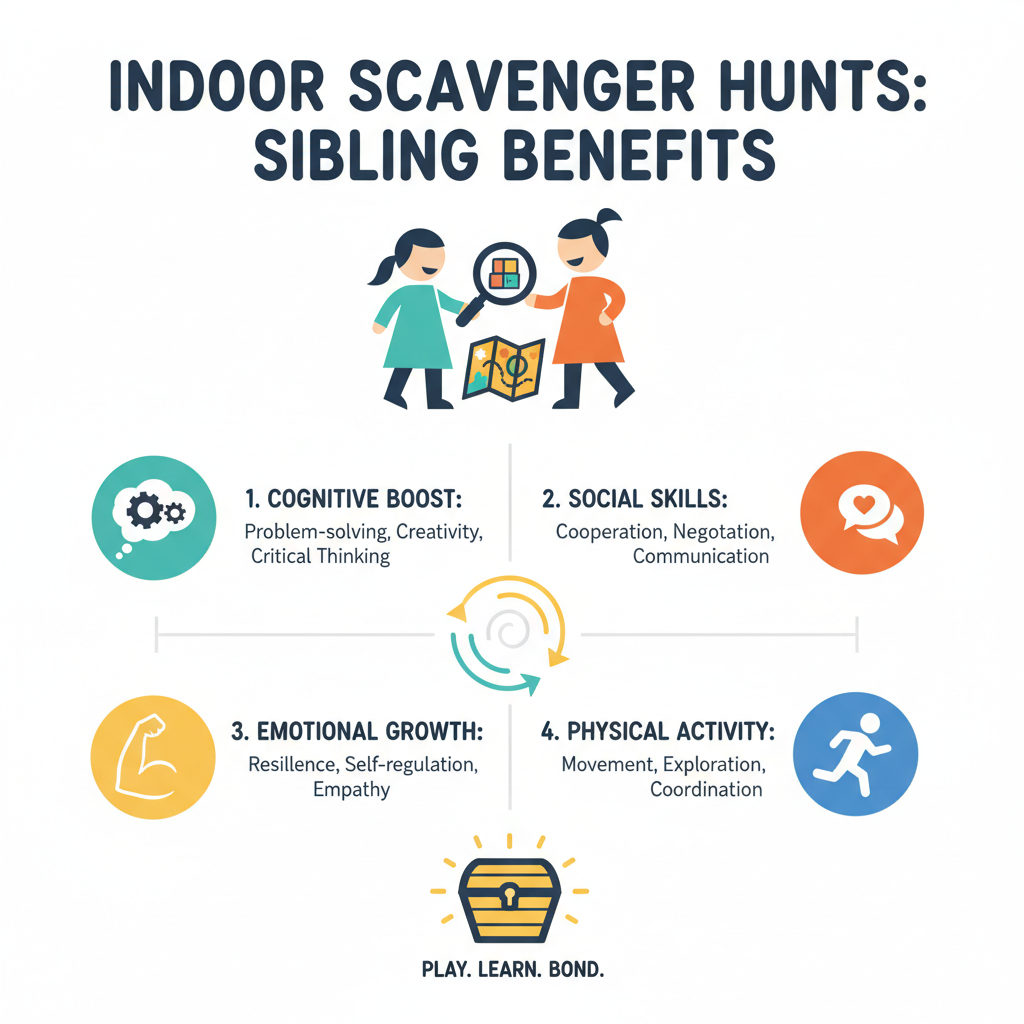
That’s where a sibling scavenger hunt earns its place. It turns restless energy into a shared mission. It gets kids moving, thinking, and — maybe most importantly — cooperating.
Research backs this up too. A University of Cambridge study found that guided play can be more effective than direct instruction for developing early math, problem-solving, and social skills. And according to the Institute of Education Sciences, play-based learning also supports self-regulation and social-emotional growth — the exact skills that make sibling relationships easier to manage.
The best part? You can set one up in under 10 minutes with things already in your home.
Why an Indoor Hunt for Siblings is the Ultimate Boredom Buster
We have all been there: the rain is pouring, the energy in the living room is reaching a boiling point, and the “he touched my toy” arguments are starting. An indoor hunt for siblings is the ultimate circuit breaker. It shifts the dynamic from competition (who can be loudest?) to collaboration (how do we find the next clue?).
When siblings hunt together, they practice essential social skills. They have to negotiate who holds the list, who reads the clue, and who gets to look under the sofa first. These aren’t just “game skills”; they are life skills. By working toward a common goal, they learn to value each other’s strengths. Maybe the older child is the master riddle-solver, while the younger one is small enough to spot the clue tucked behind the leg of the dining table.
Furthermore, these hunts are excellent for developing problem-solving and self-regulation. Instead of getting frustrated when they can’t find an item immediately, they learn to pause, think, and try a different room. This is the “sneaky learning” we love at Curta Arte—where kids are building brainpower while they think they are just playing. For more ideas on managing high-energy days, check out our guide on fun indoor activities for energetic kids.
How to Plan a Successful Indoor Hunt for Siblings
Planning a hunt doesn’t require a PhD in party planning. In fact, the simpler you keep it, the more likely you are to actually do it! Here is our step-by-step guide to setting up an indoor hunt for siblings that actually works.
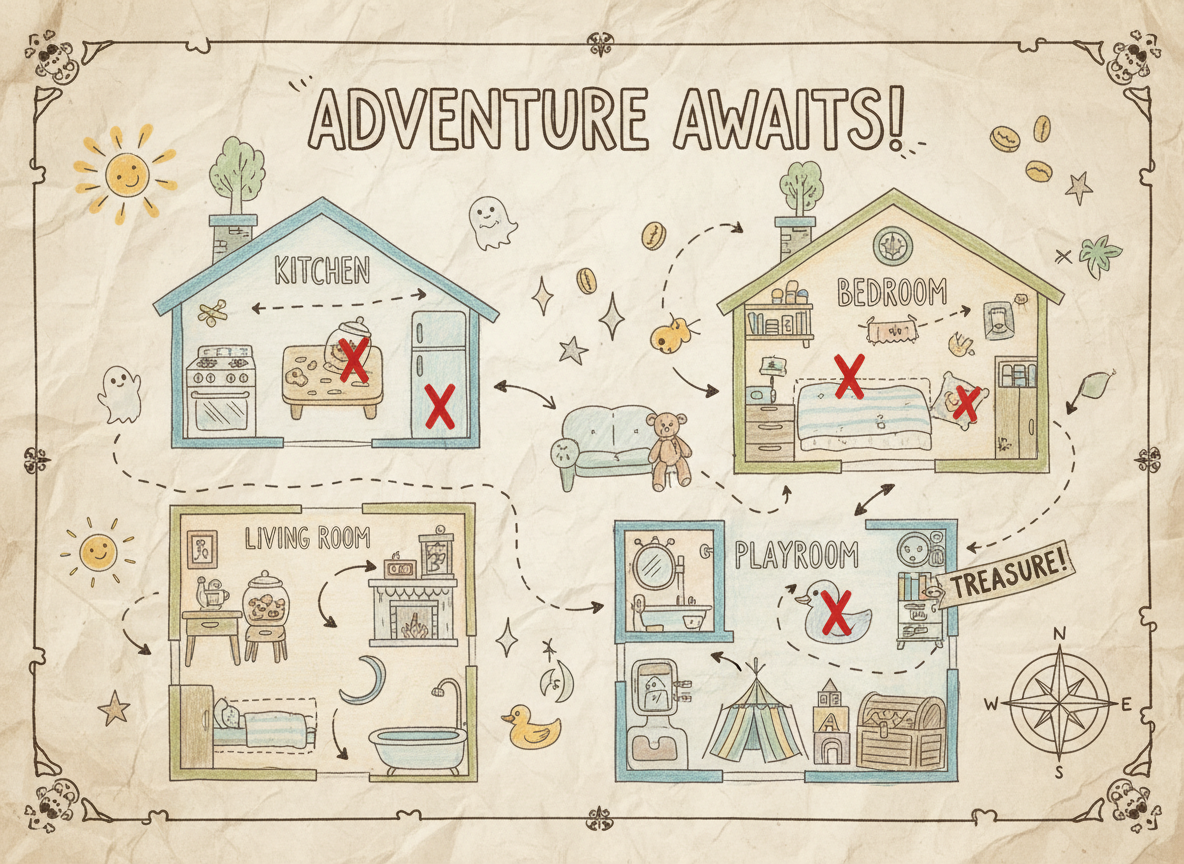
- Start at the End: Decide where the “treasure” will be. This could be a kitchen cabinet with a special snack or a bedroom with a new library book.
- Work Backwards: It is much easier to place clues if you start from the final location and work your way back to the start. If the treasure is in the fridge, the clue leading to it should be placed in the spot before that—perhaps the microwave.
- Choose Your Hiding Spots: Think of everyday furniture—under cushions, taped to the back of doors, or inside a favorite pair of shoes. Make sure the spots are accessible to all the children involved.
- Write or Draw the Clues: Depending on their ages, you might use written riddles, simple sentences, or hand-drawn pictures.
- Set the Ground Rules: Before they start, gather them for a “briefing.” No running, no climbing on high shelves, and no pushing. Remind them that they are a team!
If you are looking for more structured ideas, we have a great resource on easy indoor scavenger hunts for kids and a list of stay-at-home fun exciting activities for kids to keep the momentum going.
Age-Appropriate Adaptations for an Indoor Hunt for Siblings
The biggest challenge with siblings is often the age gap. How do you keep an 8-year-old engaged without leaving the 3-year-old in the dust?
- For Toddlers: Use visual cues. If the next clue is in the bathtub, show them a picture of a rubber duck or a bar of soap. They love the “find and bring” style of play. You can ask them to find “something red” or “something soft.” For more toddler-specific inspiration, see our indoor adventures creative activities for toddlers.
- For Preschoolers: Incorporate shapes, colors, and letters. “Find something that starts with the letter B” or “Find something shaped like a circle.” This reinforces what they are learning in school.
- For Elementary Kids: This is where you can get clever with rhyming riddles and puzzles. You can even use “secret codes” where they have to decode the next location using a simple cipher (A=1, B=2, etc.).
Essential Materials for Your Indoor Hunt for Siblings
You likely have everything you need in your junk drawer right now. To make an indoor hunt for siblings feel official, we suggest gathering:
- Paper or Cardstock: Cardstock is more durable if you have “enthusiastic” hunters.
- Pencils or Markers: For ticking off items on a list.
- Tape: To stick clues to the underside of tables or onto walls.
- The “Treasure”: This doesn’t have to be expensive. A “coupon” for an extra bedtime story, a small piece of fruit, or even just a “Winner” certificate works wonders.
- Printables: If you’re short on time, you can find a Free Printable Indoor Scavenger Hunt or use The Tuppenny Twins Indoor Scavenger Hunt to get started instantly.
Creative Themes and Clue Ideas to Spark Imagination
Themes turn a simple search into an adventure. Here is a quick breakdown of how to match themes to your kids’ interests:
| Theme | Best For | What they do |
|---|---|---|
| Color Hunt | Toddlers & Preschoolers | Find one item for every color of the rainbow. |
| Shape Hunt | Preschoolers | Find a circle (clock), a rectangle (book), and a square (cushion). |
| Story-Building | All Ages | Each found item must be used to tell a story at the end. |
| Photo Hunt | Elementary | Use a phone to take a “silly selfie” with specific items. |
| Nature Indoors | All Ages | Find items made of wood, cotton, or stone (like a pet rock). |
For a deep dive into themed adventures, we recommend checking out 3 Indoor Treasure Hunts For Every Age – Active Parents.
Sample Rhyming Clues for Common Household Items
If you aren’t feeling like a poet today, don’t worry. We have pulled together some classic riddles that work for almost any home. These are perfect for an indoor hunt for siblings because they are challenging but solvable.
- Refrigerator: “I’m in the kitchen and I’m very cold. I keep the milk from getting old.”
- Pillow: “I am soft and fluffy and stay on your bed. At night time, you rest your sleepy head.”
- Toaster: “I make your bread hot and crunchy and brown. Just push the lever and wait for the ‘pop’ sound!”
- Bathtub: “I have a drain and I get very wet. Getting you clean is my favorite bet.”
- Shoe Closet: “I’m where you put your feet before you go out. I have laces and tongues, but I never shout.”
For a full set of 18 ready-to-go clues, you can visit Indoor Scavenger Hunt For Kids (18 Clues).
Turning the Hunt into a Sneaky Learning Activity
We love “sneaky learning” because it feels like a game but builds real academic muscles. An indoor hunt for siblings is a goldmine for educational moments:
- Math and Counting: Ask them to find “five blue things” or “three items that are heavier than a spoon.” This builds number sense and comparison skills.
- Literacy: For kids who are just learning to read, have them find items that start with specific phonics sounds. For older kids, the riddles themselves are great reading practice.
- Categorization: Ask them to find “things we use in the kitchen” or “things that are made of plastic.” This helps with logical thinking and sorting.
If you are stuck inside on a rainy day, these educational twists can be a lifesaver. Check out our other jump indoor games for rainy days for more ways to keep their brains active.
Managing the Sibling Dynamic: Leadership and Troubleshooting
Let’s be real: sometimes the “rivalry” part of sibling rivalry wins. To prevent the hunt from turning into a tug-of-war over a piece of paper, we recommend assigning roles.
If you have a significant age gap, give the older child a “Junior Detective” role. Their job isn’t just to find the items, but to help the younger child find them. This builds empathy and leadership. If they are closer in age, you can use a “Co-Captain” system where they take turns reading the clues.
If an argument breaks out, pause the hunt. Remind them that the treasure only appears if the team works together. We have found that praising effort—”I love how you waited for your brother to catch up!”—is more effective than just focusing on the finish line. For more tips on keeping the peace, see our guide on fun indoor activities for kids on a rainy day.
Involving Older Siblings as Clue Creators
One of our favorite hacks for single parents is to let the older siblings design the hunt for the younger ones. This gives you a much-needed break while they take on a project.
Planning a hunt requires logic and organization. They have to think about the sequence of clues and ensure they aren’t too hard or too easy. It gives them a sense of responsibility and pride when they see their younger siblings enjoying something they created. For more on fostering this kind of independence, explore jump indoor games for rainy days 2.
Frequently Asked Questions about Indoor Hunts
How long should an indoor scavenger hunt last?
For younger children (ages 3-5), 10 to 15 minutes is the sweet spot. Any longer and they might lose focus. For older kids, you can extend it to 30 minutes by adding puzzles or harder hiding spots. You can also make it a “repeat play” by letting them hide the clues for you afterward!
What are the best rewards for the end of the hunt?
The reward doesn’t have to be a toy. Some of the best “treasures” are:
- Choosing the movie for family movie night.
- A “get out of chores” pass.
- A special snack like popcorn or fruit kebabs.
- A Pregnancy Reveal Indoor Scavenger Hunt for Siblings if you have a very special announcement to make!
How do I adapt a hunt for non-readers or children with disabilities?
For non-readers, use picture clues or photos of the locations. For children with diverse abilities, focus on sensory items. A “Sensory Hunt” where they find something “bumpy,” “smooth,” or “scented” is inclusive and fun. If you are out at a sibling’s sporting event, you can even use this FREE PRINTABLE Scavenger Hunt for siblings during their brother or sister’s sports practice to keep them occupied in a confined space.
Conclusion
At Curta Arte, we know that being a single parent means you are the CEO, the chef, and the entertainment director all at once. An indoor hunt for siblings is a powerful tool in your parenting kit because it fosters the very things we want for our families: bonding, persistence, and a lot of laughter.
By turning your home into a treasure map, you aren’t just killing time; you are building memories and teaching your children that they are a team. Whether it’s a rainy Tuesday or a long weekend, these hunts prove that you don’t need a big budget to have a big adventure.
For more support and creative ways to navigate the joys and challenges of solo parenting, explore more fun activities for kids on our site. Happy hunting!
