
When the Rain Hits, an Easy Indoor Scavenger Hunt Saves the Day
An easy indoor scavenger hunt is one of the simplest, most effective ways to keep kids entertained at home — no special supplies, no big budget, and no stress.
Here’s a quick overview of how to run one:
- Pick a format — a simple checklist of household items or a series of riddle clues leading from one spot to the next
- Choose your items — everyday objects like a spoon, a red sock, or a stuffed animal work perfectly
- Set the rules — no running, stay in allowed areas, and each item counts only once
- Hand over the list — give kids a pencil and clipboard and let them go
- End with a reward — a small snack, sticker, or just the thrill of finishing is all you need
It really is that simple.
Whether it’s a rainy afternoon, a school holiday, or just one of those days when the walls feel like they’re closing in, a scavenger hunt can buy you real breathing room. Kids get to move, think, and explore — and you get a moment to exhale.
The best part? You can set one up in under ten minutes using things already in your home.
Why an Easy Indoor Scavenger Hunt is the Ultimate Parenting Hack
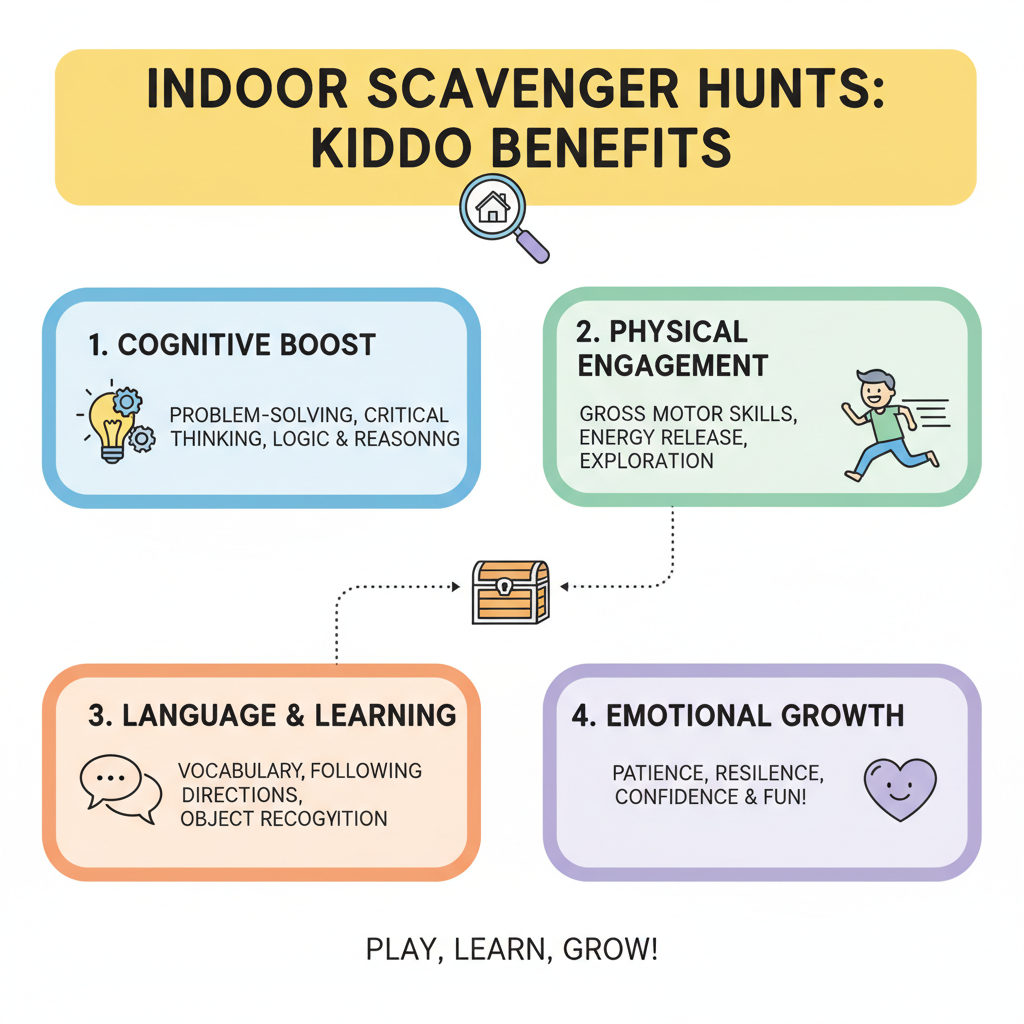
As parents, we are often looking for that “magic” activity—the one that requires zero prep but provides maximum engagement. An easy indoor scavenger hunt fits the bill perfectly. Beyond just being a boredom buster, these hunts are powerhouse tools for childhood development.
When children navigate the living room or kitchen looking for a “shiny object” or “something that starts with the letter B,” they are actively engaging in problem-solving. They have to categorize objects, analyze their environment, and use deductive reasoning. It’s also a fantastic way to burn off that restless energy that tends to build up when kids are stuck inside. If you are looking for more fun indoor activities for kids on a rainy day, a scavenger hunt should be at the top of your list.
From a cognitive perspective, these hunts encourage creative thinking. Instead of literal interpretations, we can encourage kids to think outside the box. Is a yellow banana the only “yellow thing” in the kitchen, or does the dish soap count too? This flexibility builds observation skills that are vital for school-age success. Most importantly, it serves as a high-quality screen-time alternative. Instead of passive consumption, kids are moving their bodies and using their brains in a “full-contact” participation sport.
How to Plan Your Easy Indoor Scavenger Hunt Step-by-Step
Planning doesn’t have to be a chore. In fact, the “easier” you keep it, the more likely you are to do it again next week!
Basic Supplies
You likely have everything you need in your junk drawer right now:
- Paper or Printables: You can hand-write a list or use a free printable indoor scavenger hunt.
- Writing Utensils: Pencils or crayons for ticking off items.
- Clipboards: These make kids feel like “official” explorers and provide a sturdy surface for writing while on the move.
- A Timer: Optional, but great for adding a sense of urgency for older kids.
Choosing Your Format
There are two main ways to play. Here is a quick comparison to help you decide:
| Feature | Checklist Hunt | Riddle-Based Treasure Hunt |
|---|---|---|
| Setup Time | 2 Minutes | 10-15 Minutes |
| Skill Level | Great for all ages (use pictures for toddlers) | Best for readers or with adult help |
| Logic Type | Observation and counting | Deductive reasoning and rhyming |
| Goal | Find everything on the list | Follow clues to a final “treasure” |
Setting Boundaries and Strategies
Before you say “Go!”, establish the ground rules. Define off-limit areas like high shelves, medicine cabinets, or your home office. To keep things mess-free, you might decide that items should be pointed at rather than collected, or you can opt for an indoor photo scavenger hunt where kids simply take a picture of their find.
If you are looking for more stay-at-home fun and exciting activities for kids, the “hiding” part is half the fun. For younger kids, keep items in plain sight. For older children, tuck things behind pillows or inside empty shoes to increase the challenge.
Age-Appropriate Variations for Every Stage
One of the reasons we love the easy indoor scavenger hunt is its versatility. You can adapt the complexity based on who is playing.
Toddlers and Preschoolers
For the littlest hunters, skip the complex riddles. Use picture lists—draw a simple red circle for “something red” or a stick-figure sock. Keep the list short (3 to 5 items) to prevent frustration. You can also try “silhouette hunts,” where you trace the outline of a toy on paper and have the toddler find the matching object. For more inspiration, check out our guide on easy indoor scavenger hunts for kids.
School-Age Kids
This age group thrives on competition. Introduce rhyming clues or “property-based” searches. Instead of saying “find a spoon,” ask them to find “something made of metal that you can’t see through.” This encourages them to learn about materials and textures. You can find excellent indoor scavenger hunt for kids (18 clues) online that provide ready-made riddles for this age group.
Older Kids and Teens
To keep teens engaged, go digital. A photo hunt is perfect here. Give them prompts like “a reflection of yourself in something that isn’t a mirror” or “a photo of something that smells like breakfast.” You can also introduce ciphers or Morse code clues to turn the hunt into a mini-escape room experience.
15 Creative Ideas for Your Easy Indoor Scavenger Hunt
If you’re staring at a blank piece of paper, don’t worry! We’ve gathered some of the best items and clues to get you started.
Rhyming Clues for an Easy Indoor Scavenger Hunt
Rhymes add a layer of magic to the search. Here are a few favorites for different rooms:
- Kitchen: “I get cold, but my door twin gets colder. I hold the milk until you’re a bit older.” (The Refrigerator)
- Bathroom: “I have a neck but no head, and I help you get clean before you go to bed.” (The Bathtub or Sink)
- Living Room: “I have four legs but cannot walk. I’m where you sit when you want to talk.” (A Chair or Sofa)
- Bedroom: “I have a face but no eyes, and hands that move but never rise.” (A Clock)
Using these types of clues is great for fun indoor activities for energetic kids because it forces them to pause and think between bursts of running.
Themed Lists for an Easy Indoor Scavenger Hunt
Themes make the hunt repeatable. You can do a “Color Hunt” on Monday and an “Alphabet Search” on Tuesday.
- The Color Hunt: Find one item for every color of the rainbow.
- The Alphabet Search: Find an item starting with every letter from A to Z.
- The Math Tally: How many windows are in the house? How many clocks? How many forks? This is a great way to sneak in some weekend fun and simple activities for kids while practicing counting.
- The Shape Recognition: Find a circle (clock), a rectangle (book), and a cylinder (paper towel roll).
- The Sensory Hunt: Find something “squishy,” something “scratchy,” and something “cold.”
- The Holiday Theme: Search for hidden plastic eggs or paper snowflakes.
- The “Get Moving” Hunt: Find an item, then do 5 jumping jacks before moving to the next.
- The Nature-In-Home Hunt: Find a wooden chair (from a tree), a cotton shirt (from a plant), and a glass window (from sand).
- The Book Hunt: Find a book with a blue cover, a book with a dog in it, and a book that starts with the letter ‘T’.
- The Clothing Hunt: Find a mismatched pair of socks, a hat, and something with buttons.
For even more variety, you can combine these hunts with easy DIY crafts to keep kids busy by having them decorate their own collection bags or “treasure chests” before the hunt begins.
Pro-Tips for a Safe and Mess-Free Adventure
To ensure the hunt remains a “rescue” and not another chore for you, follow these sanity-saving tips:
- Establish No-Go Zones: Clearly mark rooms that are off-limits (like a sleeping baby’s room or a home office).
- The “No Running” Rule: Inside houses, walking feet are safer. Remind them that it’s a game of skill, not just speed. This is a staple for all indoor games for rainy days.
- Use “Eyes Only” for Fragiles: If you have heirlooms or breakables, tell the kids they only need to find and point to the item rather than picking it up.
- Photo Hunts for Zero Cleanup: If the thought of 20 household items piled on your rug stresses you out, have them take photos. It’s one of our favorite easy indoor scavenger hunt for kids – ideas for the home tips.
- Cleanup Incentives: If they do collect items, make the “return to home” part of the game. The first person to put all their items back in the correct spot wins a bonus point!
- Small Prizes and Snacks: You don’t need to buy toys. A “treasure” can be a special snack, 15 minutes of extra reading time, or a sticker.
For more ways to burn off steam safely, check out our other resources on more indoor games for rainy days.
Frequently Asked Questions about Indoor Scavenger Hunts
How can I adapt a scavenger hunt for virtual play?
If your kids are missing their cousins or friends, a virtual easy indoor scavenger hunt is a fantastic way to connect. Host a Zoom or FaceTime call and call out items one by one. “The first person to find a wooden spoon and bring it back to the camera gets a point!” It’s high-energy and works perfectly across different households. You can even use a free printable indoor scavenger hunt for kids and email it to all participants beforehand.
What are common mistakes to avoid when organizing a hunt?
The biggest mistake is over-complicating it. If the clues are too hard, kids get frustrated. If the list is too long, they lose interest. Start small! Another mistake is forgetting to check the hiding spots beforehand—make sure that “under the sink” doesn’t lead them to cleaning chemicals. Always prioritize safety and keep a loose eye on the proceedings.
Do I need to buy special supplies for a scavenger hunt?
Absolutely not. The beauty of this activity is that it uses what you already have. A free printable indoor scavenger hunt is a great resource if you want something “fancy” looking, but a piece of notebook paper works just as well. Recycled materials like egg cartons can also be used as “collection trays” for smaller items.
Conclusion
At Curta Arte, we understand that parenting—especially as a single parent—is a balancing act. You want to provide enriching, joyful experiences for your children, but you also need activities that are manageable and stress-free. Our mission is to provide empathetic, targeted guidance to help you navigate these everyday challenges with confidence.
An easy indoor scavenger hunt is more than just a game; it’s a way to reclaim a rainy afternoon and turn it into a family memory. Whether you’re using rhyming riddles or a simple picture checklist, the goal is the same: connection, creativity, and a little bit of peace and quiet for you.
We hope these ideas help you rescue your next rainy day! For more tips on solo parenting and engaging your little ones, explore more fun activities for kids at Curta Arte.
