
Why a Rainy Day Calls for an At Home Scavenger Hunt
An at home scavenger hunt is one of the easiest, most rewarding activities you can pull together on a rainy day — with no special supplies, no budget, and no co-parent required.
Here’s the quick version of how it works:
- Write or print a list of clues (rhyming riddles or picture cards work great)
- Hide the clues around your home, each pointing to the next location
- Give kids the first clue and let them go
- End with a small prize or treat at the final hiding spot
That’s it. Kids as young as 2 and as old as 12 can play — you just adjust the difficulty.
Whether your kids are bouncing off the walls, glued to a screen, or just whining “I’m bored” for the fifth time today, a scavenger hunt flips the whole mood. It gets them moving, thinking, and genuinely excited — and it gives you a much-needed breather.
Parents who’ve tried it often say the same thing: the scavenger hunt ends up being the kids’ favorite part of the day.
The best part? You probably already have everything you need right at home.
Why an At Home Scavenger Hunt is the Ultimate Boredom Buster
When we are stuck inside, especially during those long stretches of rainy weather or school breaks, the energy in the house can reach a boiling point. An at home scavenger hunt acts as a safety valve. It transforms your living space from a “containment zone” into a world of adventure.
Beyond just being a way to pass the time, these hunts are powerhouse tools for development. We love them because they naturally encourage:
- Problem-Solving: Deciphering a riddle or figuring out where a “cold place that makes cubes” might be requires critical thinking.
- Motor Skills: Whether it’s a toddler squatting to look under a chair or a tween racing up the stairs, it gets their bodies moving.
- Observation: Kids have to look at their everyday environment with fresh eyes, noticing details they usually walk right past.
- Cognitive Growth: Following a sequence of clues helps children understand logical progression and “if-then” scenarios.
As parents, we are often looking for fun indoor activities for kids on a rainy day that don’t involve a tablet. A scavenger hunt is the perfect screen-free solution. It’s a “full-contact” sport for the brain that provides stay-at-home fun and exciting activities for kids without requiring a trip to the store.
Step-by-Step Guide to Setting Up Your At Home Scavenger Hunt
Setting up a hunt doesn’t have to be a multi-hour project. In fact, we’ve found that the best hunts are often the ones thrown together in fifteen minutes. Here is our tried-and-true method for a successful setup:
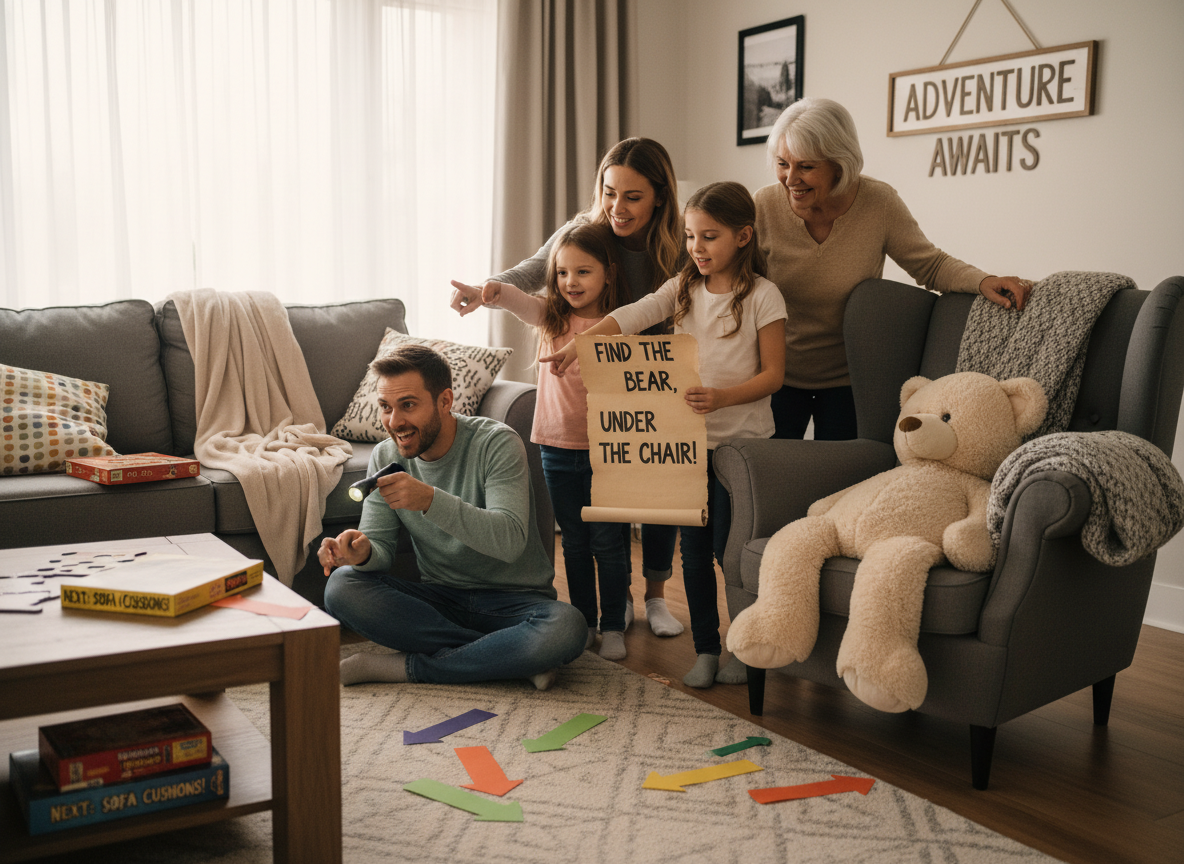
- Choose Your Format: Decide if you want a “Checklist Hunt” (find all these items and bring them back) or a “Clue-to-Clue Hunt” (each clue leads to the location of the next).
- Prepare Your Materials: Grab some cardstock or even just Post-it notes. Using sturdy paper makes the clues feel more like “treasure,” and Post-its are great because they won’t damage your furniture.
- Map the Route: If you’re doing a clue-based hunt, write down your locations first. Start in the living room, go to the fridge, then the bathtub, then a shoe, and finally the washing machine.
- Write the Clues: Tailor these to your child’s age (we’ll give you some samples below!). For non-readers, draw a picture of the next location.
- Hide the Clues: This is the most important part—don’t hide the first clue! You hand that one to the kids. Place Clue #2 at the location described in Clue #1, and so on.
- The Grand Finale: Place a small prize or a “congratulations” sign at the very last stop.
For more inspiration on keeping things simple yet engaging, check out our guide on easy indoor scavenger hunts for kids.
Customizing Your At Home Scavenger Hunt for Learning
We can easily turn a fun game into a “sneaky” educational lesson. This is particularly helpful for single parents who are trying to balance homeschooling or supplemental learning with daily chores.
- The Alphabet Hunt: Ask kids to find one item for every letter of the alphabet.
- The Color Quest: Great for toddlers! “Find something red and round” or “Bring me three things that are blue.”
- Math and Counting: For older kids, include clues like “Count all the windows in the house” or “Find a place where 2 + 3 equals the number of drawers.” Using tally marks is a great way to practice basic math skills during the hunt.
| Feature | Toddler Hunt (Ages 2-4) | Tween Hunt (Ages 9-12) |
|---|---|---|
| Clue Type | Pictures or simple verbal prompts | Complex riddles or codes |
| Duration | 10–15 minutes | 30–45 minutes |
| Area | One or two rooms | The entire house and garage |
| Goal | Identification and matching | Logic and deduction |
| Learning Focus | Colors, shapes, basic nouns | Math, vocabulary, trivia |
Creating Your Own At Home Scavenger Hunt Riddles
You don’t need to be a poet to write great clues. The goal is to describe a household item’s function or appearance in a way that makes the kids think for a second.
- Use Rhyme Schemes: Even “bad” rhymes work! If it rhymes, kids think it’s a professional game. (e.g., “I have a face but no eyes, I tell you the time before the sun dies” — a clock).
- Personification: Give inanimate objects a personality. “I have four legs but I cannot walk; I’m where you sit when you want to talk” (a chair).
- Simple Descriptions: For younger kids, keep it literal. “I am cold and hold the milk.”
If you are looking for more ways to keep the momentum going on a gloomy afternoon, explore our jump indoor games for rainy days for high-energy alternatives.
20 Rhyming Clues for Common Household Objects
To make your life easier, we have compiled a list of ready-to-use clues. You can write these on scraps of paper or print them out.
- Toaster: I’m in the kitchen and give quite a fright, when your bread pops up all toasted and light.
- Pillow: I’m soft and feathers are what I hold, lay your head on me when the day gets old.
- Washing Machine: I spin round and round and get quite wet, I’m the best place for your dirty clothes, I bet!
- Fridge: I’m very cold and have a light, I keep your snacks fresh day and night.
- Bathtub: I hold the water and your rubber duck too, jump inside when you’re sticky like glue.
- Dog Food: They’re furry and cuddly, they go bow-wow, the next clue is hiding where you keep their chow.
- Mirror: I look just like you but I cannot speak, look into me to see your own cheek.
- Shoes: You wear us outside to protect your feet, you’ll find the next clue where we stay nice and neat.
- Clock: I have two hands but cannot clap, I tick and tock while you take a nap.
- Bookshelf: I hold many stories of dragons and kings, look among my pages for the next of your things.
- TV: I have a screen and show you a show, sit on the couch and watch the light glow.
- Microwave: Give me a minute and I’ll make things hot, I’m a “zap” in the kitchen, believe it or not!
- Dining Table: I have four legs but cannot run, I’m where we eat when the cooking is done.
- Toothbrush: I’m small and bumpy and help you smile, use me every morning for a little while.
- Front Door: I have a handle and a little hole for a key, I’m the way you come home to see me!
- Tissues: When your nose is runny and you need to sneeze, grab one of me to feel at ease.
- Sofa: I’m big and comfy and hold the whole crew, look under my cushions for the next clue.
- Lamp: Turn me on when the room gets dark, I don’t need a fire or even a spark.
- Computer/Laptop: I have a keyboard and a mouse that doesn’t squeak, I’m where you go to take a “peak.”
- Trash Can: I might smell bad, but I’m helpful to you, throw away your wrappers when you are through!
Planning a hunt like this is one of our favorite weekend fun simple activities for kids because it requires zero prep but yields maximum smiles.
Rules, Safety, and Rewards for Indoor Fun
To keep the hunt from turning into chaos, we recommend setting a few “Ground Rules” before you hand over the first clue.
- No Running: This is especially important indoors. Remind them that it’s a game of “brains, not brawn.”
- Teamwork: If you have multiple kids, encourage them to solve the riddles together rather than racing against each other, which can lead to tears.
- Safety First: Remind them not to climb on furniture or open “off-limits” cabinets (like those containing cleaning supplies).
- Time Limits: For older kids, a 30-45 minute timer adds a fun element of “Mission Impossible” style pressure.
The Prize: The reward doesn’t have to be expensive. In fact, some of the best rewards are “privilege” based.
- Stickers or small DIY crafts: Check out our easy DIY crafts to keep kids busy for items you can make together after the hunt.
- Screen-time coupons: A voucher for an extra 30 minutes of a favorite game.
- A special snack: A “treasure” of cookies or a fruit kabob.
- Choosing the movie: The winner gets to pick the family movie for the night.
Frequently Asked Questions about Indoor Hunts
What age groups is an at-home scavenger hunt suitable for?
An at home scavenger hunt is incredibly adaptable. Toddlers as young as two can participate with picture-based lists. Preschoolers (ages 4-6) love simple rhyming clues. Tweens (ages 9-12) enjoy more complex riddles, codes, or “photo hunts” where they have to take a picture of the item rather than just finding it. Even for mixed-age groups, you can pair an older child with a younger one to act as the “designated reader.”
What are some easy household items to include as targets?
If you are doing a “Checklist” style hunt, look for items that are common but require a bit of searching. Great targets include:
- A remote control
- Three different fridge magnets
- Two empty toilet paper rolls
- Their favorite book
- Something yellow (like a shirt or a toy)
- A coin from the year they were born (for older kids)
How do you adapt scavenger hunts for toddlers vs. tweens?
For toddlers, keep the hunt “open-ended.” Instead of one specific item, ask for “something soft” or “something blue.” This allows them to feel successful quickly. For tweens, make it a “Photo Scavenger Hunt.” Give them a list of prompts like “A photo of someone’s reflection” or “A photo of something that starts with the letter Z.” This uses their interest in technology for a creative, active purpose.
Conclusion
At Curta Arte, we know that being a single parent means you are often the Chief Entertainment Officer, the Cook, and the Referee all at once. An at home scavenger hunt is a gift to yourself as much as it is to your kids. It’s a way to provide structured, empathetic guidance through play, allowing your children to build confidence and problem-solving skills while you manage the household.
By using items you already have and a little bit of imagination, you can turn a dreary rainy day into a memory your kids will talk about for weeks. Whether you use our rhyming clues or create your own, the goal is simple: have fun together.
For more ways to keep your family engaged and thriving, explore more fun activities for kids on our site. Happy hunting!
