
Your 5-Year-Old Is Already a Scientist (They Just Need You to Notice)
Easy at home science experiments for 5 year olds don’t require a lab, a kit, or a free weekend. Most take under 10 minutes to set up using things already in your kitchen.
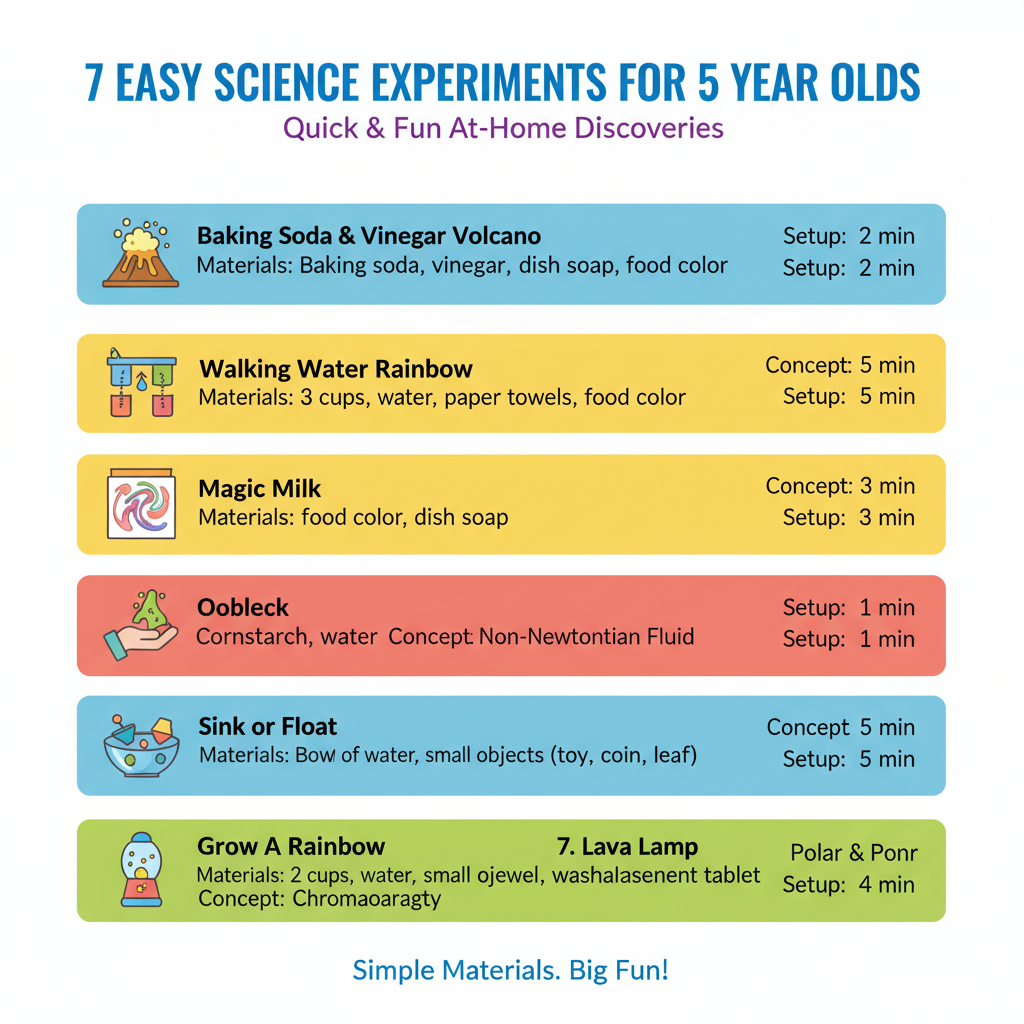
Here are the best options to get started right now:
- Baking soda and vinegar volcano – mix, watch it fizz, done
- Walking water rainbow – paper towels + food coloring + cups of water
- Magic milk – drop dish soap into colored milk and watch it swirl
- Oobleck – cornstarch + water = a liquid that acts like a solid
- Sink or float – drop random objects into a bowl of water and observe
- Grow a rainbow – washable markers on a paper towel bridge between two cups of water
- Lava lamp – oil, water, food coloring, and an Alka-Seltzer tablet
All seven use household items. All seven work. And all seven will make your kid say “again!”
Five-year-olds are wired for curiosity. They ask why constantly, they mix things without being asked, and they treat every puddle like a research project. That’s not a problem to manage — that’s science happening naturally.
The good news for parents doing this solo: you don’t need to be a science teacher. You don’t need to explain everything. You just need to hand them a cup of vinegar and stand back.
This list gives you simple, low-mess experiments that teach real concepts — chemical reactions, density, capillary action — without requiring any prep beyond what’s already in your pantry. No special equipment. No stress.
Setting the Stage for Easy At Home Science Experiments for 5 Year Olds
Before we dive into the bubbling potions and walking rainbows, let’s talk about the “lab” environment. When you are navigating solo parenting, your kitchen table often doubles as a craft station, a dining area, and now, a research center. The key to success with easy at home science experiments for 5 year olds is keeping things manageable.
Safety First
While we are using pantry staples, safety is still our top priority. Always supervise your little scientist. Even food-grade items like vinegar can sting if they get in a curious eye, and small items like Alka-Seltzer tablets or Skittles are choking hazards for younger siblings who might be wandering nearby.
The Scientific Method (Preschool Style)
You don’t need a PhD to teach scientific thinking. At five years old, science is about three simple steps:
- Observation: “What do you see?”
- Prediction: “What do you think will happen if we add this?”
- Hypothesis: “Why do you think it did that?”
By asking these questions, you are Sparking Curiosity: Science Experiments for Kids at Home and building a foundation for STEM (Science, Technology, Engineering, and Math) learning that will serve them well in kindergarten and beyond.
Experiment Comparison Table
To help you choose the right activity for your current energy level, we’ve broken down the most popular experiments by setup time and “mess factor.”
| Experiment | Setup Time | Mess Level | Key Concept |
|---|---|---|---|
| Baking Soda Volcano | 2 Minutes | High (Use a tray!) | Chemical Reactions |
| Walking Water | 5 Minutes | Low | Capillary Action |
| Magic Milk | 3 Minutes | Medium | Surface Tension |
| Oobleck | 5 Minutes | High (But easy to clean) | Non-Newtonian Fluids |
| Sink or Float | 1 Minute | Low | Density/Buoyancy |
| Skittles Rainbow | 2 Minutes | Low | Solubility/Diffusion |
Colorful Chemistry and Fizzing Reactions
There is nothing quite like the “wow” factor of a chemical reaction. For a five-year-old, watching something transform from a still liquid into a bubbling foam is pure magic. In reality, it’s an acid-base reaction. When we mix an acid (vinegar or lemon juice) with a base (baking soda), they create carbon dioxide gas. Those bubbles are the gas trying to escape!
One of our favorite variations is the Melting Rainbow Preschool Science Experiment. Instead of just one big explosion, use a muffin tin. Put a few drops of different food coloring in each well, cover them with baking soda, and give your child a pipette or a small spray bottle filled with vinegar.
This is excellent for First Steps in Science: Simple Experiments for Kids because it builds fine motor skills. Squeezing a pipette takes concentration and muscle control, which are essential for learning to write. Plus, using a muffin tin keeps the “lava” contained, making cleanup a breeze for busy parents.
The Classic Volcano: A Staple of Easy At Home Science Experiments for 5 Year Olds
If you want the full “erupting mountain” experience, here is the foolproof way to do it.
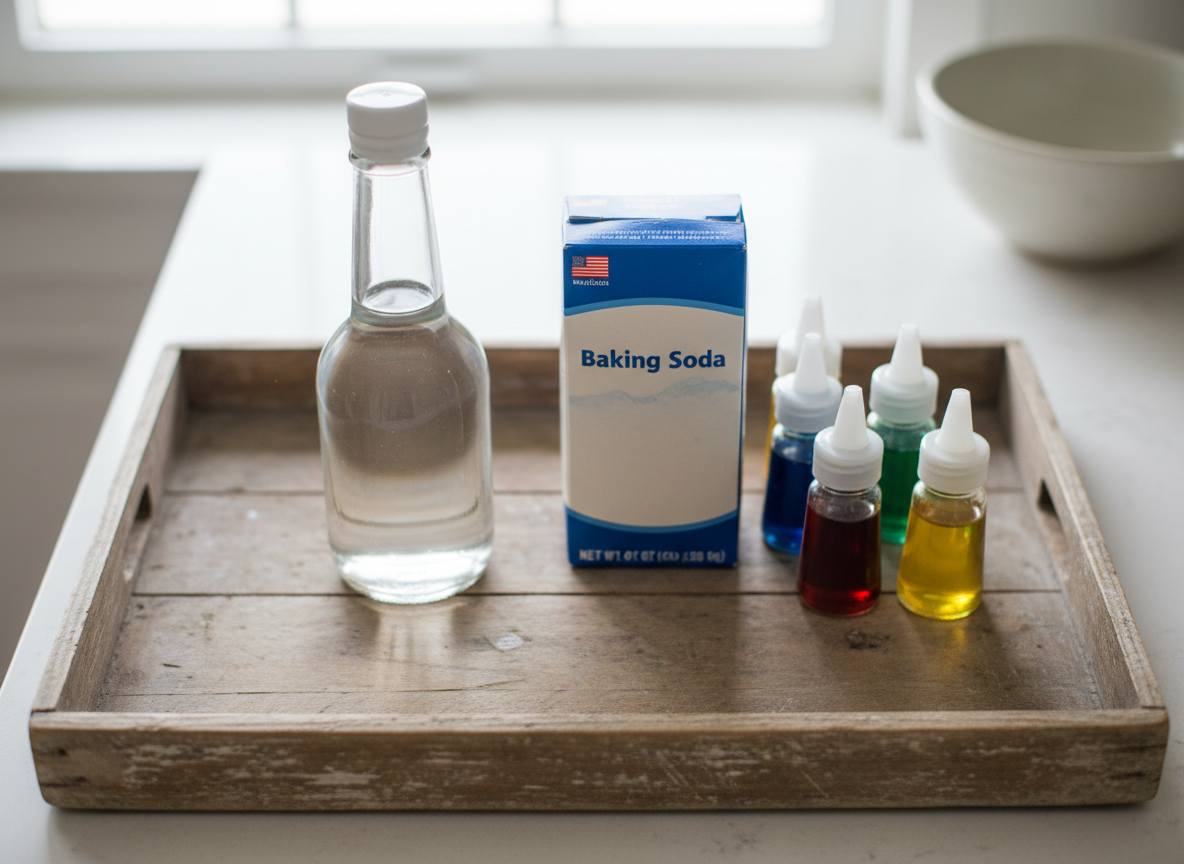
Materials Needed:
- A small plastic bottle or cup
- Baking soda (about 2 tablespoons)
- Vinegar (about 1/2 cup)
- Dish soap (a quick squirt)
- Food coloring (red is classic, but any color works!)
- Optional: Glitter for a “sparkly volcano”
Step-by-Step Setup:
- Place your bottle in the center of a large tray or even in the bathtub to catch the overflow.
- Add the baking soda to the bottle.
- Add a squirt of dish soap. This is a “pro tip” — the soap traps the gas bubbles and makes the foam much thicker and slower-moving.
- Add your food coloring and glitter.
- The Big Moment: Have your child pour the vinegar into the bottle.
The Science: Explain that the vinegar and baking soda are “meeting” and creating a gas called carbon dioxide. It’s the same stuff that makes soda fizzy! This is a great way of Engaging Minds: Hands-On STEM Activities at Home for Kids by showing them that invisible gases can take up space and move things.
Magic Milk and Surface Tension
This experiment looks like a psychedelic light show and is incredibly low-prep. It teaches children about surface tension and how soap molecules interact with fats.
How to do it:
- Pour enough whole milk (fat content matters here!) into a shallow plate to cover the bottom.
- Add several drops of different food coloring (primary colors like red, yellow, and blue are best) in the center. Keep the drops close together but not touching.
- Dip a cotton swab into liquid dish soap.
- Touch the soapy swab to the center of the milk. Do not stir!
What happens? The colors will suddenly “explode” outward, swirling and mixing into secondary colors like purple, orange, and green.
The Simple Explanation: Tell your child that milk has tiny bits of fat in it, and the soap is “chasing” the fat. As the soap moves to find the fat, it pushes the food coloring along with it. This is a perfect introduction to a Color Mixing Science Fair Project (Kindergarten-2nd Grade) because it allows kids to see colors blending in real-time.
Water Wonders and Capillary Action
Water doesn’t just flow down; sometimes, it “walks” up! This is thanks to capillary action, the same process that allows giant trees to get water from their roots all the way up to their highest leaves.
Growing Rainbows: Visual Magic in Easy At Home Science Experiments for 5 Year Olds
This is one of the most visually stunning easy at home science experiments for 5 year olds. It feels like magic, but it’s actually a lesson in cohesion (water sticking to itself) and adhesion (water sticking to other things).
The “Grow a Rainbow” Method: This version is quick and yields results in about 10 minutes.
- Take a paper towel and cut it into a strip about 7 inches long.
- Use washable markers to color small rectangles of the rainbow (Red, Orange, Yellow, Green, Blue, Purple) on both ends of the strip. Leave the middle white.
- Fill two small cups about 3/4 full with water.
- Place one end of the paper towel in one cup and the other end in the second cup, so the paper towel forms a bridge.
- Watch as the colors “climb” up the paper towel and meet in the middle.
For a more long-term version, try the Walking Water Rainbow. You’ll need 6 or 7 clear glasses arranged in a circle or a row. Fill every other glass with water and add primary food coloring (Red, Yellow, Blue). Connect the glasses with folded strips of paper towel. Over several hours, the water will “walk” into the empty glasses, mixing the primary colors to create a full rainbow of secondary colors.
This experiment is a favorite for First Steps in Science: Simple Experiments for Kids 2 because it encourages patience and observation. Your child can check on it every hour to see how far the water has traveled.
You can find more detailed instructions on these variations at Grow a Rainbow Science Experiment, Walking Water Rainbow Science Experiment For Kids – Fox Farm Home, Melting Rainbow Preschool Science Experiment, Easy Rainbow Walking Water Experiment For Kids – Made In A Pinch, and Walking Water Experiment – Little Bins for Little Hands.
Physics, Density, and Sensory Exploration
Physics sounds intimidating, but for a 5-year-old, it’s just about how things move and feel.
Homemade Lava Lamps (Density)
Why don’t oil and water mix? Because they have different densities. Water is “heavier” (more dense) than oil, so it sinks to the bottom.
How to make one:
- Fill a clear jar or plastic bottle about 2/3 full with vegetable oil.
- Fill the rest with water, leaving a little space at the top.
- Add a few drops of food coloring. Notice how the drops pass through the oil and only mix with the water at the bottom!
- Break an Alka-Seltzer tablet into small pieces and drop one in.
The tablet creates carbon dioxide bubbles that attach to the colored water and carry it to the top. When the bubble pops, the water sinks back down. It’s mesmerizing and completely repeatable!
Oobleck: The “Is it a Solid or Liquid?” Mystery
Named after a Dr. Seuss book, Oobleck is a non-Newtonian fluid. It doesn’t follow the normal rules of liquids.
Materials:
- 2 cups cornstarch
- 1 cup water
- Food coloring (optional)
The Experiment: Mix the cornstarch and water in a bowl. If you poke it quickly, it feels like a solid. If you pick it up and hold it still, it melts through your fingers like a liquid.
This is a fantastic way of Engaging Minds: Hands-On STEM Activities at Home for Kids 2 because it’s a full sensory experience. Ask your child: “How does it feel when you squeeze it? What happens when you let go?” This encourages them to use descriptive language and observe physical changes.
Sink or Float
This is the ultimate “zero-prep” experiment. Fill a large bowl or the bathtub with water. Gather various household items (a metal spoon, a plastic toy, a cork, a grape, a rock). Before dropping each one in, ask your child to predict if it will sink or float.
This simple game teaches buoyancy and density. You can even “level up” by trying to make a piece of aluminum foil sink (by crumpling it into a tight ball) or float (by shaping it into a boat). For more on this, check out the Easy Rainbow Walking Water Experiment For Kids.
Frequently Asked Questions about Preschool Science
What are the best mess-free experiments for indoors?
We know that as a parent, sometimes the thought of “science” just sounds like “more cleaning.” If you want the learning without the scrubbing, stick to these:
- Walking Water: Since the water stays in the cups and paper towels, it’s very contained.
- Ziploc Bag Slime: Mix your ingredients inside a sealed freezer bag. Kids can squish and move the slime around without ever touching the goo.
- Density Jars: Create a beautiful layered jar using honey, dish soap, water, and oil. Once the lid is on (and maybe taped shut!), it’s a permanent, mess-free discovery bottle.
- Magnet Hunt: Give your child a magnet and let them find things around the house that are magnetic.
For more low-stress ideas, see Sparking Curiosity: Science Experiments for Kids at Home 2.
Are these experiments safe if my child tastes the ingredients?
While we don’t recommend a diet of science projects, many of these are “taste-safe.” Using food-grade items like baking soda, vinegar, cornstarch, and lemon juice means that if a curious 5-year-old takes a tiny lick, they might get a sour face, but they will be fine.
- Edible Paint: You can make paint using yogurt and food coloring for a completely safe sensory experience.
- Fizzy Lemonade: Mixing a little baking soda into lemonade creates a safe, drinkable “volcano” in your mouth!
How do I explain complex science to a 5-year-old?
The key is to use analogies. You don’t need to explain molecular bonds.
- Capillary Action: “The water molecules are holding hands and pulling each other up the paper towel like a ladder.”
- Surface Tension: “The top of the water is like a stretchy balloon skin. The soap pops that skin.”
- Density: “Some things are ‘heavy’ for their size and sink, while others are ‘light’ and stay on top.”
These simple explanations align perfectly with kindergarten learning goals, which focus on observing patterns and understanding the properties of matter.
Conclusion
At Curta Arte, we believe that you don’t need a fancy lab or a second parent to provide a world-class educational experience for your child. Solo parenting is a journey of discovery, and sometimes the best way to bond with your 5-year-old is to get a little messy and wonder at the world together.
Whether you are building a baking soda volcano or watching water walk across the kitchen counter, you are doing more than just “playing.” You are teaching your child to ask questions, solve problems, and stay curious.
As Aria James often says, the goal isn’t to have all the answers—it’s to enjoy the process of finding them. We hope these easy at home science experiments for 5 year olds bring a little spark of magic to your home today.
If you enjoyed these activities, we have plenty more resources for you! Explore more fun activities for kids on our blog for empathetic guidance and creative play ideas designed for families of all shapes and sizes.
