
When the Life You Knew Is Gone: Starting Your Divorce Emotional Healing Steps
The divorce emotional healing steps below give you a clear starting point — because when you’re in survival mode, you need answers fast:
- Allow yourself to grieve — all feelings are valid, even conflicting ones
- Survive first — the first 40 days are about getting through, not thriving
- Build a support network — friends, family, or a support group
- Maintain daily routines — for your stability and your children’s
- Avoid major decisions — don’t make big life changes while emotions are running high
- Practice basic self-care — sleep, eat, move your body
- Seek professional help — if grief feels stuck or overwhelming
- Rediscover yourself — slowly rebuild your identity and interests
- Set clear boundaries with your ex — especially around co-parenting
- Move forward at your own pace — healing is not linear, and there is no fixed deadline
Divorce doesn’t just end a marriage. It upends everything — your daily routine, your identity, your family structure, your sense of the future.
And if you’re a single parent? You’re carrying all of that emotional weight while still showing up for your kids every single day. That’s an enormous amount to hold.
Here’s what the research actually shows: feeling deeply depressed and sad for around 9 months after a divorce is completely normal. Full emotional recovery typically takes one to two years. And the very first 40 days — sometimes called the “40 nights” — are often described as walking through a dark forest. Pure survival mode.
One Reddit user who was 15 years past their divorce put it this way: even after doing the emotional work beforehand, those first 40 nights hit like a wall anyway.
That’s not weakness. That’s grief. And grief, in this case, is the only honest response to a loss this big.
This guide walks you through what to expect, what actually helps, and how to move through the pain without getting stuck in it — especially as a parent who needs to stay functional for the kids who are counting on you.
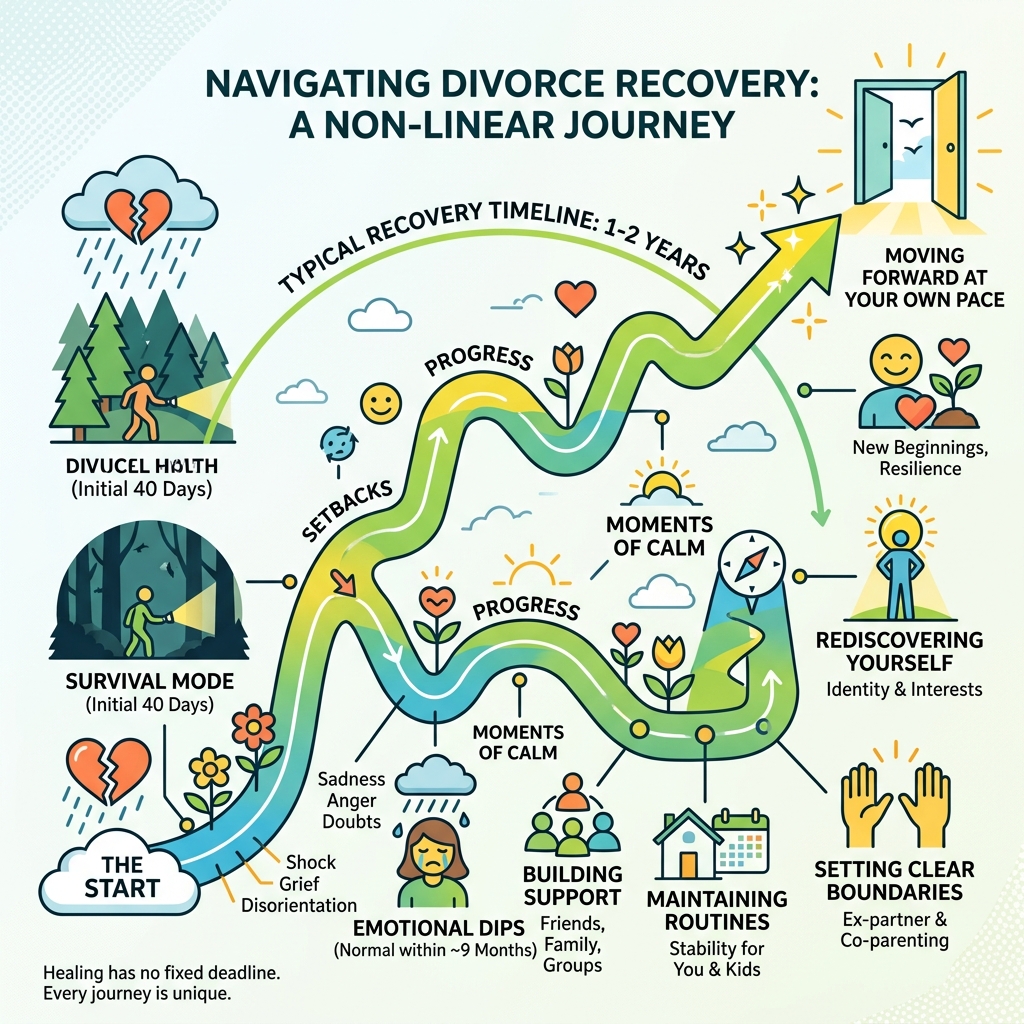
Navigating the Timeline of Divorce Emotional Healing Steps
One of the most frustrating things about divorce is the feeling that you should be over it by now. We live in a society that pressures people to “bounce back,” but your brain and heart have their own internal clocks. Understanding the typical timeline of divorce emotional healing steps can help you stop judging yourself for where you are in the process.
Research suggests that it is normal and expected to experience significant depression and sadness for about nine months after the split. This isn’t just a “bad mood”; it’s a profound shift in your internal chemistry as you process the loss of your partnership. Generally, it takes between one and two years to fully integrate this change and feel like yourself again.

The First 40 Nights: Survival Mode and Initial Divorce Emotional Healing Steps
In many cultures and personal accounts, the “40 nights” rule refers to the period immediately following the separation. Think of this as an “emotional hemorrhage.” Just as you wouldn’t expect someone who just had major surgery to run a marathon, you shouldn’t expect yourself to be productive or “zen” during this window.
In this stage, your goals should be incredibly basic:
- Stay hydrated and try to eat nutritious meals.
- Sleep whenever your body allows it.
- Maintain a bare-minimum routine to keep the household running.
- Avoid major life decisions. This is not the time to quit your job, sell the house (unless legally required), or get a large tattoo. Your “logic center” is currently offline, overwhelmed by the emotional centers of your brain.
Gender Differences in Processing Grief
While everyone’s journey is unique, research highlights some common differences in how men and women navigate divorce emotional healing steps.
Men often suffer longer from sadness and insomnia after a separation. This is frequently because men tend to internalize their grief and may have smaller emotional support networks. On the other hand, women often have broader social circles that provide a “buffer” for the emotional fallout.
However, women may process the grief earlier and more intensely, whereas men might experience a delayed response, hitting their lowest point months after the paperwork is finalized. Regardless of your gender, recognizing these patterns can help you seek the right kind of support—whether that’s a structured support group or a one-on-one therapist.
Practical Coping Strategies for Grief and Stress
Healing isn’t just about waiting for time to pass; it’s about what you do with that time. Most experts agree that divorce grief follows a modified version of the Five Stages of Grief: Denial, Anger, Bargaining, Depression, and Acceptance.
Some even add a sixth stage: The Phoenix Stage. This is where you don’t just accept the divorce; you rise from the ashes of your old life to build something more authentic and fulfilling.
Daily Tools for Emotional Regulation
To get to that Phoenix Stage, you need daily tools to manage the “Crazy Time”—that period where you feel like you’re losing your mind.
- Journaling: Write it all down. Even if you feel like you’re lying to yourself or being “dramatic,” getting thoughts out of your head and onto paper reduces their power.
- Pensive Silence: Spend 15 minutes a day in silence. No phone, no music, no distractions. Just sit with your feelings. It prevents you from “bottling” emotions that will eventually explode like a volcano.
- The 24-Hour Reply Rule: Never respond to a non-emergency text or email from your ex immediately. Wait 24 hours. This allows your “emotional brain” to cool down so your “logical brain” can draft a professional, boundary-focused response.
- Mindfulness: Use meditation or simple breathing exercises to stay grounded. For parents, this is especially helpful because your kids will mirror your emotional state. We have found that Mental Health Tips for Children can also provide great frameworks for parents to use on themselves.
- Routine Building: Something as simple as making your bed or taking a 20-minute walk at the same time every day provides a “scaffold” for your life when everything else feels unstable.
When to Seek Professional Mental Health Help
While sadness is normal, some signs indicate you might need a professional to help you navigate your divorce emotional healing steps. Consider seeking a therapist if:
- You feel “stuck” in anger or are becoming an “injustice collector” (someone who obsessively tallies every wrong your ex ever did).
- You are relying on alcohol or drugs to numb the pain.
- You are experiencing clinical depression that prevents you from caring for your children or holding down a job.
- You are having thoughts of self-harm.
Seeking help isn’t a sign of failure; it’s like setting a broken bone so it heals straight. For more on rebuilding, you can check out 10 tips to help you rebuild your life after divorce — Calm Blog.
Protecting Children and Mastering Co-Parenting
If you are a parent, your divorce emotional healing steps are inextricably linked to your children’s well-being. The good news? Research shows that children can thrive after divorce if their parents provide stability and avoid high-conflict power struggles.
One of the most significant findings in family research is the “35% rule.” Studies suggest that children fare significantly better when they spend at least 35% of their time with each parent (assuming both parents are safe and fit). This consistency helps maintain the parent-child bond and reduces the feeling of “losing” a parent.
Essential Divorce Emotional Healing Steps for Parents and Co-Parents
To support your kids while you heal, focus on these core pillars:
- Age-Appropriate Honesty: You don’t need to tell your kids the “dirty laundry” of the divorce. Be honest about the changes in a way they can understand, but avoid making them your confidants.
- Consistent Discipline: When the world feels shaky, kids need to know the rules haven’t changed. Effective Discipline Techniques for Kids can help you maintain a sense of order in both households.
- Communication: Keep interactions with your ex-spouse business-like. Focus only on the kids. For help with this, see our guide on Tips for Effective Communication with Kids.
- The Calendar is Your Friend: Uncertainty breeds anxiety for children. Using tools like a Holiday Co-Parenting Calendar ensures everyone knows what to expect, reducing last-minute arguments.
- Model Resilience: Show your kids that it’s okay to be sad, but also show them how you take care of yourself. This teaches them emotional intelligence and Family Bonding.
If you’re noticing changes in your child’s behavior, don’t panic. It’s a natural reaction to stress. Check out How to Improve Child Behavior at Home for practical strategies to bring peace back to your living room.
Rebuilding Identity and Reclaiming Your Future
After years of being a “we,” becoming an “I” is terrifying. You might even forget what kind of music you like or what you enjoy doing on a Sunday morning. This is the time to rediscover yourself.
| Feature | Survival Mode (The First 6 Months) | Growth Mode (1 Year+) |
|---|---|---|
| Focus | Getting through the day | Planning for the future |
| Social Life | Leaning on close family/friends | Exploring new hobbies and groups |
| Self-Care | Basic hygiene and sleep | Investing in Health and fitness |
| Identity | “The person getting divorced” | “A person with new goals and interests” |
Signs You Are Ready to Move Forward
How do you know when your divorce emotional healing steps are working? You’ll notice small shifts:
- Comfort in Solitude: You no longer feel a desperate need to fill the silence in your house.
- Reduced Rumination: You realize you haven’t thought about your ex or the “reasons why” for several hours—or even a whole day.
- Excitement for the Future: You start making plans (trips, classes, career moves) that have nothing to do with your past marriage.
- Healthy Boundaries: You can interact with your ex without it ruining your entire week.
- Dating Readiness: You feel curious about meeting new people, not because you need a “replacement,” but because you’re genuinely ready to share your life again.
For a deeper dive into this stage, read Healing After Divorce: A Comprehensive Guide.
Frequently Asked Questions about Divorce Recovery
How long does it typically take to heal emotionally from a divorce?
While every journey is individual, the “standard” recovery time is one to two years. The 9-month mark is often a significant milestone where the initial “fog” of depression begins to lift. Healing is a process, not an event. You will have “five steps forward, three steps back” days. That is not a failure; it’s just how progress works.
What are the most common mistakes to avoid during healing?
The biggest mistake is the “rebound” or “Crazy Time” behaviors. This includes rushing into a new relationship to avoid being alone, using drugs or alcohol to numb feelings, or using your children as messengers to hurt your ex. Another common pitfall is neglecting your physical health; your mind cannot heal if your body is exhausted and malnourished.
How can I handle a toxic ex-spouse without losing my progress?
The key is emotional detachment. Treat your interactions like a business transaction at a job you don’t particularly like. Use “Parallel Parenting” if co-parenting is too high-conflict—this means you each parent your own way in your own home with minimal contact. Stick to written communication and keep it strictly about logistics. For more tools, see 7 Tools to Help You Get Through Your Divorce Grief.
Conclusion
At Curta Arte, we know that divorce is one of the hardest things you will ever go through. But we also know that it isn’t the end of your story. Through the empathetic guidance of writers like Aria James, we aim to provide the tools you need to navigate this transition with dignity.
Whether you are looking for Advice for Single Parents or just need to know that your feelings are valid, you are not alone. The divorce emotional healing steps you take today are laying the foundation for a life that is not just “okay,” but truly fulfilling.
You’ve survived the 40 nights. Now, it’s time to start building your morning. For more support and 12 key steps for moving on, visit Divorce Can Feel Devastating, But It’s Not the End — 12 Tips to Start Anew.
