
Why Every Student Needs a Science Project Step by Step
A science project step by step is one of the most powerful ways for kids to build real-world skills — and for busy parents, knowing the process makes it so much less stressful.
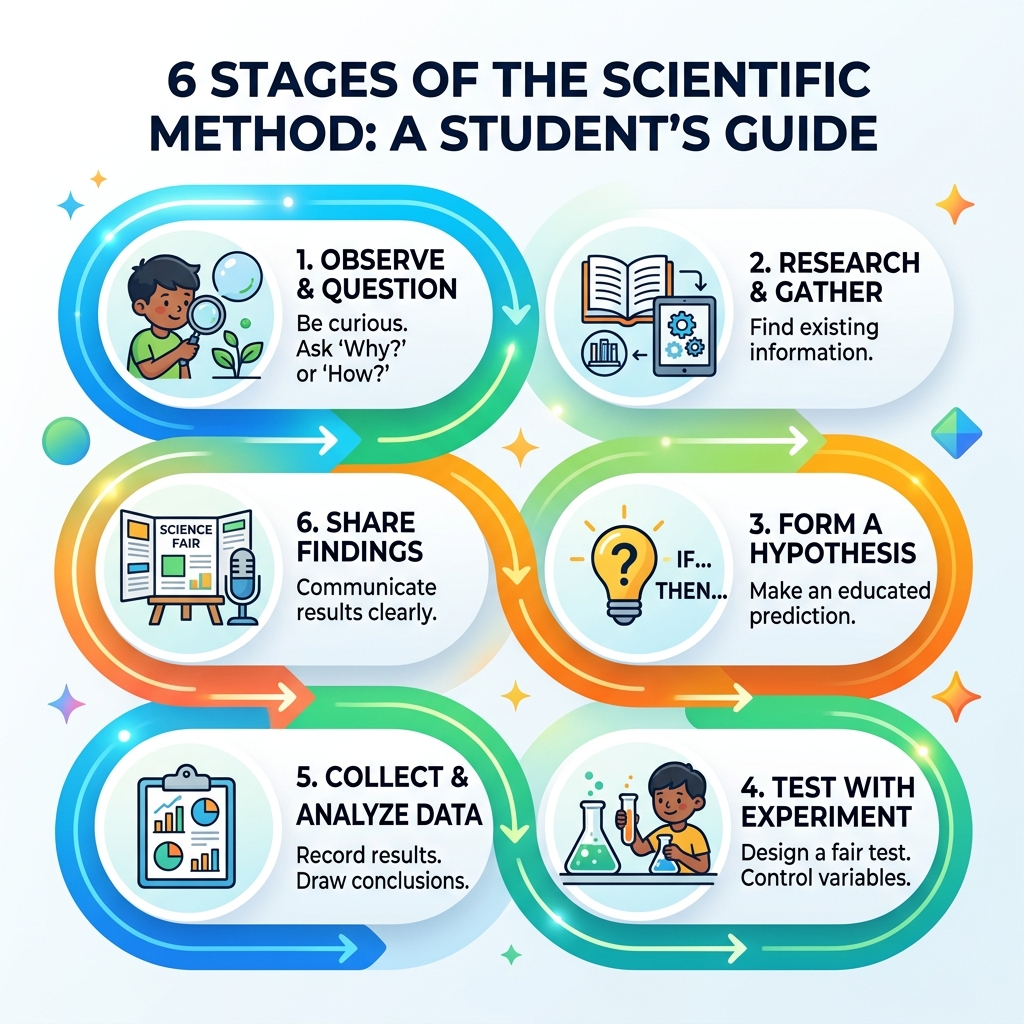
Here’s a quick overview of the core stages:
- Choose a topic – Pick something your child is genuinely curious about
- Do background research – Use libraries, trusted websites, and books
- Form a hypothesis – Make an educated “If…then…because” prediction
- Design and run the experiment – Change only one variable at a time
- Collect and analyze data – Record everything in a logbook
- Share your findings – Build a display board and practice presenting
These six stages follow what scientists call the scientific method — the same process used by forensic investigators, medical researchers, and even backyard gardeners to uncover new knowledge.
Think of it like a mystery novel. Your child starts with a question, gathers clues (data), and works toward a conclusion. The process builds critical thinking, problem-solving, and communication skills that matter long after the science fair is over.
And here’s the good news: you don’t need a science background to help your child succeed. A clear roadmap makes all the difference.
Choosing a Winning Topic and Starting Your Science Project Step by Step
The first hurdle is often the highest: “What should my project be about?” For many of us balancing solo parenting, the goal is to find a topic that is engaging but also feasible within our schedule and budget.
We suggest starting with your child’s natural interests. Does your child love baking? Look into the chemistry of yeast. Are they obsessed with video games? Explore the psychology of reaction times. The best topics come from everyday observations. As Albert Einstein once said, “The important thing is not to stop questioning. Curiosity has its own reason for existing.”
Once you have a general area, it’s time for a literature review. This sounds fancy, but it just means seeing what others have already discovered. You can use resources like Science.gov, which searches over 60 databases and 2,200 websites, to find reliable information. This background research ensures your child isn’t just “showing what they know” but is actually investigating a question. For a detailed breakdown of these initial phases, check out these Steps to prepare a Science Project.

Formulating a Testable Question
A common mistake is picking a topic that is too broad, like “Plants.” To make it a real science project step by step, you need a testable question. A great trick used by NASA JPL experts is the “Input-Output” format: “How does [input] affect [output]?”
For example:
- How does the amount of sunlight affect plant growth?
- How does water temperature affect how much salt dissolves?
By framing the question this way, you’ve already identified your variables. If you’re looking for ways to jumpstart this process at home, our guide on Sparking Curiosity: Science Experiments for Kids at Home offers plenty of inspiration for turning “Why?” into a workable project.
Developing a Strong Hypothesis
Once you have a question, your child needs to make an “educated guess” about the answer. This is the hypothesis. It’s not just a random stab in the dark; it’s based on the background research you did earlier.
The most effective way to write this is the “If… then… because…” format:
- “If plants receive more sunlight, then they will grow taller because sunlight provides energy for photosynthesis.”
This structure is perfect because it forces the student to explain the logic behind their prediction. Even for younger children, setting this foundation is vital. You can find more tips on introducing these concepts in our article First Steps in Science: Simple Experiments for Kids.
Designing a Valid Experiment: Variables, Controls, and Safety
Now we get to the “doing” part. Designing a valid experiment is about creating a “fair test.” In science, a fair test happens when you change only one factor (variable) and keep everything else the same.
Before you start, it’s helpful to know if you are doing a science project or an engineering project, as the steps differ slightly:
| Feature | Scientific Method | Engineering Design Process |
|---|---|---|
| Goal | Answer a question | Solve a problem / Create a tool |
| Starting Point | Hypothesis | Defined Need |
| Process | Experimentation | Prototyping and Testing |
| Outcome | New Knowledge | Working Invention/Solution |
For those aiming for advanced competitions, the Experimental Design for Advanced Science Projects guide provides deeper insights into statistical rigor.
Identifying Variables in Your Science Project Step by Step
To keep the experiment “fair,” you must identify three types of variables:
- Independent Variable: The one thing you change (e.g., the amount of light).
- Dependent Variable: What you measure to see the change (e.g., the height of the plant).
- Controlled Variables (Constants): Everything you keep exactly the same (e.g., the type of soil, the size of the pot, the amount of water).
You should also have a control group. This is a set of subjects that doesn’t receive the “treatment.” If you’re testing a new fertilizer, the control group gets no fertilizer. This allows you to prove that any growth was actually caused by the fertilizer and not just by the water or soil.
Safety Protocols and Required Approvals
Safety is our top priority. Always ensure an adult is supervising the experiment. If your child is entering a formal science fair, they may need prior approval from a Scientific Review Committee (SRC) or an Institutional Review Board (IRB), especially if the project involves:
- Human subjects (even just surveys!)
- Vertebrate animals
- Hazardous chemicals or biological agents
For the little ones, you can keep it safe and simple with ideas from No Lab Coat Required: Simple Science for Your 5-Year-Old. Always check your school’s specific safety rules before buying materials.
Data Collection and Analysis: From Logbooks to Statistics
A scientist is only as good as their records. One of the most important habits for a successful science project step by step is maintaining a scientific notebook or logbook.
This should be a bound notebook (not loose-leaf) where your child records everything: ideas, research notes, daily observations, and even mistakes! Every entry should be dated and signed. If a mistake is made, just draw a single line through it—never use white-out or tear out pages. This maintains the integrity of the data. For more on how the pros do it, see this guide from NASA JPL Education.
Organizing Data with Tables and Graphs
Raw numbers can be hard to read. To make sense of the results, your child should organize their data into tables immediately during the experiment. Later, these tables can be turned into colorful graphs.
- Bar Graphs: Best for comparing different groups (e.g., Brand A vs. Brand B).
- Line Graphs: Best for showing change over time (e.g., growth over 10 days).
- Pie Charts: Best for showing parts of a whole.
Visualizing data helps children spot trends they might have missed in a list of numbers. For more hands-on ways to engage with these concepts, explore our Engaging Minds: Hands-On STEM Activities at Home for Kids.
Analyzing Results with Statistical Rigor
For older students, basic averages (the mean) might not be enough. Advanced projects often require:
- Standard Deviation: This shows how spread out the numbers are. If your results are all over the place, your experiment might not be reliable.
- Percent Error: This compares your result to a known “true” value.
- Replication: You should never rely on just one trial. We recommend at least three trials for each group to ensure the results aren’t just a fluke. In plant studies, some experts suggest using at least 24 plants to get a truly representative sample!
Presenting Your Findings: Reports, Abstracts, and Display Boards
The final step is telling the world what you found. This involves three main parts: a written report, an abstract, and the display board.
The research paper should be a comprehensive document including your literature review, procedure, data, and conclusion. Use APA citations to give credit to your sources—this is a great way to teach children about academic honesty and avoiding plagiarism.
Writing an Effective Abstract
An abstract is a short summary (usually about 250 words) that lets people quickly understand what the project was about. A good four-paragraph format includes:
- Purpose: Why did you do this project?
- Methodology: How did you do it?
- Results: What did you find?
- Conclusion: What do the results mean?
Think of the abstract as the “movie trailer” for the science project. It should be punchy and informative!
Mastering the Oral Presentation for Your Science Project Step by Step
When fair day arrives, the judges will want to talk to your child. This is often the most nerve-wracking part for students, but it’s also the most rewarding.
Help your child practice their “elevator pitch.” They should be able to explain their project in two minutes or less. Encourage them to:
- Make eye contact with the judges.
- Speak clearly and confidently.
- Use the display board as a visual aid.
- Be honest. If they don’t know the answer to a question, it’s okay to say, “That’s an interesting question; I haven’t looked into that yet, but it would be a great idea for future research.”
Common Mistakes to Avoid in a Science Fair Project
Even with the best intentions, it’s easy to fall into common traps. Here are a few things to watch out for:
- Product Comparisons: Simply testing which paper towel is “the best” isn’t very scientific. It’s better to test a specific property, like “the impact of fiber density on liquid absorption.”
- Changing Multiple Variables: If you change the light and the water, you won’t know which one caused the plant to grow.
- Small Sample Size: Testing on one person or one plant doesn’t prove anything. Aim for at least three trials.
- Lack of Controls: Without a control group, you have nothing to compare your results against.
- The “Last Minute” Rush: Science takes time! Plants take weeks to grow, and crystals take days to form. Start early to avoid stress.
- Messy Displays: A board with spelling errors or crooked photos can distract from great science. Keep it neat and logical.
Frequently Asked Questions about Science Projects
What is the difference between a science project and an engineering project?
A science project asks a question about how the world works (e.g., “How does gravity affect magnets?”). An engineering project identifies a problem and builds a solution (e.g., “How can I build a bridge that holds 10 pounds?”). Both use a step-by-step process, but the goals are different.
How many trials should I perform for my experiment?
At a minimum, you should perform three trials for each group. However, for advanced or competition-level projects, more trials (10 or even 20+) provide much stronger statistical evidence.
What should I do if my results do not support my hypothesis?
Don’t panic! This is actually a very important part of science. A “failed” hypothesis is not a failed project. Judges love to see a student who can explain why the results were different than expected and what they learned from the process. Never change your data to fit your hypothesis—that is scientific fraud!
Conclusion
Guiding your child through a science project step by step is a journey of discovery for both of you. While it requires time and organization, the confidence your child gains from solving a problem on their own is priceless. At Curta Arte, we understand that as a single parent, your time is a precious commodity. Our goal is to provide the empathetic guidance you need to make these milestones manageable and fun.
Whether you are navigating the challenges of solo parenting or simply looking for ways to spark a love of learning in your home, we are here to help. For more ideas on how to bring science to life in your living room, visit our More resources for family science activities. Good luck, and have fun being a scientist!
