
Why Solo Parent Kid Games Are a Game-Changer for Single Parents
Solo parent kid games are activities and games that children can enjoy independently — or with minimal parent involvement — giving single parents a much-needed break while keeping kids happy and engaged.
Here are the best solo games for kids of single parents:
- Sensory bins (rice, beans, or textured objects) — great for toddlers, zero prep
- The 7-Up ball game — builds coordination, works indoors or outdoors
- Pillow fort building — open-ended, creative, no supplies needed
- Sidewalk chalk art and hopscotch — outdoor, screen-free, hours of fun
- Solo balloon volleyball — a ribbon net + balloon = instant solo sport
- Cup tower stacking — simple, quiet, and surprisingly absorbing
- Paper airplane challenges — fold, fly, beat their own distance record
- Backyard scavenger hunts — set it up once, kids run it solo
- Khan Academy Kids or Crash Course Kids — free, educational, self-directed
- Dance freeze — blast music, pause it, freeze — no partner needed
If you’re a single parent, you already know the feeling. The to-do list never ends. Work, meals, laundry, school runs — and somewhere in there, you’re supposed to play too.
The good news? It doesn’t have to be that hard.
The right games let kids build real skills — coordination, creativity, confidence — while you get a few minutes to breathe. Research even links solo motor play to stronger academic performance in children, so the benefits go well beyond just keeping the peace.
This list is built for exactly your situation: low prep, low cost, and designed so your child can actually do them without you hovering.
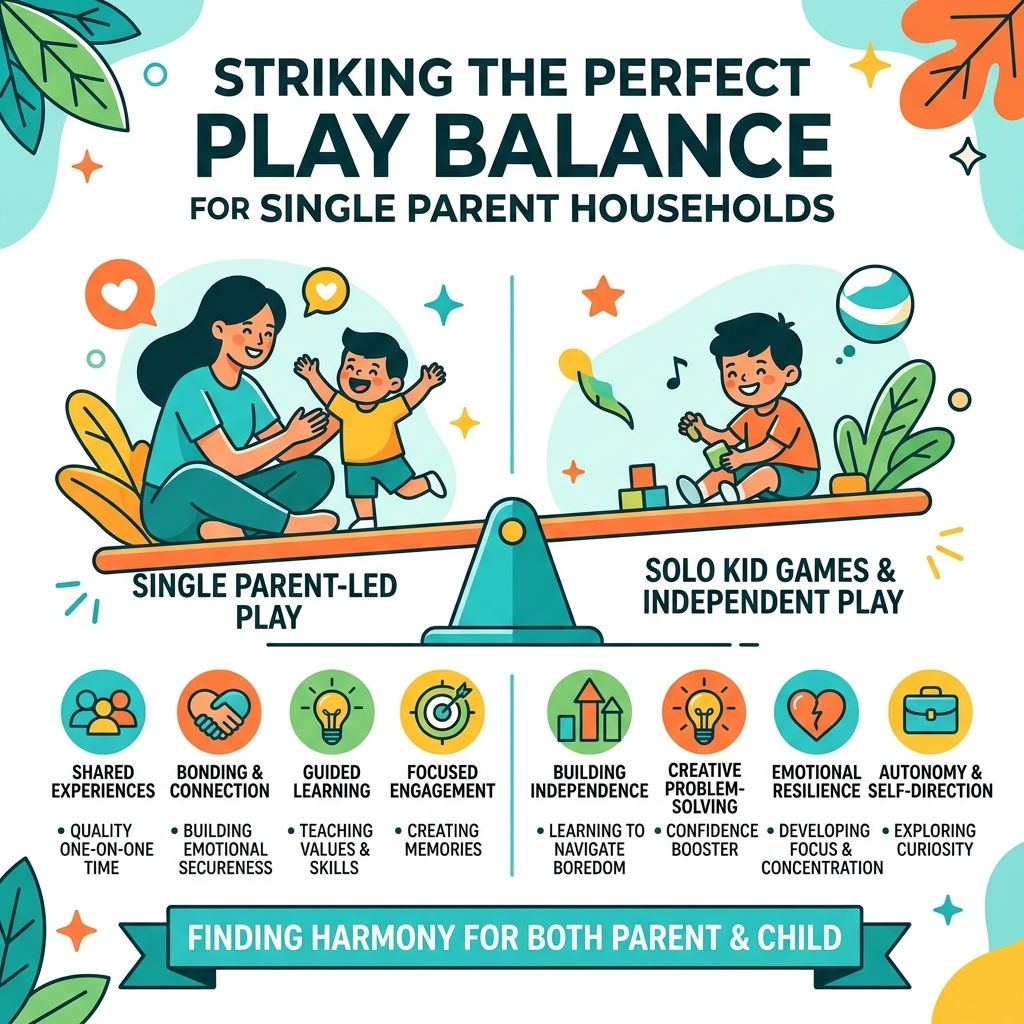
The Power of Solo Parent Kid Games for Independent Growth
As solo parents, we often feel the weight of being the “everything” person. We are the provider, the nurturer, and the primary playmate. However, encouraging independent play through solo parent kid games isn’t just about giving us a break (though we definitely need one!); it is a vital part of a child’s development.
When a child engages in play on their own, they are building emotional resilience. They learn how to navigate boredom, solve problems without immediate adult intervention, and gain a sense of autonomy. This stability and routine are especially important in single-parent households where schedules can be tight and energy levels can fluctuate.
Beyond the emotional benefits, there is a strong link between physical solo play and cognitive growth. According to research on motor coordination and academic achievement, children who develop strong hand-eye coordination and motor skills through solo activities like ball drills or building projects often see a correlation with better academic performance and cognitive function. By providing opportunities for them to practice these skills independently, we are setting them up for success in the classroom.
At Curta Arte, we believe that navigating the journey of single parenthood requires a mix of self-care and smart strategies. For more tailored guidance on managing these daily hurdles, check out our advice-for-single-parents.

Building Emotional Bonds Through Solo Parent Kid Games
It might sound counterintuitive to talk about “bonding” while discussing “solo” games, but the two go hand-in-hand. Independent play thrives when a child feels secure in their connection with us. Even if we aren’t actively moving the toy cars or building the LEGO tower, our “passive presence”—sitting nearby with a book or a cup of coffee—provides a safety net that boosts their confidence.
One way we can bridge the gap between solo play and connection is through the “Yes, and…” storytelling method. If your child is playing with stuffed animals or dolls, you can occasionally contribute a single line to their story: “Yes, and then the dragon found a secret map!” This tiny interaction validates their creativity without requiring you to take over the game.
For those with younger children, setting up simple environments for exploration can lead to hours of quiet discovery. You can find more inspiration for these early stages in our guide on indoor-adventures-creative-activities-for-toddlers.
Adapting Popular Family Games for Solo Play at Home
Many games that are traditionally played with a partner can be easily modified for a “party of one.” This is a lifesaver when you are busy with chores or simply need a moment of silence.
- Solo Balloon Volleyball: This is a classic. All you need is a piece of ribbon or painter’s tape to act as a “net” across a doorway or between two chairs. Give your child a balloon and challenge them to hit it over the net, then run to the other side to hit it back before it touches the ground. It’s high energy and keeps them moving!
- The 7-Up Game: This is a progressive ball game that builds complex skills. The child stands against a wall with a ball and completes a series of tasks: 7 times throwing and catching, 6 times bouncing against the wall and catching, 5 times bouncing on the ground, and so on. It’s a fantastic way to improve hand-eye coordination.
- Racket Drills: If you have a tennis or badminton racket, your child can practice by volleying a ball against an outdoor wall or seeing how many times they can bounce a birdie or ball upward on the racket face without dropping it.
If you have multiple children and find that solo play often turns into a squabble, you might want to look into sibling-rivalry-vs-scavenger-hunt-who-will-win-the-indoor-games to help manage the group dynamic.
15 Low-Prep Solo Games and Activities for Every Age
We know that as a single parent, “prep time” is a luxury you rarely have. These activities use items you likely already have around the house and require less than five minutes to set up.
- Laundry Basket Basketball: Give your child a pile of rolled-up socks and a laundry basket. They can practice their “pro shots” from different distances. To make it harder, have them try to toss the socks while standing on one leg!
- Sock Sliding: If you have hardwood or tile floors, spray a little bit of floor cleaner (or just water) and let your child “skate” around in their socks. It’s a fun physical activity that actually helps get the floor a little cleaner—a win-win for us!
- The Indoor Sandbox: Mix 4 cups of rice with 3 tablespoons of rubbing alcohol and a few drops of food coloring. Let it dry, and you have a mess-free “sand” for a bin. Add measuring cups, spoons, and small plastic dinosaurs or cars.
- Duct Tape Race Track: Use painter’s tape or duct tape to create a massive road system on the carpet or floor. Include parking spots, roundabouts, and “off-road” sections.
- Musical Water Glasses: Fill several glasses with varying levels of water. Give your child a spoon and let them experiment with the different pitches to create their own “symphony.”
- Pet Rock Painting: Find a few smooth stones in the yard and set out some paints or markers. This is an excellent quiet-time activity that encourages artistic expression.
- Backyard Digging Zone: If you have a yard, designate a specific “digging spot.” Provide shovels, pails, and old spoons. Kids can spend hours building “underground cities” or searching for “fossils.”
- Hula Hoop Tricks: Encourage your child to watch a few (parent-approved) videos of hula hoop tricks and then try to master them, like moving the hoop from their hips to their neck.
- Sidewalk Chalk Obstacle Course: Instead of just drawing pictures, have them draw a course that includes “jump like a frog” circles, “spin three times” squares, and “walk the tightrope” lines.
- The Three-Marker Challenge: Have your child close their eyes and pick three markers at random. They then have to create an entire drawing using only those three colors.
- Tongue Twister Practice: Write down a few classic tongue twisters and see if they can master them at high speeds.
- Card Tower Stacking: A simple deck of cards can provide a major engineering challenge for older kids.
- Stuffed Animal Theater: Have your child set up a stage using a blanket and perform a play for their “audience” of stuffed animals.
- Alphabet Scavenger Hunt: Ask them to find one item in the house that starts with every letter of the alphabet.
- Fairy Tale Writing: Give them a notebook and ask them to write a “sequel” to their favorite movie or book.
For more structured ideas, you can explore easy-indoor-scavenger-hunts-for-kids, fun-indoor-activities-for-energetic-kids, or our dedicated section on educational-games-for-toddlers.
Quick 5-Minute Solo Parent Kid Games for Busy Moments
Sometimes you don’t even have five minutes to set something up—you just need thirty seconds to get them started so you can jump on a work call or finish the dishes.
- Pillow Forts: The ultimate low-prep activity. Throw a few blankets over the couch and chairs and tell them it’s their “secret base” for reading or drawing.
- Cup Stacking: A stack of plastic solo cups can become a skyscraper, a wall, or a pyramid. It’s quiet and surprisingly addictive.
- Paper Airplanes: If they don’t know how to fold them, a quick one-minute demonstration is all it takes. Then, set a “landing strip” (a rug or a piece of tape) and see if they can land their planes on target.
For those unexpected rainy days when everyone is stuck inside, our rainy-day-rescue-with-an-easy-indoor-scavenger-hunt is a perfect quick-start guide.
Screen-Based Solutions for Tired Parents
We’ve all been there. You’re exhausted, it’s been a long day, and you just need twenty minutes of peace. While we love screen-free play, there are times when digital tools are the perfect ally for a solo parent. The key is choosing high-quality, engaging content that doesn’t require you to sit there and troubleshoot every two minutes.
- Wonzie World: This is a fantastic, family-friendly game designed for younger children (ages 3 and up). It’s cooperative and non-violent. In Wonzie World, players try to avoid “Kissies” from grandparents while building dens. It’s silly, accessible, and even has a “Kiss Shield” setting to make it easier for very young players.
- Parents vs Kids: If you have a Nintendo Switch, Parents vs Kids is a great way to gamify household chores. It features 50 mini-games that use simple motion controls. You can set “stakes” for the games—like the loser has to set the table or the winner gets to pick the movie.
- Think of the Children: For a bit of humor, Think of the Children is a parenting simulator that captures the chaotic reality of raising kids. It’s available on Nintendo Switch and other platforms, allowing for solo or cooperative play where you try to keep your virtual kids safe in ridiculous scenarios.
- Educational YouTube Channels: Channels like Crash Course Kids (science) and Art for Kids Hub (drawing tutorials) provide self-directed learning that feels like entertainment.
- Podcasts for Kids: “Little Stories for Tiny People” or STEM-focused podcasts are great for kids to listen to while having a snack or coloring. It keeps their minds busy without the “zombie” effect of some cartoons.
Safety and Routine: Making Independent Play Sustainable
The secret to successful solo play is setting boundaries. When kids know the “rules of the road,” they are less likely to interrupt you with questions and more likely to stay safe.
Setting up a daily routine that includes “Quiet Time” or “Solo Play Time” helps manage expectations. Using a visual schedule can be incredibly helpful for younger children who can’t yet tell time.
| Activity Type | Indoor Safety Rules | Outdoor Safety Rules |
|---|---|---|
| Physical Play | No running near sharp corners; use “soft” balls only. | Stay within the fenced area; wear a helmet for bikes/scooters. |
| Creative Play | Markers stay on the paper; no “painting” the furniture. | Use sidewalk chalk on pavement only; no throwing rocks. |
| Building/Digging | Keep small parts away from younger siblings. | Dig only in the designated “digging zone.” |
| Screen Time | Devices stay at the charging station when finished. | Only use devices in shaded, seated areas. |
For more tips on creating a fun environment at home, check out stay-at-home-fun-exciting-activities-for-kids and our ideas for weekend-fun-simple-activities-for-kids.
Frequently Asked Questions about Solo Parent Kid Games
How can I encourage my child to play alone without feeling guilty?
Guilt is a common feeling for solo parents, but remember: you are teaching your child a valuable life skill. Independent play fosters creativity and self-reliance. Start small—set a timer for 10 minutes of “solo time” and gradually increase it. Frame it as “Special Adventure Time” where they get to be the boss of their own world.
What are the best household items to repurpose for solo games?
You don’t need fancy toys! Cardboard boxes are the gold standard—they can be cars, houses, or space shuttles. Plastic cups, laundry baskets, old socks, and even kitchen colanders (great for “fishing” games in a water bin) are all excellent, free resources for solo parent kid games.
Are there educational apps that don’t require parent supervision?
Yes! Khan Academy Kids is a completely free, high-quality app that guides children through lessons in a way that is very easy for them to navigate solo. BrainPop and Scholastic also offer great independent printables and digital activities that keep kids learning while you focus on your own tasks.
Conclusion
Being a single parent is a marathon, not a sprint. We don’t have to be the “entertainment director” 24/7 to be amazing parents. By introducing solo parent kid games into your daily routine, you are giving your child the gift of independence and giving yourself the gift of a few moments of peace.
Whether it’s a high-energy game of solo balloon volleyball or a quiet afternoon with a sensory bin, these activities build the skills and resilience our children need to thrive. At Curta Arte, we are here to support you with the resources and empathy you need to navigate this journey with confidence.
Ready for more ideas? Explore our full library of more fun activities for kids and start building those joyful memories today!
