
Why Co-Parenting Communication Makes or Breaks Your Child’s Well-Being
Co-parenting communication is the ongoing exchange of information, decisions, and logistics between separated or divorced parents — and how well you do it has a direct impact on your child’s mental health, stability, and long-term development.
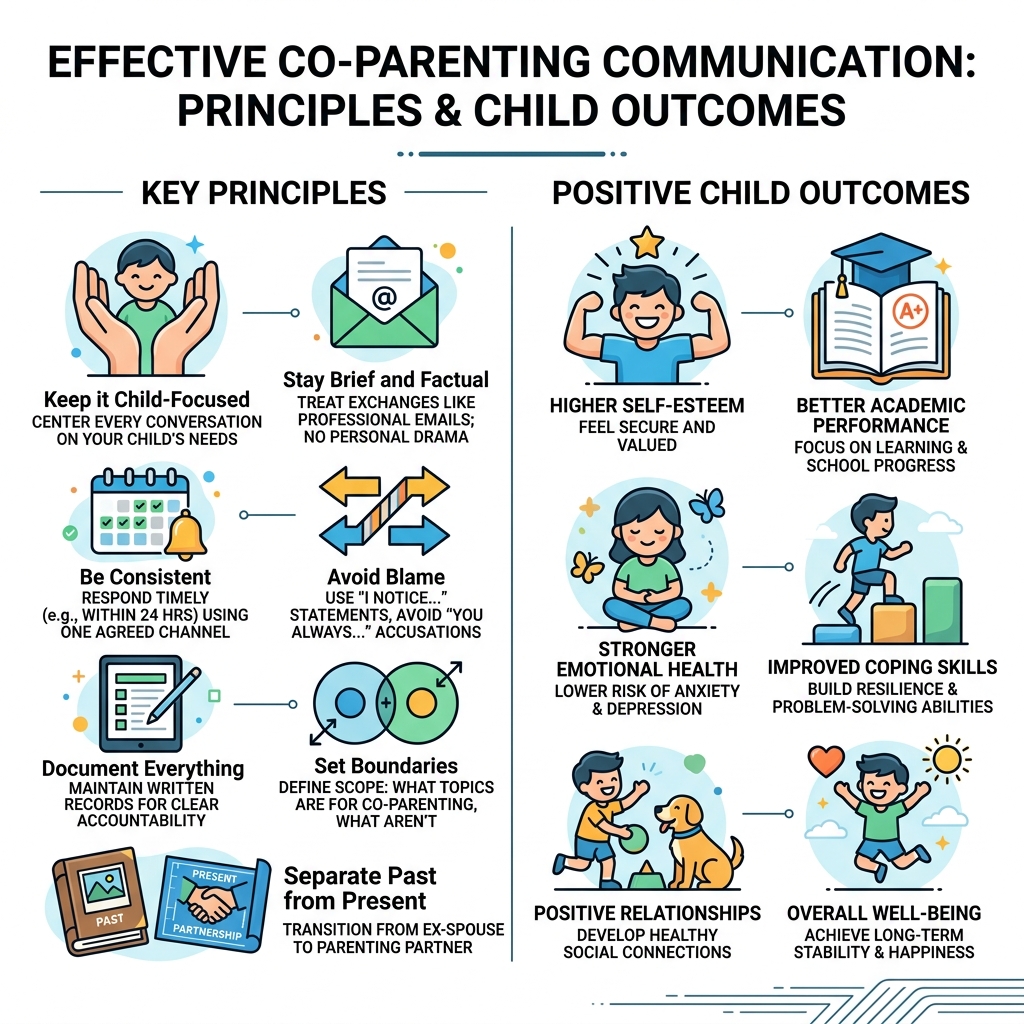
Here are the key principles for effective co-parenting communication:
- Keep it child-focused — every message, call, or decision should center on your child’s needs
- Stay brief and factual — treat exchanges like professional emails, not personal conversations
- Be consistent — respond within 24 hours and use one agreed-upon communication channel
- Avoid blame — use “I notice…” instead of “You always…”
- Document everything — written communication creates a clear, accountable record
- Set boundaries — define what topics are in scope and what aren’t
- Separate the past from the present — your co-parent is now a parenting partner, not a former spouse you’re in conflict with
Here’s the hard truth: poor communication doesn’t end when a relationship does.
A study of 886 divorcing parents in Hennepin County, Minnesota found that 53% cited “not able to talk together” as a primary reason for their divorce. Yet after separation, those same parents are legally required to keep talking — about school, medical care, schedules, and more — often for 18 years or longer.
That’s a painful contradiction. And it’s one millions of parents face every day.
Research consistently shows that parental conflict is the strongest predictor of a child’s long-term well-being after divorce — stronger than custody arrangements or finances. Children exposed to ongoing parental conflict are at higher risk of anxiety, depression, and behavioral problems. But when parents communicate well, children show higher self-esteem, better academic performance, and stronger emotional health.
The good news? Co-parenting communication is a skill — and skills can be learned.
This guide gives you practical frameworks, real templates, and the right tools to make those conversations less draining and more effective — for your sake and your child’s.
What is Co-Parenting and Why Communication Matters?
At its core, co-parenting is a legal and personal arrangement where two parents who are no longer in a romantic relationship share the responsibility of raising their children. It means being parenting partners, even if you are no longer life partners. While the romantic chapter has closed, the parenting chapter remains wide open, requiring a foundation of mutual respect and shared decision-making.
In many jurisdictions, court orders for shared parental rights specifically require parents to communicate regarding the child’s welfare, education, medical needs, and religious upbringing. This isn’t just a suggestion; it’s often a legal mandate. For more on the fundamentals, check out this Co-Parenting 101: Effective Communication guide.
Why is this so critical? Because when co parenting communication breaks down, the children are the ones who pay the price. One of the most common reasons for divorce is “conflict and arguing,” and if that behavior continues post-split, it creates an environment of toxic stress for the child. Ongoing parental conflict is considered an Adverse Childhood Experience (ACE), which can lead to long-term trauma.
By prioritizing healthy communication, we aren’t just making our own lives easier (though that’s a nice bonus); we are actively protecting our children’s mental health. We are providing them with a sense of safety and predictability. When children see their parents working together—or at least interacting civilly—it reduces their anxiety and allows them to focus on just being kids. If you’re currently navigating these waters solo, our advice-for-single-parents can provide further support.
The Business Partnership Model for Co-Parenting
If you find it impossible to talk to your ex without bringing up the time they forgot your anniversary or that annoying thing they do with their teeth, it’s time for a reframe. We like to call this the “Business Partnership Model.”
Imagine you and your ex are co-CEOs of a small but very important startup: “Your Child, Inc.” In a professional business setting, you wouldn’t yell at a colleague about their past dating habits during a budget meeting. You would stick to the facts, stay polite, and focus on the goal.
Reframing the Relationship
The romantic relationship is dead. Long live the parenting partnership! By treating co parenting communication as a professional interaction, you create emotional distance. This detachment is your superpower. It allows you to receive a frustrating text and think, “How would I respond to a difficult client?” rather than “How do I win this argument?”
Factual Interactions
Keep your interactions focused on logistics. If you need to discuss a soccer schedule, don’t mention how the other parent was always late when you were married. Stick to the time, the place, and the equipment needed. We’ve found that a “B-minus solution” that both parents agree on is often better for the child than an “A-plus solution” that only one parent wants. Compromise is the currency of the business world, and it should be the currency of your co-parenting world, too.

When we communicate this way, we also model healthy conflict resolution for our kids. For more tips on how to translate these adult skills into kid-friendly interactions, see our guide on tips-for-effective-communication-with-kids.
Setting Boundaries in Co-Parenting Communication
Boundaries are the guardrails that keep your “parenting business” from veering off a cliff. Without them, communication can become intrusive, overwhelming, and a source of constant stress.
- Privacy Guardrails: You no longer have the right to know who your ex is dating, how they spend their money, or what they do on their “off” time—unless it directly affects the safety of the child.
- Cooling-Off Protocols: Never respond to a triggering message immediately. We recommend a “two-hour rule” or even waiting overnight for non-emergencies. This prevents “keyboard courage” from turning a simple question into a flame war.
- Response Time Expectations: Agree on a standard response time. For example, non-urgent emails should be acknowledged within 24 hours.
- Limiting Channels: If texting leads to too much “he-said-she-said,” move all communication to email or a dedicated app. This creates a clear paper trail and prevents your personal phone from buzzing with stressors while you’re at work.
Managing these boundaries is essential for your own sanity, especially when trying to figure out how-to-balance-work-and-parenting.
High-Conflict Strategies and Parallel Parenting
Sometimes, despite our best efforts, the “Business Partnership” feels more like a hostile takeover. In high-conflict situations or cases involving domestic violence nuances, traditional co-parenting might not be safe or possible. This is where parallel parenting comes in.
Parallel parenting is a method where each parent has their own parenting style and rules in their own home, with very little direct contact between the two. Communication is strictly limited to essential information (medical, school, emergencies) and is almost always done in writing.
The goal here is disengagement. By minimizing contact, you minimize the opportunities for conflict, shielding the children from the tension. It’s about creating two separate, stable worlds for the child rather than one shared world. If you’re in this boat, you might find our second part on how-to-balance-work-and-parenting-2 helpful for managing the logistical load.
Mastering Healthy co parenting communication with the BIFF Method
One of the most effective tools in the co parenting communication toolkit is the BIFF method, developed by Bill Eddy. It stands for Brief, Informative, Friendly, and Firm. This method is designed specifically to de-escalate conflict and stop the “ping-pong” of angry messages.
- Brief: Keep it to 2-5 sentences. The more you write, the more “hooks” you provide for the other person to snag onto and start an argument.
- Informative: Stick to the facts. No opinions, no “you should have,” no “I can’t believe you.”
- Friendly: This doesn’t mean “warm and fuzzy.” It means neutral and civil. “Thanks for the update” or “I hope you have a good weekend” is enough.
- Firm: Set clear boundaries or provide a clear “yes” or “no” so the conversation can end.
The BIFF Comparison Table
| Scenario | Reactive Response (Avoid This!) | BIFF Response (Do This!) |
|---|---|---|
| Late Pickup | “You are always late and you have no respect for my time. The kids were crying because they thought you forgot them again.” | “I noticed you arrived at 6:15 instead of 6:00. Please let me know via text if you’ll be more than 15 minutes late in the future. Thanks.” |
| New Activity | “I’m signing Chloe up for soccer. You never take her to her things anyway, so I’ll just handle the fees.” | “Chloe wants to play soccer this spring. Practices are Tuesdays at 5 PM. Are you able to handle transportation on your days? Please let me know by Friday.” |
| Schedule Change | “No, you can’t have her on Friday. You missed your last visit and you’re just trying to ruin my plans.” | “I can’t accommodate the change for this Friday as we have existing plans. We can stick to the court-ordered schedule. Thanks for asking.” |
By using BIFF, you avoid the “he-said-she-said” trap and keep the focus exactly where it belongs: on the logistics of raising your child.
Guidelines for Healthy co parenting communication
Beyond BIFF, we follow two core philosophies: the ACT Principle and the Golden Rule.
The ACT Principle stands for providing information that is:
- Accurate: Don’t guess on times or dates.
- Complete: Give all the details (e.g., if there’s a birthday party, include the address and the gift suggestion).
- Timely: Don’t wait until the night before to mention a school project.
The Golden Rule of co-parenting is simple: Provide the information you would want to receive. If you would be upset finding out about a doctor’s appointment after the fact, make sure you notify the other parent beforehand.
Active listening is also vital. This means repeating back what you heard to ensure there are no miscommunications. “So, to clarify, you’re saying you’ll pick up Sam from school on Wednesday because of the early release? Correct.”
Avoiding Common Mistakes and Using Proven Templates
Even with the best intentions, we all slip up. Here are the “Big Three” mistakes to avoid in co parenting communication:
- Unilateral Decision-Making: Making major choices (schooling, medical, religion) without consulting the other parent. This is a fast track to court and high resentment.
- Using Children as Messengers: “Tell your Dad he owes me child support” is a form of parentification that puts an adult burden on a child’s shoulders.
- Trash-Talking: Disparaging the other parent in front of the kids. Research shows that children view themselves as half of each parent. When you attack the other parent, the child feels like you are attacking them.
The Child News Report
To keep communication factual and organized, many parents use a “Child News Report.” This can be a notebook that travels in the child’s backpack or a weekly email. It includes:
- Medical: Any medications given, sleep patterns, or bumps/bruises.
- School: Homework due, upcoming tests, or school events.
- Social: Playdates or birthday parties.
- Home Life: A positive anecdote (“Jamie finally lost his front tooth!”).
Templates for Common Scenarios
Proposing a Schedule Change: “Hi [Name], I have a work conflict on [Date] and would like to request a swap. Could I have the kids on [Alternative Date] instead? Please let me know if this works for you by [Time/Date]. Thanks!”
Addressing a Concern: “I notice that [Child] has been coming home without her inhaler lately. I’d like to problem-solve how we can make sure it stays in her bag during transitions. Do you have any ideas on what might help?”
Expense Reimbursement: “Attached is the receipt for [Child]’s new glasses ($150). Per our agreement, your 50% share is $75. You can send this via [App] at your convenience. Thank you.”
Effective co parenting communication: What to Say Instead
The language we use can either build a bridge or burn one. Small shifts in phrasing can drastically reduce the defensiveness of the other parent.
- Instead of: “You always forget the cleats.”
- Try: “I noticed the cleats didn’t make it back this time. Can we double-check the bag before the next transition?”
- Instead of: “You need to pay me back now.”
- Try: “I’ve uploaded the receipt for the school fees. Please let me know when you’ve had a chance to look at it.”
Focus on being proactive rather than reactive. Share “good news” occasionally! Telling the other parent that their child did something funny or reached a milestone helps build goodwill. And when you make a mistake (because we all do), a simple “I’m sorry, I missed that email, I’ll get back to you now” goes a long way.
For those tricky times of year, our guide on how-to-master-your-holiday-co-parenting-calendar offers specific scripts for seasonal stressors.
Digital Tools and Handling Real-World Scenarios
Co parenting communication doesn’t have to happen face-to-face or even over the phone. In fact, for many, it shouldn’t. Digital tools provide a buffer and a record.
Real-World Scenarios
- Medical Emergencies: Notify the other parent within 2 hours. Include the hospital name, the doctor’s name, and the current status.
- School Issues: Both parents should have their own login to school portals. Don’t rely on the other parent to “forward” the report card.
- Shared Expenses: Use a digital tracker. This avoids the “I paid for the pizza last month” arguments.
Best Apps for co parenting communication
There are several industry-leading apps designed specifically to handle the “business” of co-parenting. These tools are often court-approved and provide unalterable records, which means no one can delete a message once it’s sent.
- Shared Calendars: Color-code events so everyone knows who is where and when.
- Secure Messaging: Keeps all talk in one place, separate from your personal texts.
- Expense Tracking: Upload receipts and settle balances directly.
- Info Library: Store insurance cards, school IDs, and emergency contacts.
When to Seek Professional Support
Sometimes, even the best apps and the BIFF method aren’t enough. It’s important to recognize when you need outside help.
Signs you should seek professional support:
- Persistent Escalation: Every conversation, no matter how small, turns into a fight.
- Stalled Decisions: You cannot agree on major issues like medical care or schooling.
- Child Distress: Your child is showing signs of aggression, academic decline, or extreme anxiety.
- Safety Concerns: There is a history of domestic violence or substance abuse.
Professional help can take many forms. Co-parenting therapy focuses specifically on the parenting partnership (not the past relationship). Parenting coordinators are often court-appointed individuals who help make tie-breaking decisions. Mediation can help you rewrite a parenting plan that isn’t working.
Research on Scientific research on parental conflict and child adjustment highlights that the sooner you intervene in high-conflict patterns, the better the outcome for the children.
Frequently Asked Questions about Co-Parenting
What if my co-parent refuses to communicate respectfully?
You cannot control their behavior, but you can control your response. Stick rigidly to the BIFF method and the Business Partnership model. If they send a three-paragraph rant, respond only to the one sentence that involves the child. “I see you’re frustrated. Regarding the pickup on Friday, 5 PM works for me. Thanks.” Consistency on your part often starves the conflict of oxygen over time.
Is it better to communicate via text or email?
For non-emergencies, email is generally better. It allows for more thoughtful, less reactive responses. Texting should be reserved for urgent logistics (“I’m stuck in traffic, will be 10 mins late”). For high-conflict situations, a dedicated co-parenting app is the gold standard because it provides a permanent, timestamped record.
How do we handle disagreements about parenting styles?
Accept that there will be “House Rules A” and “House Rules B.” Unless the child’s safety is at risk, you generally cannot control what happens at the other parent’s house. Focus on the major household rules (bedtime, screen time) and try to find common ground. If there’s a major deadlock on a life-altering decision, seek mediation.
Conclusion
At Curta Arte, we know that co parenting communication is a marathon, not a sprint. It requires vigilance, persistence, and an incredible amount of patience. There will be days when it feels impossible, but remember: you are doing this for your child’s future.
By adopting a professional mindset, using tools like the BIFF method, and setting firm boundaries, you are creating a stable environment where your child can thrive. It’s not about “winning” the divorce; it’s about winning at parenthood.
For more empathetic guidance and practical resources, explore our other parenting tips and resources. We’re here to support you every step of the way.
