
Why Easy Experiments for 4 Year Olds Are Worth Every Minute
Easy experiments for 4 year olds don’t need a lab, a big budget, or hours of prep. Here are some of the best ones you can do right now with things already in your kitchen:
- Muffin tin volcanoes – add food coloring and baking soda to each cup, then drizzle vinegar to fizz and mix colors
- Sink or float – fill a bowl with water and test random household objects
- Walking water rainbow – connect cups of colored water with folded paper towels and watch colors travel
- Color mixing with milk – add drops of food coloring to milk, touch with a dish soap-dipped cotton swab
- Oobleck – mix cornstarch and water for a liquid that acts like a solid
- Oil and water lava lamp – drop an Alka-Seltzer tablet into a bottle of oil and colored water
- Skittles rainbow – arrange Skittles in a circle on a plate, pour warm water in the center, and watch
Parenting alone is a lot. Some days the last thing you have energy for is setting up an activity – but these experiments take under 10 minutes to prep and keep little ones genuinely engaged.
Four-year-olds are natural scientists. They want to mix things, test things, and ask “what happens if?” constantly. One parent on Reddit described it perfectly: their 4-year-old kept requesting “science experiments,” which basically meant mixing random stuff together to see what happened.
That instinct? It’s worth encouraging. Early hands-on science builds observation skills, problem-solving habits, and curiosity that lasts. And the best part – it’s screen-free, sibling-safe, and surprisingly low mess when done right.
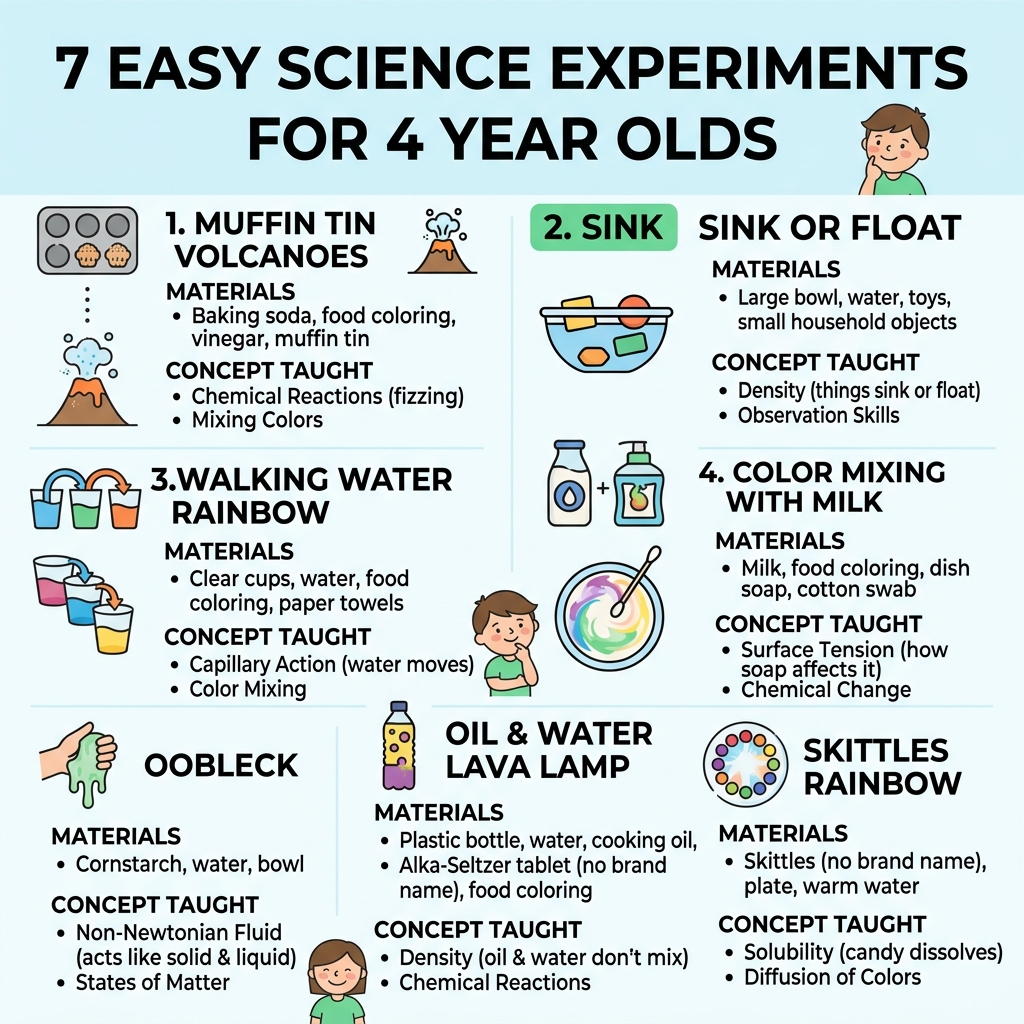
Easy experiments for 4 year olds vocab explained:
The Benefits of Early STEM Exploration
When we think of STEM (Science, Technology, Engineering, and Math), we might picture complex equations or high-tech labs. But for a 4-year-old, STEM is simply a way of interacting with the world. At Curta Arte, we believe that introducing these concepts early isn’t about raising the next Einstein—though that would be a fun bonus!—it’s about giving our children the tools to understand their environment.
Cognitive development hits a massive growth spurt at age four. By engaging in Sparking Curiosity: Science Experiments for Kids at Home, children begin to categorize information and recognize patterns. They aren’t just watching bubbles; they are learning that “Action A” leads to “Result B.”
These activities also provide a fantastic workout for fine motor skills. Using a pipette to drop vinegar into baking soda or carefully pouring water into a narrow glass requires hand-eye coordination and precision. Furthermore, science is inherently sensory. Whether it’s the squish of Oobleck or the fizzing sound of a chemical reaction, sensory play helps kids process information through multiple “data points” in their brain.
Beyond the physical, science builds early literacy. When we ask our kids to describe what they see, we are expanding their vocabulary with words like dissolve, reaction, liquid, and solid. In a world filled with digital distractions, these screen-free resources offer a tactile, grounded way to bond as a family.
Why Easy Experiments for 4 Year Olds Build Early STEM Skills
At this age, the “Scientific Method” isn’t a chart on a wall; it’s a mindset. We can help our children develop this by focusing on four key pillars:
- Observation: Looking closely at details. Is the water blue? Is the rock heavy?
- Prediction: Asking “What do you think will happen?” before we start. This encourages kids to use their existing knowledge to guess a future outcome.
- Cause-and-Effect: This is the “Why.” Why did the milk move? Why did the egg sink?
- Resilience: Sometimes, the experiment doesn’t work. Maybe the “walking water” didn’t walk fast enough, or the volcano didn’t erupt. Learning that a “wrong” guess is just a step toward a “right” answer is a vital life skill.
By Engaging Minds: Hands-On STEM Activities at Home for Kids, we are showing our children that it’s okay to be curious and even better to be wrong. Scientific vocabulary becomes a natural part of their “toddler tech” toolkit, turning everyday play into a foundation for future learning.
Top 7 Easy Experiments for 4 Year Olds Using Household Items
You don’t need a PhD or a closet full of specialized equipment to be a “science parent.” Most of the best easy experiments for 4 year olds rely on pantry staples like baking soda, vinegar, and food coloring.
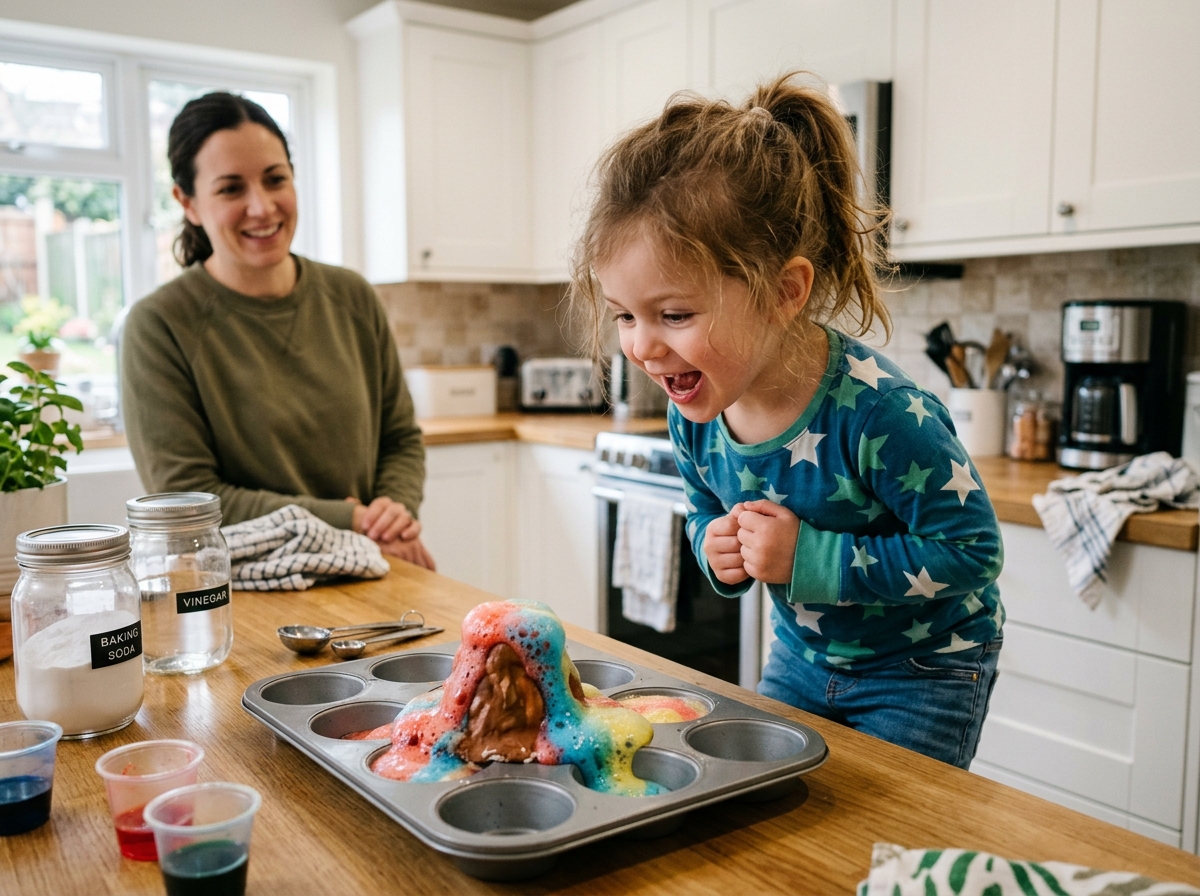
One of our absolute favorites is the Muffin Tin Volcano. It’s contained, colorful, and endlessly repeatable.
- The Setup: Place a drop of food coloring in each well of a muffin tin. Cover the coloring with a spoonful of baking soda.
- The Action: Give your child a small cup of vinegar and a spoon or pipette.
- The Lesson: As they drop the vinegar in, the hidden colors “erupt.” This teaches chemical reactions (acid + base = gas) and color mixing as the fizz overflows into neighboring wells.
Another classic is the Sink or Float Experiment. This is perfect for those “I need to make dinner” moments because it can be done right at the kitchen sink or in a plastic tub on the floor.
| Item | Prediction | Result | Why? |
|---|---|---|---|
| Metal Spoon | Sink | Sink | High density |
| Plastic Toy | Float | Float | Low density/Buoyancy |
| Apple | Float | Float | Internal air pockets |
| Penny | Sink | Sink | Heavy for its size |
| Cork | Float | Float | Very light/Porous |
This simple activity introduces Density (how tightly packed the molecules are) and Buoyancy (the upward force of the water). You can even extend this by trying to make a piece of aluminum foil sink (crumpled into a tight ball) versus float (shaped like a boat).
Setting Up Easy Experiments for 4 Year Olds: The Walking Water Rainbow
If you want a “Wow” moment that requires almost zero effort from you, the Walking Water Rainbow is it. This experiment demonstrates capillary action, which is how plants pull water from the ground up into their leaves.
- Line up glasses: Use 5 or 7 clear glasses in a row.
- Fill and Color: Fill every other glass with water. Add red to the first, yellow to the third, and blue to the fifth.
- The Bridges: Fold paper towels into long strips. Place one end in a colored water glass and the other in an empty glass.
- Wait and Watch: Over the next 30 to 60 minutes, the water will “walk” up the paper towel and into the empty glasses.
This is a beautiful way to see Cohesion (water molecules sticking to each other) and Adhesion (water molecules sticking to the paper towel fibers). Plus, as the primary colors meet in the empty glasses, they create secondary colors like orange, green, and purple. For more foundational ideas, check out First Steps in Science: Simple Experiments for Kids.
Mess-Free Color Mixing for 4 Year Olds
We know the word “mess-free” is music to a single parent’s ears. Two of the best ways to explore color without staining your carpets are Skittles Diffusion and Magic Milk.
For Skittles Diffusion, simply arrange the candies in a circle on a white plate. Pour a little warm water into the center until it touches the candies. In about 27 seconds, the sugar and food coloring will begin to dissolve and move toward the center, creating a stunning rainbow. It’s a great lesson in how molecules move from areas of high concentration to low concentration.
Magic Milk is another winner. Pour a thin layer of milk into a shallow dish. Add a few drops of food coloring. Dip a cotton swab in dish soap and touch the center of the milk. The colors will suddenly “dance” away from the swab. This happens because the soap breaks the surface tension of the milk and attaches to the fat molecules, sending the food coloring on a wild ride.
Quick 5-Minute Science for Busy Single Parents
When you’re flying solo, you don’t always have an hour for a project. Sometimes you just need 5 minutes of “toddler tech” to change the mood of the afternoon.
Lava Lamps are a fantastic spontaneous activity. Fill a clear bottle 3/4 with vegetable oil and the rest with water. Add food coloring (it will sink through the oil into the water). Drop in half an Alka-Seltzer tablet. The bubbles of CO2 will carry the colored water up through the oil, creating a temporary lava lamp effect. It’s a great way to talk about how oil and water don’t mix!
Then there is the legendary Oobleck. Named after a Dr. Seuss book, this is a “Non-Newtonian fluid.”
- Recipe: Mix 2 parts cornstarch to 1 part water.
- The Magic: If you poke it quickly, it feels like a solid. If you rest your hand on it, you sink like it’s a liquid.
- The Extension: Once the science talk is over, it becomes an art project. Add some plastic dinosaurs or cars and let it be a sensory bin.
For more quick ideas, explore Engaging Minds: Hands-On STEM Activities at Home for Kids 2. You can even transition these experiments into crafts, like making homemade playdough or “potion” mixing with leftover baking soda and vinegar.
Safety First: Tips for Taste-Safe and Sibling-Friendly Fun
Safety is our top priority, especially when you have a 4-year-old and perhaps a younger toddler running around.
- Taste-Safe Ingredients: Stick to food-grade items. Vinegar, baking soda, cornstarch, and sugar are generally safe if a curious toddler takes a tiny lick (though vinegar won’t taste very good!).
- Supervision is Key: Never leave kids alone with small objects like marbles or Alka-Seltzer tablets, which are major choking hazards.
- Staining Prevention: Food coloring is fun but can be a nightmare for furniture. We recommend doing these activities on a plastic tray, inside a large storage bin, or even outside on the grass.
- Cleanup Hacks: Keep a roll of paper towels and a damp cloth nearby before you start. If you’re doing something particularly messy like Oobleck, doing it in the kitchen sink or the bathtub makes cleanup as easy as turning on the faucet.
For those managing multiple age groups, check out First Steps in Science: Simple Experiments for Kids 2 for tips on how to adapt these for younger siblings. For example, while the 4-year-old does the measuring, a 2-year-old can be in charge of the “stirring” or simply splashing in plain water.
Frequently Asked Questions about Preschool Science
What are the best taste-safe experiments for toddlers?
Experiments using kitchen staples are best. Oobleck (cornstarch and water), Sink or Float (with large, waterproof toys), and Color Mixing with plain water and food coloring are all great options. Even the Baking Soda Volcano is taste-safe, though the vinegar will likely deter any repeat tasters!
How do I explain complex concepts like density to a 4-year-old?
Keep it simple and relatable. Instead of “molecular density,” use the “crowded room” analogy. Explain that in some objects (like a rock), the tiny pieces inside are very crowded and heavy, so they sink. In others (like a cork), the pieces have lots of space to move around, so they stay on top of the water.
What common household items do I need for a quick science setup?
You can do about 90% of preschool science with just these five things:
- Baking soda
- White vinegar
- Food coloring
- Dish soap
- Cornstarch
Conclusion
At Curta Arte, we know that being a single parent means wearing many hats—chef, chauffeur, referee, and now, scientist. But you don’t need a fancy lab to spark wonder in your child’s eyes. These easy experiments for 4 year olds are about more than just fizz and bubbles; they are about building a bond through discovery.
Aria James and our team are dedicated to providing you with the resources you need to navigate these years with confidence and a little bit of fun. Whether you’re dealing with the aftermath of a divorce or choosing to parent solo, curiosity is a gift you can give your child every single day.
Ready for more? Dive into Sparking Curiosity: Science Experiments for Kids at Home 2 or Explore more fun activities for kids to keep the “toddler tech” momentum going!
Easy Sink or Float Experiment For Kids – Little Bins for Little Hands Sink or Float Experiment for Toddlers and Preschoolers – Happy Hooligans Colorful Water Play Experiment for Preschoolers – Hands On As We Grow® Walking Water – EASY Capillary Action Science Experiment for Kids Walking Water Experiment – Little Bins for Little Hands Easy Rainbow Walking Water Experiment For Kids – Made In A Pinch
