
Why Co-Parenting Schedule Ideas Matter More Than You Think
Co-parenting schedule ideas are something most separated parents need fast — so here are the most common options at a glance:
| Schedule Type | Time Split | Best For |
|---|---|---|
| 2-2-3 Rotation | 50/50 | Young children, close-proximity parents |
| Week-On/Week-Off | 50/50 | School-age kids, simpler logistics |
| 2-2-5-5 | 50/50 | Parents needing longer blocks |
| 3-4-4-3 | 50/50 | Balanced stays, moderate transitions |
| Every Other Weekend + Weeknight | 70/30 or 80/20 | Long-distance or demanding work schedules |
| 5-2 Schedule | 70/30 | One parent with weekdays, one with weekends |
| Extended Weekend (Thu–Mon) | 60/40 | Parents wanting longer weekend blocks |
Figuring out a custody schedule after a separation is genuinely hard. You’re already emotionally stretched thin — and now you have to map out exactly when your child will sleep under which roof, for the next several years.
The good news: you don’t have to build this from scratch.
There are well-established schedule patterns that thousands of families use every day. Some prioritize equal time. Others prioritize stability. The right one depends on your child’s age, how far apart you live, and how well you and your co-parent can communicate.
Research consistently shows that children do best when they have predictable, dependable routines and regular contact with both parents — not necessarily equal time, but enough time with each parent to feel secure and loved.
This guide walks through the most practical co-parenting schedule ideas, organized by time split, child age, and real-life logistics — so you can find what actually fits your family.
Understanding Common Co-Parenting Schedule Ideas
When we talk about co parenting schedule ideas, we are essentially looking at how “residential time” is divided. This refers to where the child physically sleeps and lives. While “legal custody” covers who makes big decisions (like school or doctors), the “parenting plan” or schedule dictates the day-to-day rhythm.
The most frequent splits we see are 50/50, 60/40, and 70/30. A 70/30 custody schedule usually involves one parent having the child for about 260 overnights a year, while the other has 104. In a 14-day block, a 60/40 split typically allocates 8 days to one parent and 6 to the other. For those just starting out, advice-for-single-parents can help navigate the emotional weight of these numbers.
It is important to remember that “joint custody” doesn’t always mean a perfect 50/50 split of minutes and seconds. It means both parents remain significantly involved. You can find more Examples of Joint Custody Schedules to see how these look on a calendar.
When to Choose a 50/50 Split
A 50/50 schedule is often considered the “gold standard” for child well-being because it allows the child to spend substantial, meaningful time living with both parents. However, we’ve found that these schedules work best when specific stars align:
- Proximity: You should live fairly close to each other (ideally within 15–20 minutes) to make school runs and extracurriculars manageable.
- Communication: You don’t have to be best friends, but you must be able to share information about homework, health, and moods without a fight.
- Child Adaptability: Some children thrive on change; others find “living out of a suitcase” stressful.
- Commitment: Both parents must prioritize the child’s best interest over their own convenience.
When these factors are present, 50/50 splits offer incredible opportunities for parenting-tips-for-family-bonding in both households.
When 70/30 or 80/20 Schedules Work Best
Sometimes, equal time just isn’t practical. We often see 70/30 or 80/20 schedules (where one parent has the child 11 out of every 14 nights) used when:
- Work Travel: One parent has a job that requires frequent trips or unpredictable “on-call” hours.
- Long Distance: If parents live in different cities, a “primary residence” during the school week is usually necessary.
- Logistical Constraints: If one parent lives an hour away from the child’s school, a midweek 50/50 swap can be exhausting for the student.
In these cases, the parent with less time should focus on quality over quantity. If you’re struggling to manage a demanding career alongside these shifts, check out our guide on how-to-balance-work-and-parenting.
Age-Appropriate Co-Parenting Schedule Ideas for Every Stage
A schedule that works for a 16-year-old would likely be a disaster for a 6-month-old. Children’s developmental needs change rapidly, and your co parenting schedule ideas must evolve with them.
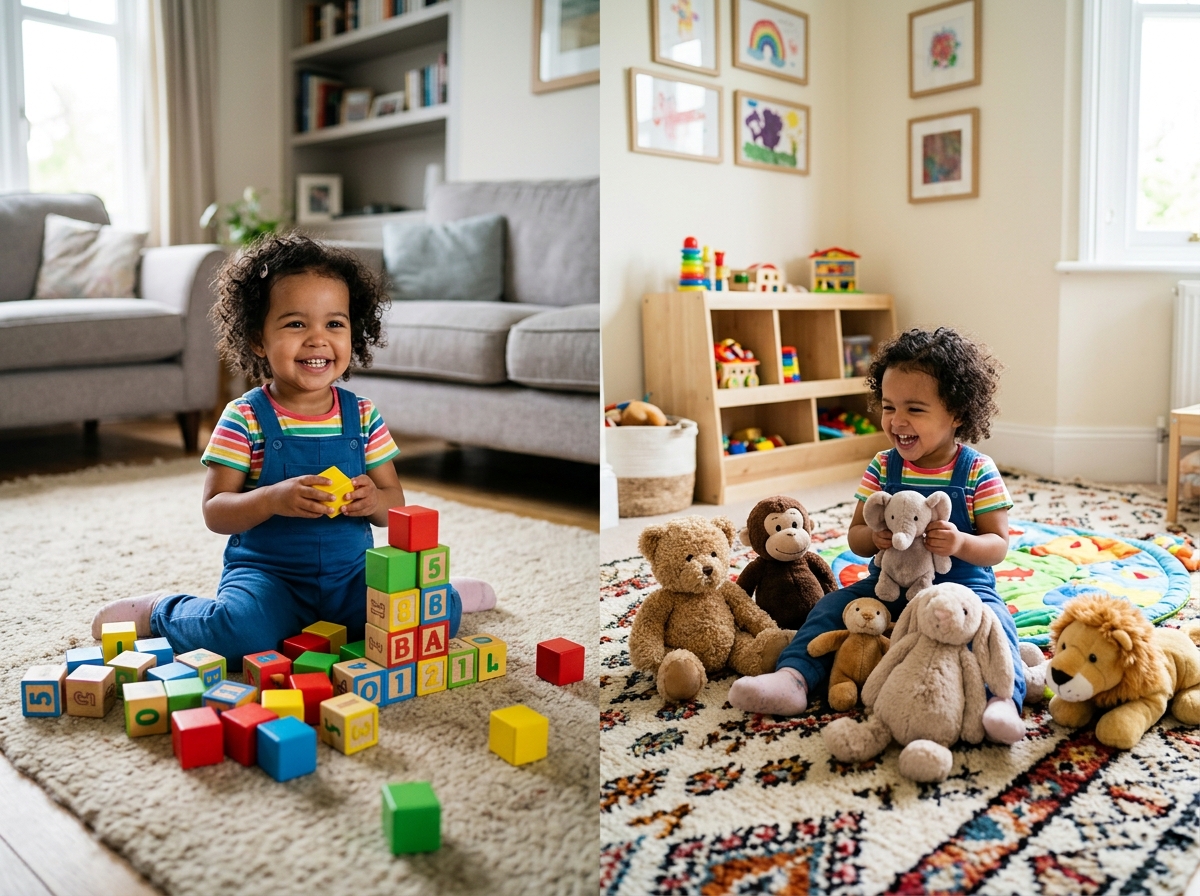
Consistency is the heartbeat of a child’s security. However, “consistency” looks different at every stage of parenting-tips-for-childrens-development.
Infants and Toddlers (Birth to 3 Years)
For the tiniest humans, attachment security is everything. Infants and toddlers have a very short sense of time. If they don’t see a parent for a week, they can lose that sense of immediate connection.
- Frequent Contact: Instead of long weekends, aim for three periods of 3–6 hours spaced throughout the week.
- Short Visits: Build bonding without overwhelming the child’s routine.
- The 4-Day Rule: For children aged 24–36 months, ideal plans limit separation from either parent to no more than 4 days.
Introducing overnights should be done gradually, starting around 12–24 months. For more specific help with this age group, read our advice-for-raising-toddlers.
Preschool and School-Age Children
By the time children reach preschool (3–5 years), they are starting to understand the concept of “Daddy’s house” and “Mommy’s house.” They need predictability.
- School Routines: Schedules should revolve around the school calendar.
- Duplicate Items: To ease transition stress, try to have duplicate pajamas, favorite toys, and school supplies in both homes.
- Midweek Visits: Even in a 60/40 or 70/30 split, a midweek dinner can bridge the gap between weekends.
Transitions can be tough for preschoolers, so keeping a “businesslike” and calm tone during handoffs is essential. See our advice-for-parents-of-preschoolers for more transition tips.
Teenagers and Flexibility
Teenagers are a different breed. They are naturally pushing for independence and their social lives often become their primary focus.
- Teen Input: Unlike younger kids, teens should have a voice in the schedule. If they want to stay at one house for a full week to study for finals, let them.
- Academic Commitments: High school sports and clubs might make frequent mid-week swaps impossible.
- Social Life: A schedule that ignores a teen’s desire to be with friends will likely lead to resentment.
If you are a busy parent trying to keep up with a teenager’s hectic calendar, these parenting-hacks-for-busy-moms might save your sanity.
Popular 50/50 Rotation Models
If you’ve decided on equal time, you need a rotation that fits your lifestyle. Each model has its own pros and cons regarding transition stress and “quality time.”
The 2-2-3 and 2-2-5-5 Rotations
These are “high-frequency” rotations, meaning the child moves between houses often.
- 2-2-3 Rotation: Parent A has 2 days, Parent B has 2 days, and then Parent A has a 3-day weekend. The next week, it flips. This is a lifesaver for parents of toddlers because separations are never long.
- 2-2-5-5 Rotation: This is more structured. Parent A always has Monday/Tuesday, Parent B always has Wednesday/Thursday, and they alternate the 3-day weekend. This gives the child predictable “home days” during the school week, which helps with how-to-balance-work-and-parenting-2.
Week-On/Week-Off and Alternating Weeks
This is the simplest model: the child spends 7 days with Parent A and 7 days with Parent B.
- Pros: It drastically reduces travel and transition stress. It’s fair and easy to track.
- Cons: A week can feel like an eternity for a young child (or a parent!).
- Birdnesting: In some unconventional cases, the children stay in the family home full-time, and the parents rotate in and out. This minimizes disruption for the kids but requires two cooperative parents and three living spaces.
Customizing Your Plan for Real-Life Logistics
No template is perfect. You will almost certainly need to tweak your co parenting schedule ideas to account for things like night shifts, long commutes, and the inevitable “I forgot my soccer cleats” moments.
Long-Distance and 70/30 Co-Parenting Schedule Ideas
When parents live 45 minutes or more apart, frequent swaps become a burden on the child.
- The 5-2 Pattern: One parent has the school week, and the other parent has every weekend (or every other extended weekend).
- Every Third Week: For very long distances, the child might spend two weeks with one parent and one week with the other (though this is often disruptive for school).
- Virtual Visitation: Don’t underestimate the power of a scheduled FaceTime call. Daily contact, even virtually, maintains the bond.
Managing Transitions and Communication
The “handoff” is often the most stressful part of co-parenting. To keep it stress-free:
- Neutral Locations: If tensions are high, meet at a library, a park, or the school.
- Duplicate Essentials: Stop the “luggage drag.” Have toiletries, underwear, and basic chargers at both houses.
- Digital Tracking: Use shared calendars to create a “single source of truth.”
- Businesslike Tone: Treat your co-parent like a colleague. Keep communications focused on the child’s needs, not your past relationship.
Frequently Asked Questions about Co-Parenting Schedules
What is the best schedule for a child under 3?
For infants and toddlers, frequent and shorter visits (3–6 hours) are generally better than long overnights. Most experts recommend not going more than 2–3 days without seeing either parent. This helps maintain a secure attachment without overwhelming the child’s need for a stable “home base” routine.
How do we handle holidays and special events?
The most common way is to alternate major holidays every other year. For example, Parent A gets Thanksgiving in even years, and Parent B gets it in odd years. Some families choose to split the day (one has Christmas morning, the other has Christmas evening), but this can be exhausting for the kids due to the extra travel.
How can we track our schedule effectively?
We highly recommend using shared digital calendars or dedicated co-parenting apps. These tools allow you to document deviations, track expenses, and keep all school and doctor appointments in one place. This shifts the conversation from “You said…” to “The calendar says…” which significantly reduces conflict.
Conclusion
At Curta Arte, we know that there is no such thing as a “perfect” family, only the family that works for you. Whether you choose a 50/50 rotation or a 70/30 split, the goal is always the same: a stable, loving future for your children.
By using these co parenting schedule ideas as a starting point, you can move away from the chaos of “winging it” and toward a structured plan that gives everyone room to breathe. Remember to stay flexible, keep your communication businesslike, and always put your child’s developmental needs first.
With empathetic guidance from writers like Aria James and our dedicated community, you can navigate these changes with confidence. Explore more parenting tips and resources to continue building a healthy, happy home for your family.
