
Why Co-Parenting With Healthy Boundaries Matters More Than You Think
Healthy boundaries co-parenting means creating clear, mutual agreements with your ex about how you’ll raise your children — covering communication, schedules, finances, and personal space.
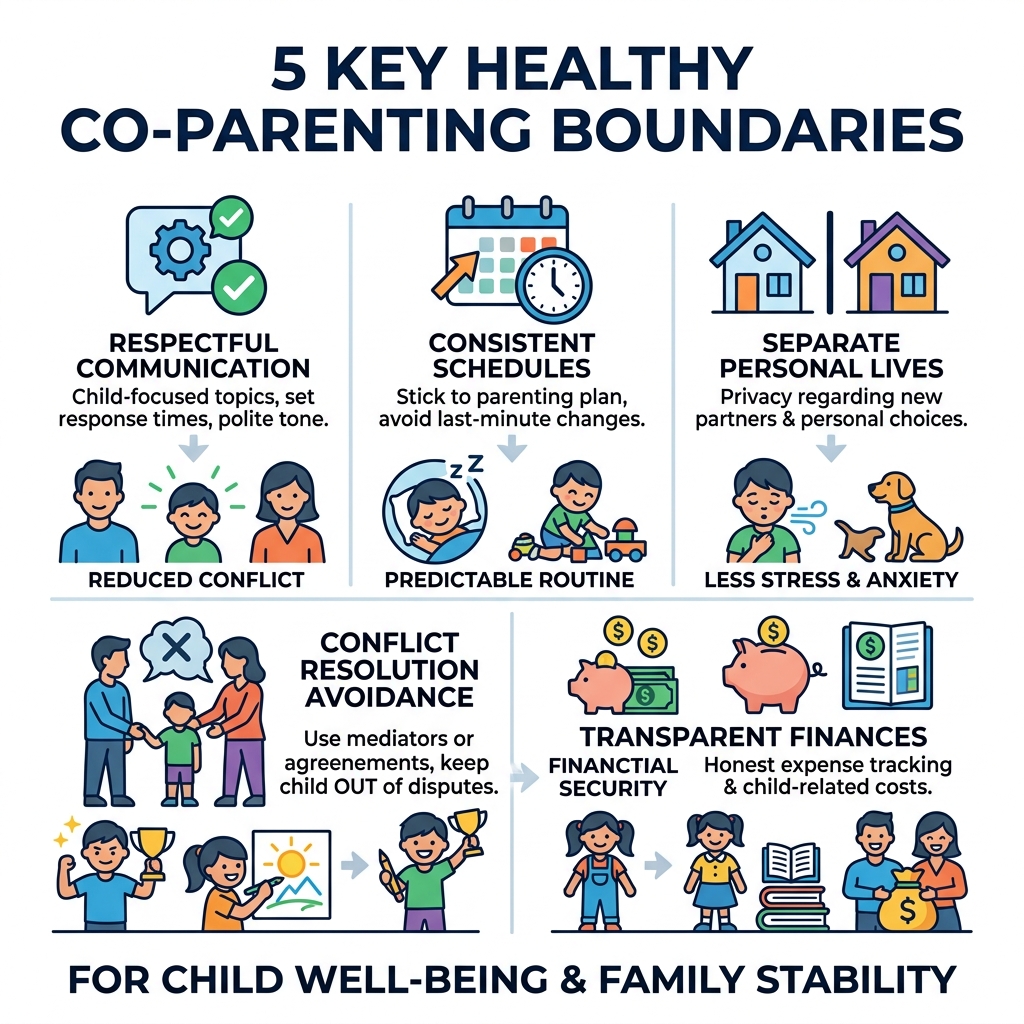
Here’s a quick summary of what healthy co-parenting boundaries look like in practice:
- Communication: Use text or email only, keep it child-focused, and agree on response times
- Schedules: Follow the parenting plan consistently; avoid last-minute changes
- Finances: Track child-related expenses honestly and transparently
- Personal life: Keep your private life separate from co-parenting conversations
- New relationships: Agree on when and how to introduce new partners to your children
- Conflict: Never involve your child as a messenger or put them in the middle
Co-parenting after a separation is hard. You’re expected to work closely with someone the relationship didn’t work with — often while still processing grief, stress, and exhaustion.
And if you’re a single parent already managing everything alone, the added friction of a difficult co-parenting dynamic can feel completely overwhelming.
But here’s what the research shows: it’s not whether parents are married or divorced that most affects children. It’s the level of conflict they’re exposed to. Parental conflict is linked to lower self-esteem, poor school performance, emotional instability, and damaged future relationships in children.
The good news? Setting clear, consistent boundaries is one of the most powerful things you can do — for your child and for your own peace of mind.
This guide walks you through exactly how to do that, even if your co-parent is difficult, resistant, or high-conflict.
Why Healthy Boundaries Co-Parenting is Essential for Your Child

When we talk about healthy boundaries co-parenting, we aren’t just talking about building walls to keep an ex away. We are talking about creating a structure where your child can thrive. Children are like little sponges; they soak up the atmosphere of their environment. If that environment is thick with tension, they feel it. If it is predictable and calm, they feel that too.
Research indicates that high levels of parental conflict can have a devastating ripple effect on a child’s life, impacting their mental health, success in school, and even their future ability to form healthy relationships. According to Scientific research on the impact of parental conflict on child mental health, children in high-conflict homes often struggle with identity and self-esteem issues that follow them into adulthood.
By contrast, when we establish clear boundaries, we provide our children with a sense of security. They know what to expect. They know that even though Mom and Dad live in different houses, the rules are consistent, and the “adult stuff” stays between the adults.
To manage the emotional rollercoaster that often comes with setting these limits, we recommend the 5 As system:
- Acknowledge: Recognize your feelings without judgment.
- Assess: Determine if the situation requires immediate action or a pause.
- Admit: Own your part in the dynamic.
- Accept: Understand that you cannot control your co-parent’s actions, only your response.
- Arise: Move forward with a plan that prioritizes the children.
The Benefits of Clear Limits
Setting limits isn’t about being “mean”—it’s about self-respect and clarity. When mutual expectations are set in stone, there is less room for misunderstandings. This creates emotional safety for everyone involved. Instead of wondering if an ex will show up three hours late or start an argument at the front door, boundaries ensure that everyone knows the “rules of engagement.” This predictability helps children develop better problem-solving skills because they aren’t constantly in “survival mode” trying to navigate parental moods.
Modeling Healthy Relationships
We are our children’s first teachers. By maintaining healthy boundaries co-parenting, we are showing them what a healthy adult relationship looks like, even when that relationship has changed form. We teach them that it is possible to be respectful and firm at the same time. This modeling is crucial for their future success and identity formation. They learn that their worth isn’t tied to their parents’ conflict and that they have the right to set their own boundaries as they grow.
| Feature | Cooperative Co-Parenting | Parallel Parenting |
|---|---|---|
| Communication | Frequent, flexible, and often verbal. | Minimal, strictly written, and child-focused. |
| Conflict Level | Low; parents can attend events together. | High; parents attend events separately. |
| Logistics | Flexible transitions and shared items. | Neutral exchange locations; duplicate items. |
| Decision Making | Collaborative discussion on most issues. | Independent decisions during parenting time. |
Communication and Financial Ground Rules
Communication is often where healthy boundaries co-parenting either succeeds or fails. When we communicate with an ex, we need to treat it like a business partnership. Think of it this way: your children are the “joint venture,” and you are the business partners. You don’t have to like your business partner, but you do have to be professional to ensure the company succeeds.
We suggest using the KFCs system for every interaction:
- Keep your emotions in check.
- Focus on your shared goal (the kids).
- Communicate professionally.
Another excellent tool is the BIFF method: keep your messages Brief, Informative, Friendly (but firm), and Firm. If your ex sends a three-paragraph rant about your personal life, a BIFF response would ignore the insults and simply say: “I received the update about the soccer schedule. I will pick up Sarah at 5:00 PM on Friday. Thanks.”
Establishing Healthy Boundaries Co-Parenting Communication
To keep the peace, we must define how and when we talk.
- Use Written Records: Email or dedicated parenting apps are best. They provide an unalterable record which encourages civility.
- Set Response Times: Unless it’s a medical emergency, agree that non-urgent messages will be answered within 24–48 hours. This stops the “instant gratification” cycle of high-conflict texting.
- Neutral Topics Only: If the conversation isn’t about the child’s health, education, or schedule, it’s off-limits.
- Holiday Planning: Use a structured calendar to avoid last-minute drama. For more tips on this, check out our guide on how-to-master-your-holiday-co-parenting-calendar.
Handling Child-Related Expenses and Belongings
Money is a major trigger for conflict. To maintain healthy boundaries co-parenting, transparency is key.
- Financial Transparency: Use a shared spreadsheet or app to track expenses like medical co-pays or extracurricular fees. Keep receipts for everything.
- Duplicate Items: If “forgetting the cleats” becomes a weekly battle, consider buying duplicates. Having a set of school supplies, basic clothing, and toiletries at both houses reduces the “messenger bag” stress for the child.
- Return Policies: If a special toy goes to the other house, agree on a “return by Sunday” rule. If that’s too difficult, keep special items at the primary residence to avoid loss and resentment.
Personal Lives and New Relationships
One of the hardest parts of healthy boundaries co-parenting is learning to “stay on your side of the street.” This means focusing on your own household and your own life, rather than policing what your ex is doing during their time or in their private life.
Privacy is a right, not a luxury. You are no longer entitled to know who your ex is dating, where they are going, or how they are spending their money—and they aren’t entitled to that info from you either.
Respecting Privacy and Healthy Boundaries Co-Parenting in New Relationships
Introducing a new partner is a major milestone that requires extra boundaries.
- Introduction Timelines: Many experts suggest waiting at least six months to a year into a committed relationship before introducing a new partner to the children.
- The “Heads Up” Rule: As a courtesy, give your co-parent a brief “heads up” before the kids meet a new partner. This isn’t asking for permission; it’s providing information so the co-parent isn’t blindsided when the child mentions “Mom’s new friend” at the dinner table.
- Household Rules: Accept that your ex’s house may have different rules. If they allow a later bedtime or more screen time, you can’t force them to change. Focus on maintaining your own standards in your home.
Avoiding Common Pitfalls and Behaviors
We’ve all seen it in movies, but in real life, these behaviors are damaging:
- The Messenger Role: Never ask your child to “Tell your Dad he owes me $50.” Communicate directly. Using children as messengers puts them in the middle of adult stress.
- Bad-mouthing: Even if your ex is acting poorly, don’t vent about it to your child. Children see themselves as half Mom and half Dad. When you insult the other parent, the child feels like you are insulting half of them.
- Disney Parenting: This happens when a parent feels guilty about the divorce and tries to “buy” the child’s love with constant gifts and no discipline. Healthy boundaries co-parenting requires both parents to actually parent, which includes chores and consequences.
- Loyalty Splits: Don’t make your child feel like they have to choose a “side.” They should love both of you without guilt.
High-Conflict Strategies and Parallel Parenting
Sometimes, despite our best efforts, we are dealing with a toxic or high-conflict co-parent. In these cases, the standard “let’s grab coffee and talk about it” approach won’t work. This is where parallel parenting becomes a lifesaver. Parallel parenting allows each parent to parent their own way during their own time, with almost zero direct contact.
Setting Boundaries with a Toxic Co-Parent
If you are dealing with a narcissist or a high-conflict personality, boundaries aren’t just suggestions—they are shields.
- Firm, Professional Tone: Never respond to insults in kind. It only fuels the fire.
- Silence as a Boundary: If a message is abusive or unrelated to the children, you don’t have to respond. Silence is a powerful tool.
- Court Strategies: If your ex refuses to follow any rules, you may need a very specific, court-ordered parenting plan that leaves no room for “interpretation.”
- Parenting Journals: Keep a detailed log of missed visits, late arrivals, or hostile interactions. This documentation is essential if you ever need to return to court.
What to Do When Boundaries Are Violated
Boundaries are only effective if there are consequences.
- Documentation: Keep a paper trail. If a pickup is missed, send a brief email: “I waited at the exchange point until 5:30 PM. Since you didn’t arrive, I am taking the children home.”
- Reaffirm the Consequence: “As we agreed, if you are more than 30 minutes late without calling, the visit is forfeited for today.”
- Professional Mediation: If you can’t agree on major issues like school or medical care, don’t keep arguing. Bring in a neutral third party, like a mediator or a parenting coordinator.
- Legal Recourse: If a court order is consistently ignored, consult your attorney. In extreme cases, you may need to file for contempt of court.
Frequently Asked Questions about Co-Parenting Boundaries
What are the most important boundaries to set first?
The “Big Three” are communication methods (sticking to apps/email), the custody schedule (no last-minute changes), and the “no bad-mouthing” rule. Once these are stable, you can layer in finer details like new partner introductions or specific financial protocols.
How do I handle a co-parent who refuses to follow the parenting plan?
Documentation is your best friend. Record every violation calmly. If the behavior persists, try mediation first. If that fails, a family law attorney can help you enforce the order through the court system. You can only control your adherence to the plan; don’t let their bad behavior trigger you into breaking the rules too.
Can co-parenting boundaries change as my child gets older?
Absolutely! Healthy boundaries co-parenting should be flexible as children grow. A toddler needs a very rigid, frequent schedule to feel safe. A teenager, however, may need more flexibility for their job, social life, and extracurriculars. It’s okay to revisit your parenting plan every few years to ensure it still serves your child’s best interests.
Conclusion
Navigating life as a single parent is a journey filled with ups and downs. Whether you are dealing with the aftermath of a divorce or are a choice-based solo parent, establishing healthy boundaries co-parenting is the key to finding your “new normal.”
At Curta Arte, we understand that this isn’t just about legal documents—it’s about your family’s peace. Our team, including writers like Aria James, is dedicated to providing the empathetic, targeted guidance you need to protect your children and your own mental health.
You don’t have to be best friends with your ex to be great parents. You just need to be clear, consistent, and child-focused. For more support on your journey, explore More parenting tips on our site. By setting these boundaries today, you are building a more stable and loving future for your children tomorrow.
