
Why Every Single Parent Deserves a Gratitude Practice
Single parent gratitude practices are simple, daily habits that help you shift your focus from what’s hard to what’s working — even on the most exhausting days.
Here are the most effective ones to start today:
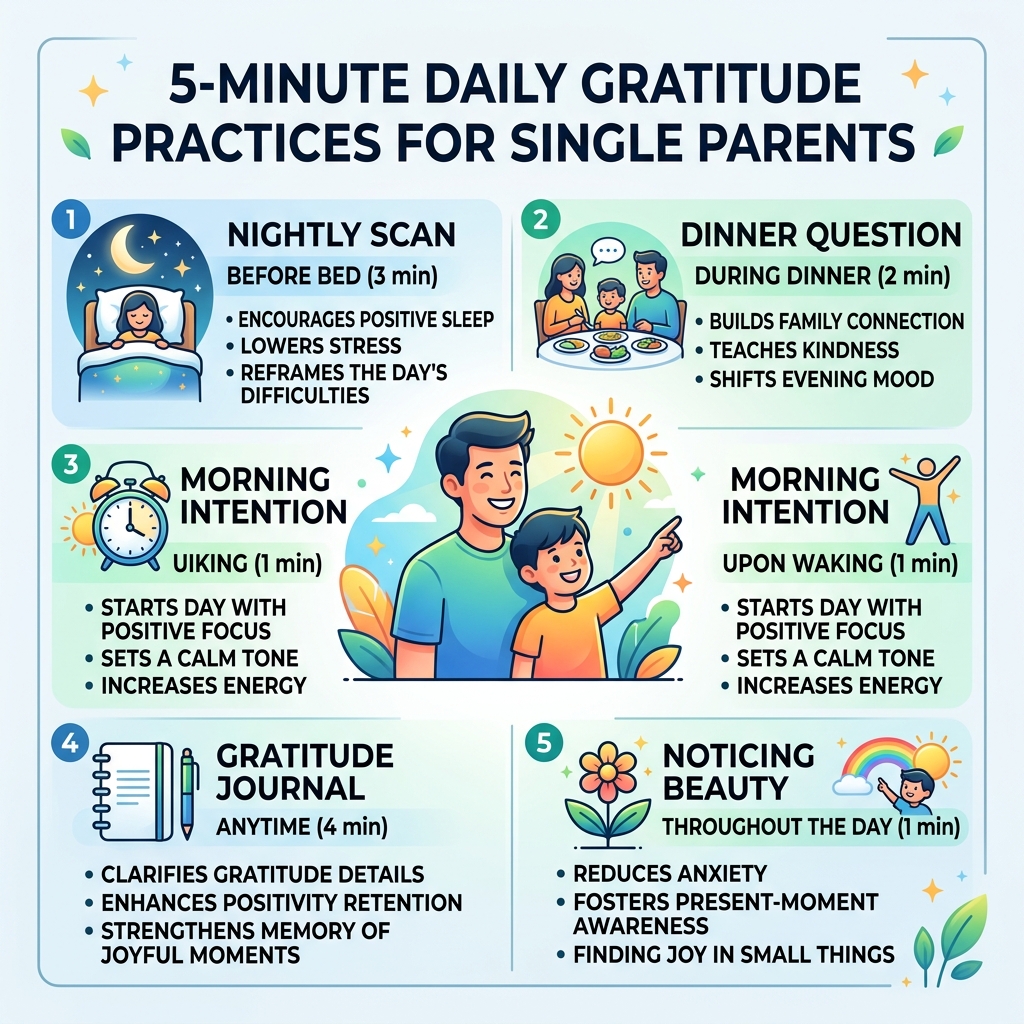
- Nightly scan — Before bed, name 3 moments from your day you’re grateful for
- Dinner question — Ask each family member one thing they’re grateful for
- Morning intention — Start your day by acknowledging one good thing in your life
- Gratitude journal — Write down 3 specific things daily (include why you’re grateful)
- “Aren’t we lucky?” game — During car rides, take turns listing things your family appreciates
- Gratitude storytime — Weave thankfulness into bedtime stories with your kids
- Reframe a complaint — When something frustrates you, find one silver lining in it
- Thank your kids — Specifically acknowledge positive things they do each day
- Notice beauty — Point out something lovely in your everyday surroundings
- Sticky note reminders — Place a gratitude prompt somewhere you’ll see it each morning
Being a single parent is genuinely hard. The mental load, the financial pressure, the late nights wondering if you’re doing enough — it adds up fast.
But here’s something worth knowing: gratitude is not just a feel-good idea. Research by psychologist Dr. Robert Emmons defines it as “a felt sense of wonder, thankfulness, and appreciation for life” — and his work shows it’s one of the most reliable ways to increase happiness and life satisfaction.
That doesn’t mean pretending everything is fine. It means training your brain to notice what’s good, even when a lot isn’t.
The good news? These practices take minutes. And many of them involve your kids, so you’re building something together.
Why Single Parent Gratitude Practices Matter
We often hear that gratitude is a “nice to have” habit, but for those of us navigating the solo parenting journey, it is actually a survival tool. Leading happiness researcher Sonja Lyubomirsky identifies gratitude as the number one tool for increasing human happiness. When we intentionally focus on single parent gratitude practices, we aren’t just being “positive”—we are physically changing our brain chemistry.
Scientific research on how gratitude rewires the brain shows that consistent practice releases dopamine and serotonin. These are the “feel-good” neurotransmitters that improve our mood and help us manage the chronic stress that often comes with managing a household alone.
One of the biggest enemies of happiness for single parents is “hedonic adaptation.” This is a fancy way of saying we get used to the good things in our lives until we stop noticing them. We might have worked incredibly hard to secure a new apartment or a promotion, but after a few months, that “win” becomes the new normal, and we go back to focusing on the mounting bills. Gratitude acts as an anchor, pulling us back to the present moment and forcing us to acknowledge that the life we have now contains many of the things we once prayed for.
By reducing anxiety and increasing life satisfaction, these practices build emotional resilience. When the car breaks down or the kids get sick, a parent with a gratitude habit has a “reserve” of optimism to draw from. We aren’t just being happy; we are being prepared.
Gratitude vs. Thankfulness: A Deep Mindset Shift
It is common to use the words “thankfulness” and “gratitude” interchangeably, but for a single parent, understanding the difference is life-changing. Thankfulness is often a reaction to an external event—someone holds the door for you, or you get a tax refund. It is wonderful, but it is temporary and dependent on outside circumstances.
Gratitude, however, is a state of being. It is an internal choice to appreciate life regardless of what is happening on the outside. For many of us, this ties into spiritual growth and embodying what some call the “fruit of the spirit”—qualities like patience, peace, and joy that remain steady even during a custody battle or a tight month financially.
| Feature | Thankfulness | Gratitude |
|---|---|---|
| Nature | Event-based and reactive | A consistent state of being |
| Duration | Short-term / Surface level | Long-term / Deep-rooted |
| Dependency | Depends on “good” things happening | Independent of external circumstances |
| Impact | Temporary mood boost | Permanent mindset shift |
| Focus | On the gift or the giver | On the abundance of life itself |
Moving from being “thankful” to “grateful” helps us overcome bitterness. It allows us to stop looking at what we lack and start seeing the “emotional wealth” we share with our children. It provides an internal peace that doesn’t disappear just because the “to-do” list is long.
10 Daily Practices to Transform Your Home

Establishing single parent gratitude practices doesn’t require hours of meditation. It requires consistency. Research suggests it takes about 21 days to form a new habit. Here are ten ways we can weave gratitude into our busy schedules:
1. The Nightly Scan
Before you close your eyes, scan your day for three specific, meaningful moments. It could be the way the light hit the trees during your commute or a funny thing your toddler said. This trains your brain to “hunt” for the good throughout the day so you have something to report at night.
2. The “Aren’t We Lucky?” Game
This is perfect for the school run or grocery trips. Take turns listing things your family is lucky to have. “Aren’t we lucky we have a car that gets us to school?” or “Aren’t we lucky we have the best dog in the world?” It turns a mundane chore into a bonding ritual.
3. Gratitude Dinner Questions
Instead of the standard “How was your day?” (which often gets a one-word answer), ask: “What is one thing you are grateful for today?” It encourages children to reflect on their own lives and see you modeling the same behavior.
4. Morning Prayer or Intention
Before the chaos of breakfast begins, take thirty seconds to thank a higher power or simply acknowledge the gift of a new day. Starting with a “thank you” sets a much different tone than starting with a “have to.”
5. Reframing Complaints
This is a tough one but incredibly effective. When you find yourself complaining—perhaps about the mountain of laundry—try adding the phrase, “and that’s the way I like it” or “and I’m grateful I have clothes to wash.” It sounds silly, but it shifts the focus from the labor to the blessing of having a family to care for.
6. Gratitude Storytime
When reading to your little ones, point out characters who show appreciation or make up stories where the “superpower” is noticing the good in the world. It builds a foundation for their own emotional health.
7. Noticing Beauty
Stop and point out a beautiful sunset or a flower blooming in a sidewalk crack. By narrating the beauty you see, you teach your children to be mindful of their environment.
8. Specifically Thanking Your Kids
Instead of a general “good job,” try: “I’m so grateful for how you helped your sister with her shoes today. It really helped us get out the door on time.” This makes them feel seen and appreciated.
9. Acknowledging Past Hurdles
Sometimes, looking back is the best way to feel grateful for the present. Remind yourself (and your kids) of how far you’ve come. “Remember when we lived in that tiny apartment? I’m so grateful we have this space now.”
10. Sticky Note Reminders
Write a simple prompt like “What made you smile today?” and stick it on the bathroom mirror. It’s a low-effort way to keep your mindset on track. More info about advice for single parents can help you find even more ways to simplify your daily routines.
Overcoming Obstacles to Consistency
We know that life as a single parent is rarely “Instagram-perfect.” There are real obstacles to maintaining a positive outlook, such as financial stress, the “single mom guilt,” and pure physical exhaustion.
The key is self-compassion. If you miss a day of journaling, don’t use it as an excuse to quit. Gratitude isn’t about perfection; it’s about direction. We can use “habit stacking” to make it easier—pair your gratitude practice with something you already do, like drinking your morning coffee or waiting at the red light on the way to daycare.
Reframing Co-Parenting with Single Parent Gratitude Practices
Co-parenting can be one of the greatest sources of bitterness. However, we can use gratitude to reframe this difficult area. Instead of focusing on the frustration of a difficult ex, try to find gratitude for the “lessons” the situation has taught you.
Perhaps the challenge has made you more independent, more resilient, or more financially savvy. You can be grateful for the time you have alone to recharge when the kids are with the other parent, or grateful for the stability you provide in your own home. Releasing resentment through gratitude doesn’t mean the other person was right; it means you are choosing your own peace over their drama.
Finding Time for Daily Single Parent Gratitude Practices
Time is our most precious resource. If a 10-minute journal session feels impossible, go digital. Use a gratitude app on your phone during your lunch break or while waiting in the school pickup line. Even a 30-second reflection during your commute counts. The goal is to make single parent gratitude practices fit your life, not the other way around.
Frequently Asked Questions about Single Parent Gratitude
How can I practice gratitude when I’m struggling financially?
It feels counterintuitive to be grateful when you’re worried about rent. However, this is when gratitude is most needed. Focus on “emotional wealth”—the hugs, the laughs, and the safety of your bond with your children. Identify non-material blessings like a supportive friend, a free local park, or your own health. This doesn’t pay the bills, but it prevents the stress from consuming your identity.
What is the best way to involve my children in these practices?
The best way is through modeling. When they hear you say, “I’m so grateful for this cool breeze,” they start to look for things to be grateful for, too. Games like the “Aren’t we lucky?” game or dinner rituals make it feel like fun rather than a chore.
How long does it take to see results from a gratitude habit?
While you might feel a small mood shift immediately, the real “brain rewiring” happens over about 21 to 30 days of consistent practice. After 100 days, many parents report that they start noticing positives automatically without even trying.
Conclusion
At Curta Arte, we believe that while single parenting is a journey of high responsibility, it can also be a journey of immense joy. Writers like Aria James emphasize that we don’t have to wait for our circumstances to be perfect to start living a happy life.
By implementing these single parent gratitude practices, you are building a legacy of resilience for your children. You are showing them that happiness isn’t something that happens to you—it’s something you create, one “thank you” at a time. More info about advice for single parents is always available to help you navigate the ups and downs of solo parenting with grace and confidence.
