
What Every Student Needs to Know Before Starting a Science Fair Project
Science fair project step by step instructions can feel overwhelming at first — but the process is simpler than it looks.
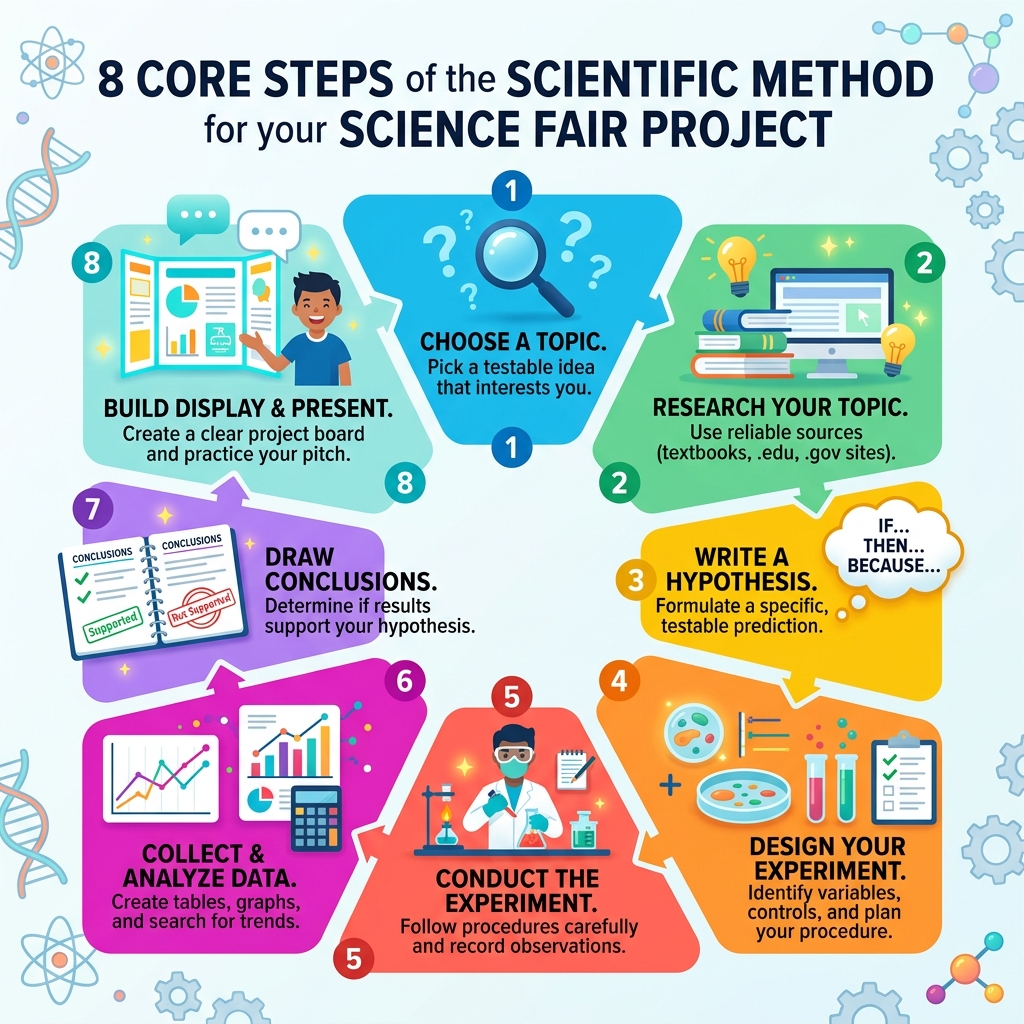
Here are the core steps to complete a science fair project:
- Choose a topic – Pick something that genuinely interests you and can be tested
- Research your topic – Use reliable sources like .edu and .gov sites, textbooks, and journals
- Write a hypothesis – Use the format: “If… then… because…”
- Design your experiment – Identify your variables, controls, and how many trials you’ll run
- Conduct the experiment – Follow your procedure carefully and record everything
- Collect and analyze data – Create tables, graphs, and look for trends
- Draw conclusions – Did your results support your hypothesis? Why or why not?
- Build your display and present – Create a clear tri-fold board and practice your verbal pitch
That’s the big picture. Each step has important details that can make or break your project — and that’s exactly what this guide covers.
Science fairs are one of the best learning experiences a student can have. They build real skills: critical thinking, data analysis, public speaking, and problem solving. These are skills that matter far beyond the classroom.
But here’s the truth: most students don’t know how to approach a science fair project strategically. They pick a random topic, rush the experiment, and throw together a poster the night before.
You don’t have to do it that way.
Whether your child is competing at the school level or aiming for a regional fair, following a clear, proven process makes all the difference. And as a parent juggling everything on your own, having a reliable roadmap means you can guide your kid confidently — without needing a science degree yourself.
Phase 1: Finding Your Winning Idea and Researching the Topic
The secret to a project that wows judges isn’t just about being “smart” — it’s about picking the right starting point. We often see students rush into an experiment because they saw a cool video online, but a winning project starts with a testable question.
To find your spark, we recommend using a “Topic Selection Wizard” or simply observing the world around you. Ask your child, “What have you noticed lately that makes you curious?” Maybe it’s how fast the bread molds in different parts of the kitchen or why certain plants in your garden grow faster than others.

When narrowing down an idea, feasibility is key. You need to consider:
- Time: Do you have enough weeks to see results (especially for biological projects)?
- Resources: Can you afford the materials or access the necessary equipment?
- Safety: Is the experiment safe to perform at home or in a school lab?
A great way to frame your idea is by using the format: “How does [input] affect [output]?” For example, “How does the type of soil affect the height of a bean plant?” This makes it clear what you are changing and what you are measuring.
Once you have a question, it’s time for a literature review. This sounds fancy, but it just means reading what other scientists have already discovered. We suggest looking at 20-50 papers or articles for advanced projects, though 3-5 reliable sources are usually plenty for elementary and middle school. This helps you avoid “reinventing the wheel” and ensures your project has novelty.
One big tip: Avoid simple product comparisons. Judges often find “Which paper towel is strongest?” or “Which battery lasts longest?” unoriginal because they lack a deep scientific question. Instead, try sparking curiosity with at-home science experiments that explore natural phenomena or solve real-world problems, like local water quality or heat retention in urban spaces.
Developing a Testable Hypothesis Using Science Fair Project Step by Step Instructions
Once you’ve done your research, you’re ready to make an “educated guess.” This is your hypothesis. A strong hypothesis isn’t just a random stab in the dark; it’s a prediction based on the facts you gathered during your research phase.
The gold standard for writing a hypothesis is the “If… then… because…” format.
- If [I change this specific thing],
- then [this specific result will happen],
- because [based on my research, this is the scientific reason why].
For example: “If I increase the amount of humus in the soil, then the plants will grow taller because smaller spaces between soil particles hold water longer for the roots to absorb.”
This structure forces the student to identify the gap in existing knowledge they are trying to fill. Even for our youngest scientists, keeping it simple is best. You can find inspiration for these early stages in our guide on no lab coat required: simple science for 5-year-olds.
Phase 2: Mastering the Science Fair Project Step by Step Instructions for Experimentation
Now we get to the “doing” part! To make your experiment rigorous, you need to understand your variables. Think of these as the moving parts of your project:
- Independent Variable: The one thing you change on purpose (e.g., the type of liquid given to a plant).
- Dependent Variable: The thing you measure to see if your change had an effect (e.g., the height of the plant).
- Control Group: The group that stays under “normal” conditions so you have something to compare your results against.
- Constants: Everything else that must stay exactly the same (e.g., the amount of light, the temperature, the size of the pot).
Before you start, create a detailed materials list and a step-by-step procedure. This procedure should be so clear that another person could read it and do the exact same experiment. We always emphasize safety precautions here. If your project involves chemicals, heat, or electricity, ensure there is constant adult supervision. You can find more detailed templates in this Comprehensive Science Fair Project Guide.
Designing Your Experiment with Science Fair Project Step by Step Instructions
One of the biggest mistakes students make is only doing the experiment once. In science, one time is an “anecdote,” but multiple times is “data.” This is called replication.
To have statistical validity, you need a large enough sample size.
- For plant projects, research suggests using at least 24 plants in your experimental group and 24 in your control group.
- For most other student work, aim for a sample size of n>30 to allow for proper statistical analysis later.
Managing your timeline is also crucial. High-quality research often takes 6 to 12 months from start to finish. If you’re working on a shorter deadline, ensure your project doesn’t require long growth cycles. Following scientific research on steps in a science fair project will help you stay on track and ensure your work is reproducible — a hallmark of great science.
Phase 3: Data Collection and Rigorous Analysis
As you conduct your experiment, you must record every single detail. We recommend using a bound scientific notebook (not a loose-leaf binder). A bound book with numbered pages is considered “tamper-proof” because you can’t easily remove or replace pages. This adds a layer of professional integrity to your work.
In your logbook, record:
- Quantitative Data: Numbers, measurements, and temperatures. Use the metric system!
- Qualitative Observations: Descriptions of what you see, smell, or hear (e.g., “The leaves turned a pale yellow on day five”).
- Unexpected Results: Did the power go out? Did you spill a little water? Write it down! Sometimes the most interesting discoveries come from things going “wrong.”
It’s also important to understand the difference between accuracy (how close your measurement is to the true value) and precision (how consistent your measurements are with each other). For those just starting out, we have a great resource on first steps in science: simple experiments for kids that explains these concepts in kid-friendly language.
Analyzing Results with Science Fair Project Step by Step Instructions
Once the experiment is over, you’ll likely have a pile of numbers. Now, you need to make sense of them. Start by organizing your raw data into clean data tables. From there, create graphs and charts.
- Bar Graphs: Best for comparing different groups.
- Line Graphs: Best for showing change over time.
- Scatter Plots: Best for seeing if two variables are related.
To really impress the judges, move beyond basic averages. Use measures of central tendency like the mean (average), median, and mode. For advanced middle and high school projects, calculating the standard deviation shows how “spread out” your data is. If your sample size is small, you might use a T-distribution analysis to see if your results are actually significant or just happened by chance.
Don’t forget to look for trends and correlation coefficients. If your hypothesis wasn’t supported, don’t panic! In science, “disproving” a hypothesis is just as valuable as “proving” one. It just means you’ve narrowed down the truth.
Phase 4: Creating a Professional Display and Nailing the Presentation
Your display board is your “silent partner” during the fair. It needs to tell your story even when you aren’t standing there. Most fairs have strict size limits — usually no more than 15” deep, 48” wide, and 60” high.
Follow the 40/40/20 rule for a balanced look:
- 40% Visuals: Graphs, photos, and diagrams.
- 40% Text: Your hypothesis, procedure, results, and conclusion.
- 20% White Space: Empty space so the board doesn’t look cluttered.
Make sure your headings are large and easy to read from four feet away. If you used photos, be sure to give photo credit (e.g., “Photo taken by student”). You’ll also need to write a concise abstract — a one-paragraph summary of your whole project — and a full research paper to keep on the table. For more tips on making science fun and visual, check out sparking curiosity with at-home science experiments part 2.
Preparing for Judging and Oral Presentations
The final hurdle is the interview. Judges aren’t there to grill you; they want to see how much you’ve learned. Prepare a 2-3 minute verbal pitch that covers:
- Why you chose the topic.
- What you did (briefly).
- What you found.
- Why it matters in the real world.
Practice this pitch at least 20 times! Anticipate questions like, “What would you do differently next time?” or “What was the most surprising thing you learned?” Maintain eye contact, stand tall, and be honest about your project’s limitations. Confidence comes from knowing your data inside and out. For more presentation confidence-building, see our guide on first steps in science: simple experiments for kids part 2.
Frequently Asked Questions about Science Fair Project Step by Step Instructions
How far in advance should I start my science fair project?
We recommend starting 6-12 months before the competition. This sounds like a long time, but high-quality research requires time for background reading, multiple trials, and potentially even publishing your results in a student journal. Starting early helps you avoid common mistakes like rushing the data collection or having a messy display board.
Do I need a PhD mentor to win top awards like ISEF?
While it isn’t a strict requirement, the data shows that almost every winner at the International Science and Engineering Fair (ISEF) has had some form of PhD-level mentorship. A mentor can provide expert guidance on methodology and help you network with other professionals. However, for school and regional fairs, a dedicated teacher or a supportive parent can provide all the guidance a student needs to succeed.
What is the difference between the scientific method and the engineering design process?
The scientific method is used when you have a testable question about how the world works (e.g., “How does temperature affect magnetism?”). The engineering design process is used when you want to solve a specific problem or build something (e.g., “How can I design a more efficient water filter?”). Instead of a hypothesis, engineering projects have a design goal, and instead of an experiment, they involve building and testing a prototype.
Conclusion
Completing a science fair project is a journey of discovery. It’s about more than just a ribbon; it’s about fostering a lifelong love of learning and the confidence to ask “Why?” and find the answer yourself.
At Curta Arte, we know that navigating these school requirements can be a challenge, especially for solo parents managing a busy household. Our goal is to provide targeted, empathetic guidance to help you and your child thrive. By following these science fair project step by step instructions, you aren’t just helping your child finish an assignment — you’re helping them become a scientist.
For more advice on navigating school challenges and more resources for family science success, stay tuned to our latest guides!
