
The Quickest Way to Beat Boredom: A Scavenger Hunt Around the House
A scavenger hunt around the house is one of the easiest, low-prep activities you can pull off solo — no special supplies, no budget, and no co-parent required.
Here’s how to run one in minutes:
- Pick a type — a simple item checklist, or a chain of riddle clues leading room to room
- Choose your hiding spots — common areas like the kitchen, bathroom, bedroom, and living room work perfectly
- Write or print your clues — rhyming riddles, photo lists for little ones, or a written checklist for older kids
- Set the rules — no running, agree on boundaries, set a time limit (20–45 minutes works well)
- Place a prize at the end — a snack, sticker sheet, or screen-time coupon is all you need
That’s it. Kids are busy, you get a breather, and everyone wins.
Whether it’s a rainy afternoon, the dreaded witching hour before dinner, or a week when the walls are closing in, a house scavenger hunt is the kind of activity that saves the day without requiring much from you. Kids as young as two and as old as twelve can join in — you just adjust the clues to match their age.
And here’s the thing most parents discover once they try it: set it up once, and you’ll want to do it every week.
Why a Scavenger Hunt Around the House is the Ultimate Boredom Buster
As parents, we have all experienced that moment—usually around 5:00 PM—when the energy in the house shifts. The kids are restless, dinner isn’t ready, and the temptation to hand over a tablet is overwhelming. This is where a scavenger hunt around the house becomes your ultimate “sanity saver.”
Research and experience tell us that these hunts are more than just a way to kill time. They provide essential mental stimulation and physical movement when you are stuck indoors. According to Wikipedia, scavenger hunts are excellent for encouraging problem-solving and teamwork. If you’ve been looking for easy indoor scavenger hunts for kids, you already know that the best activities are the ones that require zero trips to the store.
For those of us navigating solo parenting, these hunts are particularly effective because they can be adapted for any space, from a small apartment to a multi-story home. They are the perfect fun indoor activities for kids on a rainy day, turning familiar surroundings into a landscape of discovery. Beyond just “finding things,” children practice problem-solving, literacy (when reading clues), and cognitive development as they decode riddles or categorize items by color and shape.
Different Types of Indoor Quests
Not every hunt has to be a complex web of rhyming riddles. Depending on how much time you have (and how much coffee you’ve had), you can choose a format that fits your current energy level.
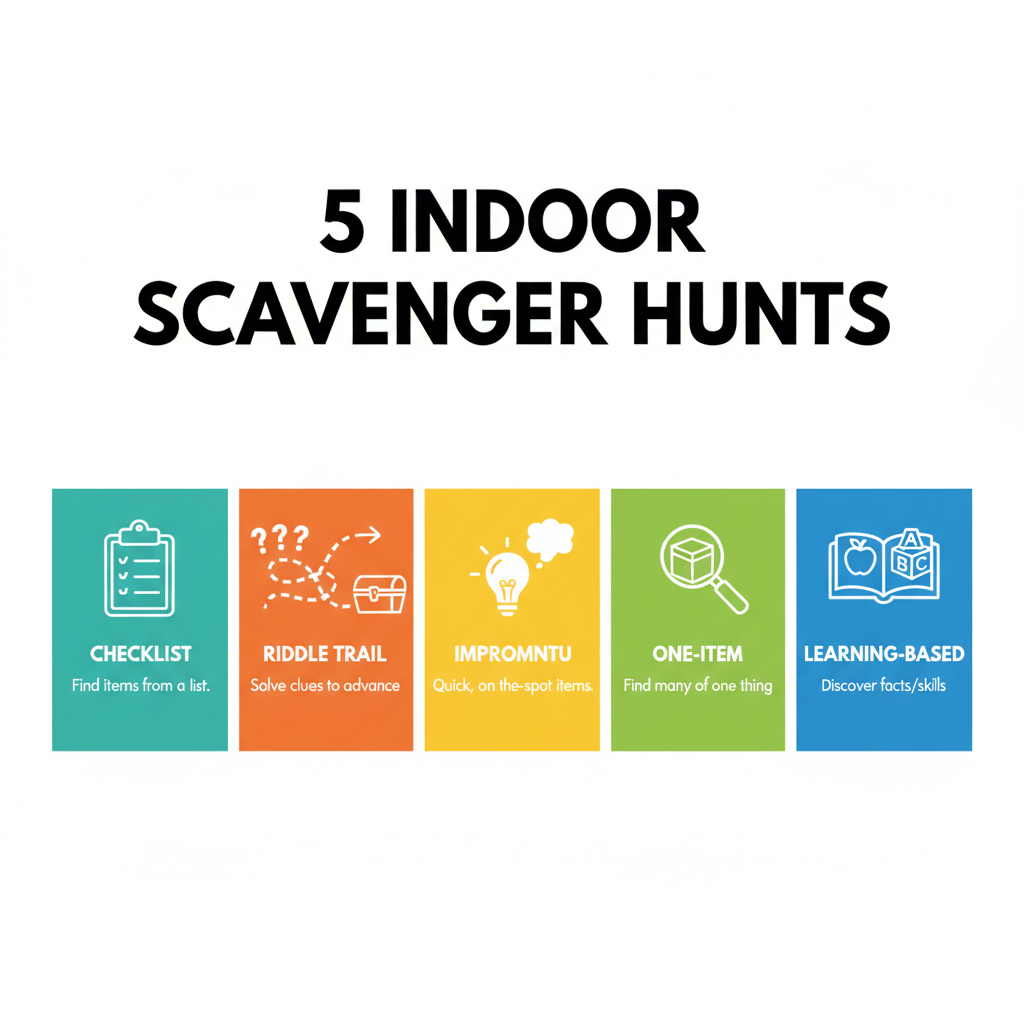
| Hunt Type | Best For | Preparation Level |
|---|---|---|
| List-Based Checklist | Toddlers & Young Kids | Low: Just a list of items to find. |
| Riddle-Based Treasure Hunt | Elementary Ages | Medium: Clues lead from one spot to the next. |
| Impromptu Hunt | The “Witching Hour” | Zero: You shout out items for them to find. |
| Traditional One-Item Search | High Energy | Low: Hide 10 of the same item (like socks or toys). |
| Learning-Based Variation | Homeschool/Education | Medium: Finding shapes, colors, or letters. |
The Impromptu Hunt
This is the “emergency” version. Hand your child a paper bag and shout, “Find me something fuzzy, something blue, and something that makes a clicking sound!” It’s immediate, engaging, and requires no printing or planning.
Sensory Exploration
Instead of looking for specific objects, ask the kids to find items based on how they feel, smell, or sound. Find “something cold,” “something that smells like lavender,” or “something that crinkles.” This is a fantastic way to ground children who might be feeling overstimulated or anxious.
How to Set Up Your Scavenger Hunt Around the House
Setting up a successful hunt is all about the “flow.” You want the kids to be challenged but not frustrated. If you are looking for stay-at-home fun exciting activities for kids, a little preparation goes a long way.

Preparation Tips
- Use Cardstock or Post-its: If you are doing a clue-based hunt, print or write your clues on sturdy cardstock. This prevents them from getting crumpled or lost. Alternatively, use Post-it notes to stick clues directly onto surfaces like the fridge or a mirror.
- Safety First: Before starting, establish clear boundaries. Remind them: “No running,” “No climbing on counters,” and “Stay out of the medicine cabinet.” For more advice on keeping the environment secure, check out our tips for keeping kids safe at home.
- The “Night Before” Strategy: If your kids are “early birds” and tend to find things before you’ve even had breakfast, set up the hunt the night before while they are sleeping. This ensures the surprise remains intact.
- Time Limits: For older kids, adding a timer (20–30 minutes) adds a layer of excitement and competition. For younger children, keep it open-ended to avoid unnecessary stress.
Creating a Clue-Based Scavenger Hunt Around the House with Riddles
A clue-based hunt (or treasure hunt) is a sequence where one clue leads to the next. You hand them the first clue, which leads to the toaster; inside the toaster is the next clue, which leads to the bathtub, and so on.
When writing your own riddles, use personification to make it fun. Instead of saying “Go to the fridge,” try: “I stay cold all day long so your milk doesn’t go bad; if you leave my door open, I’ll get really sad!” These are excellent fun indoor activities for energetic kids because they keep the brain moving as fast as the feet.
Adapting the Scavenger Hunt Around the House for Different Ages
One of the beauties of a scavenger hunt around the house is its scalability.
- Toddlers (Ages 2-3): Use a photo-based list. Instead of writing the word “Apple,” show a picture of an apple. They can check it off or bring the item to you.
- Preschoolers (Ages 4-5): Focus on attributes. “Find something red,” “Find something shaped like a circle,” or “Find something that starts with the letter B.”
- Elementary (Ages 6-10): This is the prime age for rhyming riddles and logic puzzles. You can even incorporate simple math (e.g., “The next clue is hidden under the chair that has 2+2 legs”).
- Teens (Ages 13+): Turn it into a Photo Scavenger Hunt. They don’t collect items; they take a “selfie” with them. “Take a photo of something that shouldn’t be in the kitchen,” or “Take a photo of a book with a blue spine.”
25 Creative Riddles and Clues for Common Household Items
If you’re feeling a bit of writer’s block, don’t worry. We’ve compiled a list of ready-to-use riddles for common spots around the home.
Kitchen Clues
- Toaster: I’m small and silver, and I like to eat bread; I’ll pop it back up when it’s toasted instead!
- Refrigerator: I have a cold heart but I’m filled with treats; I’m the best place in the house for keeping your meats.
- Microwave: Give me a minute and I’ll give you a “zap”; I’m great for heating up your leftover wrap.
- Dishwasher: I’m full of bubbles and I love to scrub; I’m like a kitchen version of a bathtub.
- Oven: I get very hot to bake your cake; please be careful for goodness sake!
Bathroom Riddles
- Bathtub: I’m big and white and I hold a lot of water; I’m where we scrub every son and daughter.
- Toothbrush: I have many bristles and I love to fight decay; use me every morning to start your day.
- Toilet Paper: I’m round and white and I sit on a roll; I’m the most important thing in the “loo” bowl!
- Mirror: When you look at me, what do you see? A face looking back that looks just like me!
- Towel: I’m soft and fluffy and I help you get dry; hang me back up so I can reach for the sky.
Bedroom Spots
- Pillow: I’m soft and squishy and I hold your head; you’ll find me every night waiting in your bed.
- Closet: I’m a dark little room where your clothes like to hang; I’m where you keep the shoes that you out-sang.
- Teddy Bear: I’m furry and cuddly and I have button eyes; I’m the best friend for a bedtime surprise.
- Bookshelf: I don’t have a voice but I tell many stories; I’m filled with adventures and hero glories.
- Alarm Clock: I have hands but no arms, and a face but no eyes; I’m the one who tells you it’s time to rise.
Laundry & Living Room
- Washing Machine: I go round and round and I make a loud hum; I’m where your dirty clothes always come.
- Television: I have a big screen and I show many shows; I’m where the family goes when the wind blows.
- Sofa/Couch: I have cushions and pillows and I’m great for a nap; come sit on me with a book in your lap.
- Doormat: I sit by the entrance and I’m here for your feet; wipe off the mud so the house stays neat.
- Coffee Table: I sit in the middle and I hold your drinks; I’m shorter than a desk, or so everyone thinks.
Bonus “Tricky” Clues
- Window: I’m made of glass and I let in the light; I’m where you look out to see the stars at night.
- Keys: I’m small and metal and I jingle in a pocket; I’m the only thing that can open a lock-et.
- Trash Can: I’m not very pretty and I smell kind of bad; but if you didn’t have me, you’d be quite sad.
- Umbrella: I’m useless when it’s sunny, but great in the rain; open me up to keep dry is my main gain.
- Laundry Basket: I’m usually full of things that need a wash; if you jump inside me, you’ll hear a “squash!”
Frequently Asked Questions about Indoor Scavenger Hunts
What are the best prizes for a home scavenger hunt?
The prize doesn’t have to be expensive. In fact, some of the best rewards are “experience-based.”
- Screen-Time Coupons: A voucher for an extra 30 minutes of gaming or a favorite show.
- Family Night Choice: The winner gets to pick the movie or the board game for the evening.
- Special Snacks: A treat they don’t usually get, like a specific type of fruit or a small chocolate.
- New Book or Stickers: Small, tactile items that encourage quiet time after the hunt is over.
- The “Golden Trophy”: A spray-painted rock or an old trophy that the winner gets to keep on their nightstand until the next hunt.
How do I make a scavenger hunt competitive for multiple kids?
If you have kids of different ages, you want to level the playing field so the older ones don’t just “steamroll” the little ones.
- Point Values: Assign points to items based on difficulty. Finding a “blue sock” might be 5 points, while finding “a coin from the year 2015” might be 20 points.
- Different Colored Clues: Give each child their own set of clues on a specific color of paper. They can only pick up their color.
- Team-Based Problem Solving: Pair an older child with a younger one. They have to work together to solve the riddle before they can move to the next spot.
- Staggered Starts: If they are racing for a single prize, let the younger child start two minutes earlier.
What are common mistakes to avoid when planning a hunt?
- Clues That Are Too Hard: If kids get stuck for more than five minutes, they lose interest. Be ready to give “hot or cold” hints.
- Unsafe Hiding Spots: Never hide clues inside appliances that are turned on, near cleaning chemicals, or in high places that require a ladder.
- Making It Too Long: For kids under five, 5–8 clues are plenty. For older kids, you can go up to 15–20. If it drags on too long, it stops being fun and starts being a chore.
- Lack of Boundaries: If you don’t want them in your home office or the master bedroom, state that clearly before the timer starts!
Conclusion
At Curta Arte, we understand that solo parenting means you are the Chief Entertainment Officer, the Head Chef, and the Safety Inspector all at once. Our mission, led by writers like Aria James, is to provide you with empathetic, practical guidance that makes your daily life just a little bit easier.
A scavenger hunt around the house is more than just a game; it’s a way to create lasting memories without the stress of a big outing. It turns an ordinary Tuesday into an adventure. Once the kids have found their final “treasure,” you might find that the house is a little quieter, their energy is spent, and you’ve successfully navigated another afternoon with a smile.
For more inspiration on keeping your little ones engaged, explore our library of Fun Activities for Kids. Whether you’re dealing with a rainy day or just need a twenty-minute break, we’re here to help you build a home filled with joy and discovery. Happy hunting!
