
Why Divorce Recovery for Mothers Is One of the Hardest Journeys You’ll Face
Divorce recovery for mothers is a process that touches every part of your life — your emotions, your finances, your identity, and your children’s well-being.
If you’re looking for a quick starting point, here are the core areas to focus on:
- Emotional healing – Talk therapy, support groups, and self-compassion practices
- Financial stability – Budgeting, asset protection, and understanding your legal rights
- Co-parenting – Clear communication strategies and consistent routines for your kids
- Identity rebuilding – Reconnecting with your values, strengths, and personal goals
- Practical support – Community networks, childcare help, and trusted friends
Divorce doesn’t just end a marriage. It reshapes your whole sense of self.
You’re managing schedules, emotions, finances, and parenting — often all at once, often alone. The person you were before all of this can feel very far away.
And the numbers back this up. A survey of single mothers in Utah found that nearly half were between 30 and 40 years old when they went through divorce, with 45% being 40 or older. These are women navigating major life transitions at a stage when the stakes — retirement, career, children’s futures — are especially high.
The good news? Healing is absolutely possible. And you don’t have to figure it out alone.
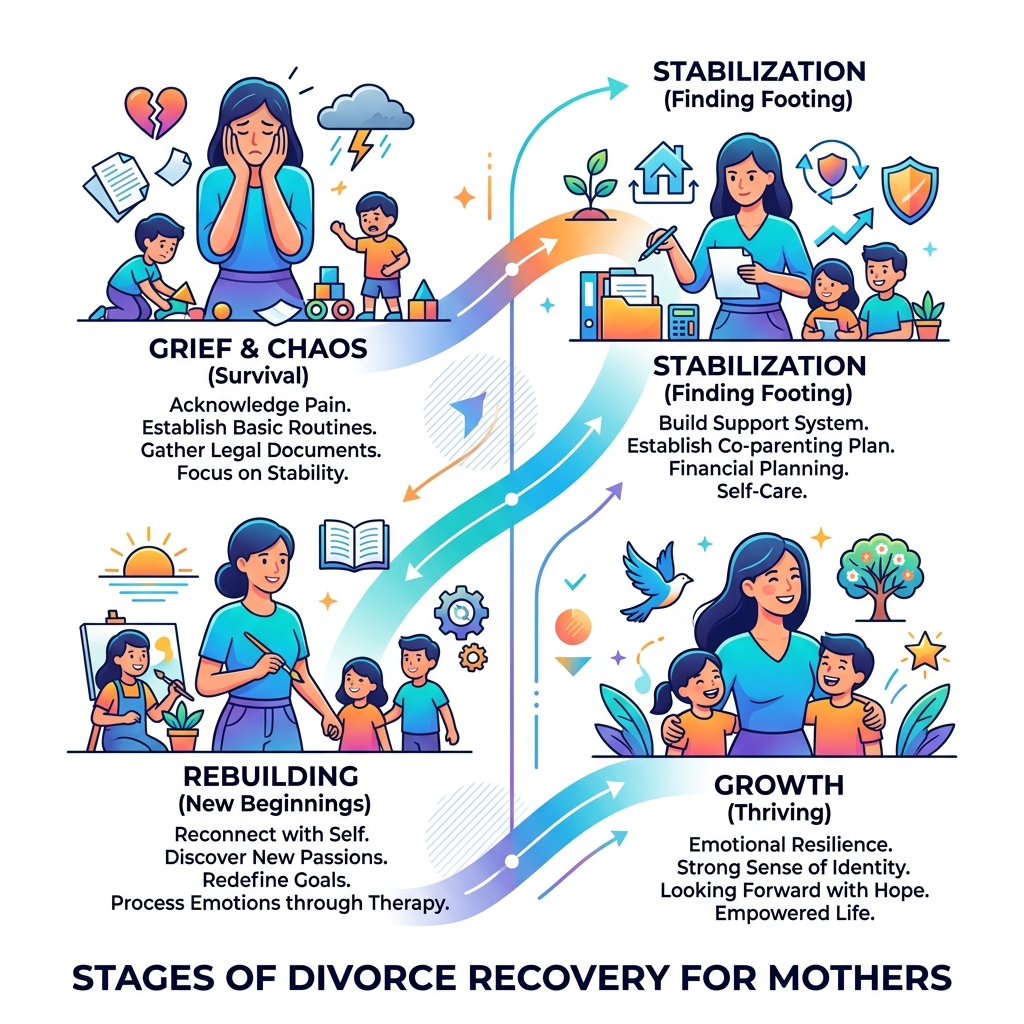
This guide walks you through the most important steps — from surviving the early days to rebuilding a life that genuinely feels like yours again.
Immediate Survival Strategies and Avoiding Common Mistakes
When the papers are served or the decision is finally made, your brain likely enters a state of high-alert survival. This is not the time for making massive, impulsive life changes; it is the time for stabilization. One of the most common mistakes we see is mothers trying to “power through” without a plan, which often leads to burnout and legal oversights.
First, we recommend conducting a thorough financial and practical inventory. This means gathering all essential documents: tax records, bank statements, titles, and insurance policies. If you have been a stay-at-home mother, you might feel disadvantaged, but you have rights. In many jurisdictions, you can request spouse-funded litigation to ensure you have the same quality of legal representation as your ex-partner.
Another critical survival strategy is avoiding the “victimhood” trap. While it is true that you may have been deeply wronged—especially in cases involving infidelity or abuse—staying stuck in a victim mindset can actually hinder your ability to parent effectively. Research suggests that when a parent remains stuck in rage or self-pity, it places an emotional burden on the children. We want to acknowledge the pain, cry when we need to, but keep our eyes focused on the future tasks of rebuilding.
To navigate these early days, check out our advice-for-single-parents for more foundational tips on managing the transition.
Protecting Your Peace Early On
Protecting your peace is a strategic move, not just a lifestyle choice. During the early stages of divorce recovery for mothers, high stress can cloud your judgment. To counteract this, we suggest establishing clear boundaries immediately.
- Financial Protection: Open your own bank account and start building individual credit. If you don’t have an emergency fund, making that a priority can alleviate significant anxiety.
- Digital Boundaries: Change passwords on all personal accounts and social media.
- Communication Buffers: If interactions with your ex are high-conflict, move all communication to writing or a dedicated co-parenting app. This creates a “paper trail” and gives you time to respond calmly rather than reacting emotionally.
Managing your time is also essential for peace. Balancing the sudden increase in household responsibilities while grieving is a monumental task. You can find strategies for this in our guide on how-to-balance-work-and-parenting-2.

Prioritizing Mental Health and Divorce Recovery for Mothers
The neurobiology of divorce is fascinating and explains why you might feel like you’re “losing your mind.” Stress triggers a massive release of catecholamines—chemicals that activate your amygdala (the fear center) and impair your prefrontal cortex (the logic center). This is why making a simple grocery list can feel as difficult as solving a complex equation.
Acknowledging that your brain is physically under stress allows you to be more compassionate with yourself. Professional support is often the most effective way to “reset” this system. Statistics show that talk therapy has an 85% effectiveness rate for single mothers and their children. It provides a safe space to process the trauma of the split and develop coping mechanisms for the road ahead.
If you notice your children are also struggling with the transition, it is helpful to look into mental-health-tips-for-children to ensure the whole family is healing together.
Support Groups and Divorce Recovery for Mothers
Isolation is the enemy of recovery. We often feel like we are the only ones failing, but the reality is that millions of women are on this same path. Over 1 million people have found hope through programs like DivorceCare, which offers a structured 13-week recovery timeline.
Finding an “anchor person”—a trusted friend, a mentor, or a family member—can make a world of difference. This is the person you call when the car breaks down or when you receive a frustrating legal email. Beyond personal anchors, community kindness plays a huge role. In a survey of mothers in Utah, many noted that small acts of kindness from neighbors, like bringing over a meal or offering a few hours of childcare, were what kept them going during their darkest weeks.
For more on supporting your family’s emotional health, see mental-health-tips-for-children-2.
Holistic Therapies for Stress Management
While talk therapy is excellent for the mind, divorce lives in the body too. Many mothers report physical symptoms like insomnia, digestive issues, and chronic tension. This is where holistic therapies come in.
According to research, 76% of single mothers found massage therapy and talk therapy to be the most beneficial combination for stress relief. Other highly recommended options include:
- Yoga and Meditation: To help regulate the nervous system.
- EMDR or Trauma Retreats: Specifically for those recovering from high-conflict or abusive relationships.
- Personal Training: Reclaiming physical strength can often lead to reclaiming emotional strength.
- Utah-Specific Resources: Many local centers offer sliding-scale counseling or specialized groups for single moms.
Practical Steps for Financial Stability and Career Growth
Rebuilding your financial life is one of the most empowering parts of divorce recovery for mothers. It’s not just about paying bills; it’s about creating a foundation of security for yourself and your children.
The costs of divorce can be staggering, with private mediation often ranging between $3,000 and $8,000. To manage these costs, we recommend being as organized as possible before meeting with professionals. Create a detailed asset inventory and a post-divorce budget.
Aim to build an emergency fund that covers 3 to 6 months of living expenses. If you are receiving alimony or child support, treat these as tools for stability, but also look toward your own earning potential. We provide extensive resources on how-to-balance-work-and-parenting to help you navigate these dual roles.
Re-entering the Workforce and Managing Income
For many mothers, divorce necessitates a return to the workforce or a push for career advancement. Since 48% of single moms in recent surveys are between 30 and 40, this transition often happens at a pivotal career stage.
If you’ve been out of the workforce for a while, start by:
- Updating your skills: Take online courses or certifications.
- Networking: Reach out to former colleagues or professional groups.
- Financial Advising: Consult a professional to discuss retirement planning, as divorce often splits retirement assets, requiring a new strategy for your later years.
Effective Co-Parenting and Protecting Your Children’s Well-being
Co-parenting is often the most challenging aspect of divorce recovery for mothers, especially if the split was high-conflict. The goal is to move from a “failed romantic partnership” to a “successful business partnership.”
Keep your communication business-like: brief, informative, and focused solely on the children. Avoid discussing personal grievances or the past. Neutral pickup locations—like a school, a park, or a library—can also reduce tension during transitions. For more specific communication strategies, visit tips-for-effective-communication-with-kids.
Creating Stability through Divorce Recovery for Mothers
Children thrive on predictability. During a divorce, their world feels like it’s shifting beneath their feet. You can provide the “ground” by maintaining consistent routines. This means similar bedtimes, mealtime rituals, and rules in your home, regardless of what happens at the other parent’s house.
Be honest with your children, but keep it age-appropriate. They don’t need to know the legal details or the “why” behind the divorce if it involves adult complexities. They just need to know they are safe and loved. For more on this, read our tips for tips-for-raising-confident-children.
Building New Traditions and Long-term Goals
One of the most beautiful parts of recovery is the chance to create your own family culture. You are no longer compromising on how to spend holidays or weekends.
- Family Meetings: Hold weekly check-ins where kids can share their feelings and help plan the week’s meals or activities.
- Bedtime Gratitude: Start a ritual of sharing three good things that happened each day.
- New Seasonal Traditions: Maybe you always go for a hike on the first day of spring or have “breakfast for dinner” every Friday night.
These small acts build a sense of belonging and “newness” that helps children see that life after divorce can be joyful. Check out tips-for-raising-confident-children-2 for more inspiration.
Rediscovering Your Identity and Rebuilding a Fulfilling Life
After years of being a “wife” and a “mother,” you might find an “identity gap” where the old version of you is gone, but the new one hasn’t quite arrived. This is a normal and even necessary stage of divorce recovery for mothers.
We encourage you to look back at your “pre-marriage self.” What did you love to do before you were part of a couple? Did you paint? Did you hike? Did you love loud music or quiet mornings? Reclaiming these small pieces of yourself is the first step toward a new identity.
For busy moms trying to find this time, our parenting-hacks-for-busy-moms can help you carve out those much-needed minutes for self-discovery.
Redefining Your Future After Heartbreak
Heartbreak is a powerful catalyst for change. It strips away the distractions and forces you to ask: Who am I now, and what do I want?
- Core Values: Write down your top five values (e.g., freedom, security, adventure, kindness). Use these as a compass for every decision you make.
- Intentional Decisions: Stop doing things out of habit or obligation. If a social circle no longer serves you, it’s okay to step away.
- Curiosity: Approach your new life with curiosity rather than fear. Try one new thing every month—a pottery class, a new hiking trail, or even just a new genre of books.
Frequently Asked Questions about Divorce Recovery
What are the most common emotional challenges single mothers face?
The most common challenges include intense grief, “mom guilt” regarding the impact on children, anxiety about financial security, and a sense of loneliness. Many mothers also struggle with a loss of identity, feeling as though they have disappeared into their roles as caregivers and legal litigants.
How long does it typically take to rebuild a life after divorce?
There is no “magic number,” but many experts and support programs, like DivorceCare, suggest that the first 13 weeks are the most acute phase of recovery. However, a full psychological transformation—where you truly feel like a “new person” and the internal voice of your ex-partner has faded—often takes one to two years.
What therapies are most beneficial for single moms and their children?
Talk therapy is the gold standard, with an 85% effectiveness rate. For stress management, massage therapy is highly rated (76%). For children, play therapy or family counseling can help them process the transition in a safe, age-appropriate environment.
Conclusion
At Curta Arte, we know that the path of divorce recovery for mothers is not a straight line. There will be days of incredible breakthrough and days where you feel like you’ve taken ten steps back. Both are part of the healing process.
By prioritizing your mental health, securing your finances, and intentionally rebuilding your identity, you aren’t just surviving—you are showing your children what resilience looks like in action. You are creating a home filled with peace, authenticity, and hope.
For more support on your journey, explore our More parenting tips and resources. You’ve got this, and we are here to help you every step of the way.
